WHY Arkreen Network?-The Reason and Purpose of its Development

In this blog, we want to discuss the WHY of the Arkreen Network by arguing the reason and purpose of its development. arkreen is an infrastructure-level project destined to be completed over a long-term journey of discovery and enrichment for the network. Let’s focus on the mission and vision of arkreen to highlight its original goal. To create real innovation, indeed inspiring products must travel through the trough of disillusionment before reaching the path of geniuses!
Arkreen Network is an infrastructure powered by the evolution of Web3; it provides a platform to interconnect and monetize globally distributed clean and renewable energy equipment, intending to help reduce carbon emissions. The “WHAT” of the arkreen network can be explained in a straightforward sentence as Arkreen Network is an Web3-powered infrastructure for globally-distributed renewable energy resources connection and monetization to enable carbon-reduction applications. however, the logics behind the motivational path to “WHY” is split into three different answers.
To answer the questions posed for the three WHYs, we first ask why we use Web3 methodology, why we wish to connect distributed renewable energy equipment resources, and finally, why we need to reduce carbon emissions. By answering these questions, we will unravel the mission and vision for the arkreen network’s existence.
Question 1: Why Web3?
arkreen is not a typical Web3-native or crypto-native application. arkreen is Web3-driven yet integrated with Web1 & Web2. We chose to adopt Web3 as arkreen’s key pillar because we saw a new trend emerging for the construction of global infrastructure powered by the Web3 method! We paid particular attention to the rise of Helium, a textbook of Web3-enabled global infrastructure construction.
Helium was very disruptive by adopting Web3 economics to construct its global IoT network in 2017. They abandoned the traditional startup mentality and employed a token incentive mechanism to motivate ordinary people worldwide to participate in network construction by transforming themselves into network builders and stakeholders. This business model offers a benchmark and footprint for the operation of Proof of Physical Work.
Over the past three years, Helium Foundation deployed nearly one million IoT hotspot miners worldwide, which is the most extensive IoT network to date. This achievement was accomplished at almost zero investment cost with only around 30 employees, while the network covers more than 7,300 cities in 180 countries. Web1 & Web2 companies like Sigfox, Ericsson, and Alibaba planned to build such a global IoT network, but they all failed by the tremendous cost and the long-term payoff time range. Web3 showcases a solid solution for infrastructure construction, especially for the global physical infrastructure, because everyone can join the network construction in a decentralized manner. This eliminates the obstacle effect of government regulation and huge sunk costs so that global individuals can coordinate together on a massive scale. Helium deployed its 5G network in the U.S. in just half a year, and the Web3 rapid pace of deployment prompted T-Mobile (Bellevue, WA) to negotiate with Helium to establish 5G coverage jointly.
Inspired by Helium, we believe the Web3-enabled global infrastructure is expected to be the most extensive narrative of the next bull market. In 2022, a few trailblazers are exploring the PoPW (Proof of Physical Work) continent. Hivemapper is building a global dashcam mapping system for every car on the road. DIMO is building the global vehicle data monetization system by deploying data connector devices to each vehicle owner. Planetwatch is building a global air quality monitoring system by deploying air quality sensors to individuals. This trend is gathering more and more momentum with PoPW league building infrastructures in different industries. Web3-enabled infra is a paradigm shift for building crypto-incentive physical infra.
In theory, compared with Web1, Web3 offers a disruptive solution for network bootstrapping in order of magnitude of lower cost, lower complexity, and higher speed. Compared with Web2, Web3 world provides more excellent economic value because Web3 builds new economies, while Web2 only makes traditional companies.
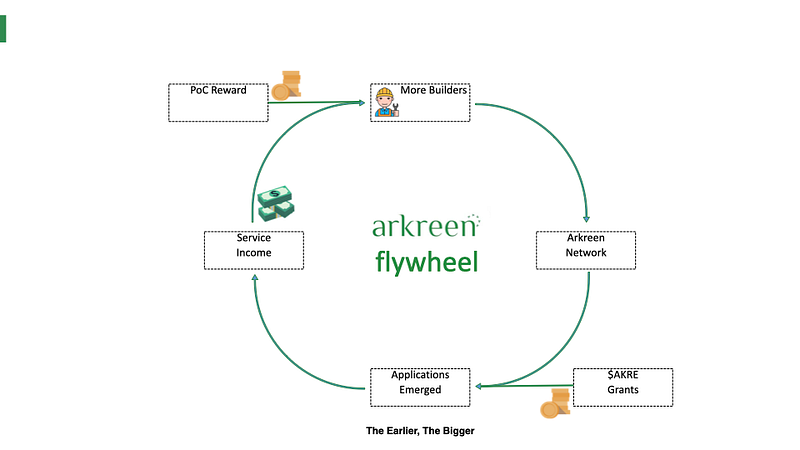
arkreen Flywheel Flow Chart
The flywheel flow chart above is an analytical model typically used by analysts such as Mr. Chris Dixon of a16z and Mr. Jasse of Variant Capital. This diagram represents the economic flywheel model of the arkreen network. In the upper left, you will note that we have designed a PoC (Proof of Capacity) model to motivate miners to join the network. As more and more miners join the network, arkreen gradually experiences a scaling effect and increases economic value. To incentivize the growth of our model, the arkreen network will provide grants to encourage entrepreneurial teams to build applications on the arkreen network. Based on the application’s service fee, a new external income will be provided to network builders, further encouraging more builders to participate in the network. The ultimate goal is to offer a monetization platform globally for owners of distributed clean and renewable energy equipment who are not currently enjoying these added-value services. We genuinely wish to enlighten them so they will want to jump on board!
The first example I want to mention is AT&T as a Web1 era behemoth with a top-down model, where the benefits of ownership are only rewarded to a network of shareholders. Airbnb, in the second example, shows a typical Web2 company. Its network construction model is bottom-up, but the benefit-seekers of the network are still its shareholders.
Incubated directly from a Web3 world, the third example, the Arkreen Network, is building its network from a bottom-up process. At the same time, the network’s value holders are the network’s builders and users. Infrastructure built from the Web1 requires enormous investment and will create monopolistic characteristics for that company culture. The Web2 does build a global infrastructure and reduce construction investment, but it will also bring about the problem of monopolistic behavior in its corporate culture.
A global infrastructure enabled by a Web3 avoids the problems of enormous investment and monopolistic tendencies internally.
Question 2: Why Distributed Energy?
Why does arkreen pursue the energy field as its go-to-market strategy? On the one hand, the energy sector brings about 75% of the global greenhouse gas emissions with urgency to promote carbon neutrality in this sector. Now, opening up the other hand reveals that the worldwide energy field is facing a new round of fundamental structural changes. Concerning several disruptive energy changes in the past few hundred years, it is conceivable that the energy industry will bring substantial investment opportunities worth trillions of dollars.
Renewable energy resources are believed to be the path to the pot of gold to achieve energy carbon neutrality. However, most of these projects focus on constructing centralized wind power and photovoltaic power plants. If we want more centralized clean and renewable power to be connected to the grid, we need to have more distributed clean and renewable energy equipment connected to the grid. These two segments for renewable energy resources are interdependent. Therefore, it is necessary to encourage and connect more distributed clean and renewable energy equipment, but this is a very fragmented and long-tailed market to expect things to evolve naturally. It’s also impossible to just rely on centralized entities for change, given that connecting these types of equipment globally would be non-economically efficient.
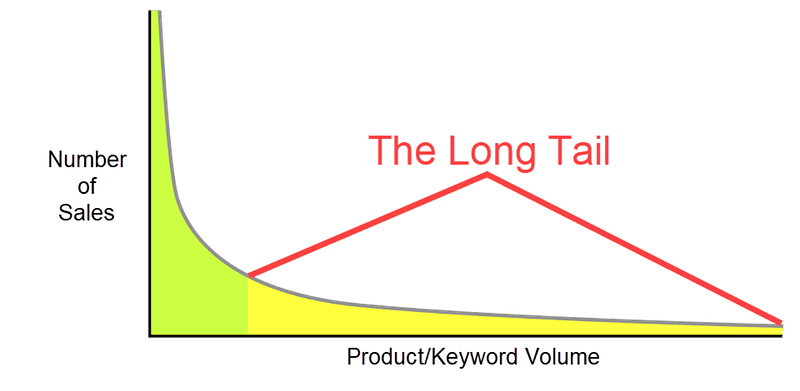
The Long Tail Model
Suppose we review this Long Tail model in the diagram above. In that case, the connection is the core catalyst driving the distributed renewable energy market, and arkreen can provide universally adaptable hardware to economically connect these pieces of renewable energy equipment to the network. With Web3 methodology and IoT connectivity, the arkreen network can enable this long but fat-tail market to kick off brilliantly.
Question 3: Why Carbon Reduction?
Why should we be paying any attention to carbon neutrality? Climate change and carbon neutrality are a global consensus, and these are the few common sense currently existing. Hence, arkreen will be widely welcomed by the majority of the world.
Carbon reduction is a very mature market, with plenty of research and science education. Still, it currently needs more viable solutions due to the inefficiency of governing public goods in a traditional manner. As the world is transitioning into the Metaverse, more devices are digitized, which means resources can be managed with digital tools. Previously public goods like climate benefits could be managed with digital tools. arkreen offers a universal, inclusive, and renewable solution for carbon reduction in the energy sector, powered by Web3 theory and meant to include the entire planet.
By Arkreen on October 27, 2022.