What’s Arkreen Network?-The Products, Mining Rewards, and Release Plan

In this blog, we want to discuss further the ecosystem, roadmap Releases, products, and rewards of Arkreen Network. Associates familiar…
What’s Arkreen Network?-The Products, Mining Rewards, and Release Plan
In this blog, we want to discuss further the ecosystem, roadmap Releases, products, and rewards of Arkreen Network. Associates familiar with our journey will recognize that we’ve been focusing on the integration and innovation of IoT and blockchain for a while. During the second half of 2021, many exchanges were had between ourselves and enterprises to discuss business opportunities and future use cases for integrating IoT and blockchain. The conclusions of our analysis led to a clear and green direction of decarbonization and sustainability. Our objective is to utilize transformative digital technologies such as the Internet of Things to collect real-time green data related to carbon emissions from renewable energy resources. The green data collected from solar PV panels, EV charging columns, renewable energy storage batteries, Smart air conditioners, and other use cases are all verifiable and immutable throughout their life cycle. A vital driving force behind the project of green data is its equitability factor because it needs to be used by 3rd parties, such as government regulators, financial institutions, upstream and downstream enterprises, and carbon exchanges.
Another significant driving force for green data is its solid financial attraction. When we reduce carbon emissions, carbon credits can be generated to form additional value, where accurate carbon emissions data helps to reduce carbon taxes effectively.
As we welcomed the year 2022, we began to plan a direction for green carbon data on-chain. Many types of green carbon data already exist; We focused on renewable energy equipment like solar (PV) photovoltaic panels, energy storage (batteries), EV charging station columns, etc.……as that is easier to retrofit digitally. As we began to focus on renewable energy equipment, we first concentrated on solar photovoltaic panels. Since the sun shines on the earth universally, it will not only shine in one place and matches the distributed nature of a Web3 world. Highly digitalized, Large-capacity, centralized solar photovoltaic panel power stations (farms) already exist globally. Still, many long-tail household, small-capacity distributed solar PV panel deployments exist where the green data hasn’t been fully developed. The green data value from one single distributed household solar photovoltaic panel is not high, and the ROI of digital transformation cannot be calculated. If, however, Web3 methodology is used to connect disassociated long-tail distributed solar photovoltaic panels globally by aggregating the green data generated by these 10,000, 100,000, or even 1 million distributed rooftop solar photovoltaics panel users, a relatively large & powerful data asset can be crystalized! Considerable green data assets can be formed and sold as a green certificates. This green data can also be provided to energy service providers such as VPP virtual power plants for power generation and power consumption forecasting and scheduling, thereby fully tapping the value of green data assets in this long-tail marketplace.
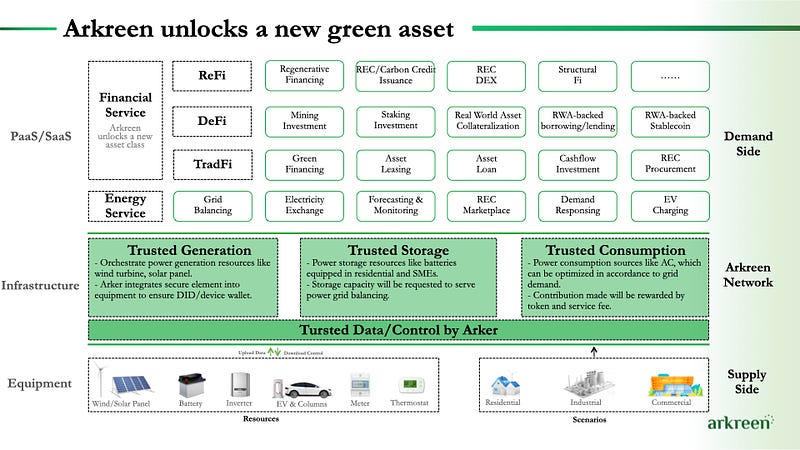
Arkreen Network: A Digital Infrastructure Network for Distributed Renewable Energy Resources
Arkreen is a digital infrastructure network for globally-distributed renewable energy equipment and devices. The goal is to onboard global long-tail fragmented renewable energy equipment to generate data value by aggregating their community resources. We can promote deploying more distributed renewable energy equipment by combining digital transformation with a decentralized Web3 approach. This will maximize the utilization of resources to achieve a global zero-carbon goal. Arkreen is a combination of the two words Ark+Green. This Green Ark helps humanity build and leapfrog to create sustainable development.
Arkreen Network implements IoT oracles through IoT + blockchain technology integration to connect various types of distributed renewable energy equipment and then allows green energy generation, electricity consumption, and energy storage data on-chain. The trustworthiness and verifiability of this data can be recognized throughout its life cycle. At the same time, future on-chain contracts can also trigger control instructions for these devices and equipment, such as notifying solar photovoltaics to feed into the grid, notifying batteries to store energy, and notifying air conditioners to increase the temperature by one degree.
Let’s expand the introduction of the arkreen network and which practical applications can be deployed. Let’s explore the use case for RECs (Renewable Energy Certificates) and explain a little more about how these RECs are used. A REC is a global standard product for any business to offset its carbon emissions caused by energy consumption. One REC equates to one megawatt-hour (MWh) of electricity generated from renewable energy resources such as solar panels or wind turbines. Ecological-friendly entities can voluntarily offset their unavoidable energy consumption carbon emissions by purchasing RECs to incentivize more renewable energy resources to be deployed. ESG giants like Google, Apple, and Microsoft have been purchasing RECs or renewable power stations to offset their carbon footprint for years. When the arkreen network reaches a particular scale, practical applications will emerge. In the short term, verifiable green power generated data from distributed solar photovoltaic panels in a long-tail market can be certified and converted into green renewable energy certificates (RECs), which can be provided to enterprises for carbon neutrality. This illustrates the first application and service for the Arkreen network that we will explore further.
Glimpsing into a mid to long-term time frame, there is an opportunity to slowly observe a decentralized network emerging that links hundreds of thousands or millions of various types of renewable energy equipment. Applications like VPPs (Virtual Power Plants) offer the ability to achieve a flexible response to energy supply & demand while allowing these on-grid renewable energy assets to be monetized more efficiently, further enhancing the deployment of renewable energy.
The Arkreen Network will implement these potential digital applications in an external business closed-loop manner to obtain green data value. It will also be promoted to more community miners to join and connect their distributed solar photovoltaic panel assets to the Arkreen Network. We are building a decentralized data infrastructure that provides verifiable and trusted uplink data and precise downlink control. It will unlock a new type of green data asset from the physical world for traditional finance and crypto communities; this will incubate many innovative applications that combine verifiable data of renewable energy scenarios with conventional finance and decentralized finance.
For traditional finance: Trusted on-chain data is provided as a risk assessment service to conventional financial institutions for pre-investment risk control and post-investment asset management of renewable energy assets. The innovative green bond project initiated by BIS last year is also based on green data on-chain.
For Decentralized Finance DeFi: can the digital assets formed by renewable energy in the physical world be connected to DeFi protocol and applications? It has been a hot topic recently around Real-World Assets (RWAs).
For Regenerative Finance ReFi: The community has recently initiated an aggressive direction for ReFi or renewable finance, combining carbon assets and DeFi.
How do we converge the supply side of long-tail green data assets faster for more efficiency on the Arkreen Network and deliver it to the demand side for green data usage? This is a challenging but also auspicious direction.
It’s no different when establishing similar digital infrastructure; tremendous fundamental value is derived from building it out. Still, if done in a traditional top-down manner, like other infrastructure construction, it will lead to a weighty and drawn-out process. Helium has created a perfect Web3 methodology with its bottom-up refactoring process of digital infrastructure based on Proof of Physical Work (PoPW) defined by Helium’s investor Multicoin. Helium has deployed about one million Lora gateways worldwide in approximately two years through the community’s miners. If this same project had to rely on traditional corporate organizations for investor growth, we would for sure be calculating this build-out in a matter of decades. For Arkreen Network, we’ve analyzed this successful model and incorporated best practices with the community to construct Arkreen Network.
A PoPW incentive mechanism is optimal to mobilize community builders to invest in arker mining machines. Our strategy incorporates a kind of Do-It-Yourself smartness to transform distributed household solar photovoltaic equipment on residential roofs to implement this digitalization process. This is a build from the bottom-up digital infrastructure plan for distributed renewable energy resources. The objective of employing a PoPW incentive mechanism is to encourage more builders to digitize their household solar photovoltaic panels by purchasing and installing Arker mining devices. By employing a Do-It-Yourself procedure to digitalize their solar PV system, the builder will register trustworthy green-energy generation data on the Arkreen Network to acquire incentive rewards. This bottom-up incentive method allows long-tail distributed solar photovoltaic panels to be constructed quickly and at a low cost for the digital infrastructure. At the same time, the community provides grants to encourage the development of more innovative applications. When more applications emerge from the trusted green data of the Arkreen Network, they will generate more benefits from external data services and feed them back to community builders to form a flywheel effect. This helps build a digital infrastructure for distributed renewable energy resources from the bottom up.
We kicked off our strategy with distributed solar photovoltaic panels and offered plug-and-play gateways corresponding to existing household solar photovoltaic panel usage. We encourage those builders to “Build-it-yourself” to accomplish digital transformation. In the future, we plan to pre-integrate arkreen network access with mainstream solar photovoltaic inverter manufacturers to achieve economies of scale and increase household solar photovoltaic panel adoption.
Down the road, we will expand beyond distributed household solar photovoltaic panels to include household energy storage batteries and various controllable energy equipment. This will help us achieve the goal of interfacing with more types of renewable energy resources for the Arkreen Network.
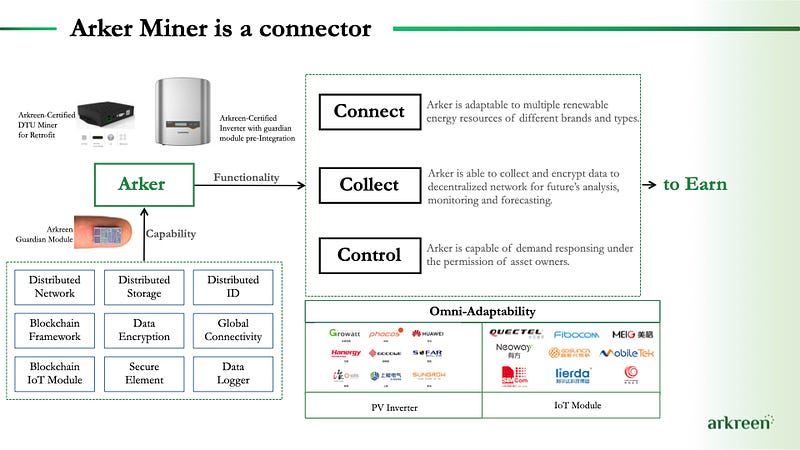
Arker: Omni-adaptable mining device
Let’s look at our mining device product called Arker, a stand-alone, mountable device gateway used to digitize solar photovoltaic panels. The current prototype version of the first-generation Arker model is centered around Microsoft Azure Sphere’s chip-security solid capabilities. Strong technical collaboration allows us to substantiate the proof of physical work (PoPW) protocol through an IoT oracle while ongoing testing on the credibility of the registration process on the chain is happening in small-scale internal tests.
Arker has a guardian module composed of three core components: an IoT wireless module, a secure element, and a data acquisition, resulting in the following three capabilities: global cellular connectivity, IoT data security, and trusted data on-chain functionality. This will help solar photovoltaic panels achieve access to web3 services through rapid digital transformation, including distributed network services, storage services, and DID services. These features allow the Arker device to accurately and digitally measure the physical workload of the solar photovoltaic panel for its internal power generation while signing those workload data with its unique digital ID. Thus, Arker can register the proof of green-energy age in an on-chain distributed ledger for fair and transparent distribution of subsequent rewards and benefits.
Arker already can adapt to the world’s mainstream solar photovoltaic inverters and mainstream cellular IoT modules. arkreeen network benefits from this compatibility to acquire all kinds of distributed solar photovoltaic equipment at the fastest speeds and gather green data generated by solar photovoltaic panels at minimal costs.
Employing our resourceful Arker device, Arkreen Network can connect to many distributed solar photovoltaic devices worldwide and register the solar photovoltaic power generated data onto the network. It is also possible to initiate verifiable commands to solar photovoltaic devices in reverse based on demand requirements. Arker is implemented as a closed-loop device with its PoPW-based incentive model that collects green data for distributed renewable energy equipment and offers a unique earnings model.
The plan for the year 2023 is to open source the specifications of the arkreen mining device and invite more OEM equipment manufacturers to develop mining devices together with arkreen joint participation.
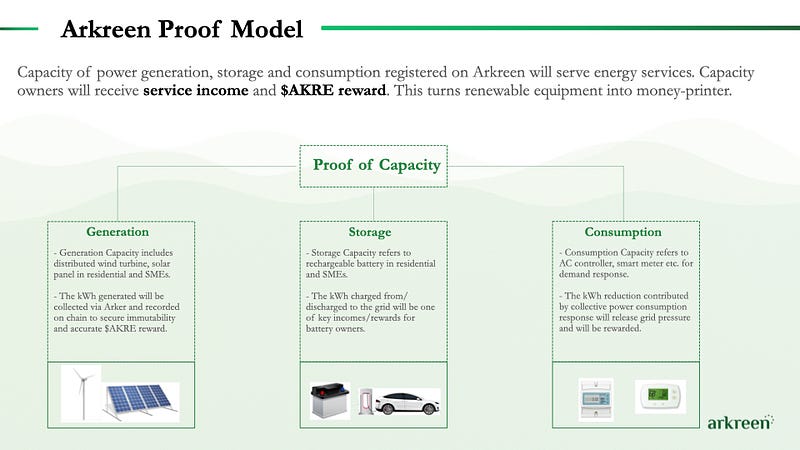
Arkreen Proof Model: Proof of Capacity(PoC)
Now that we’ve introduced our mining device, the next step is to explain our proof model. We mentioned earlier that we had already adopted a similar PoPW model implemented by Multicoin to define our PoC model, which we refer to as Proof of Capacity. The “capacity” mentioned here refers to the energy capacity of distributed renewable energy equipment, including energy generation, energy consumption, and energy storage capacities.
Based on the three types of assets that the arkreen network will access in the future, there are three use cases:
The first use case we plan to explore soon is oriented to the proof of green-energy generation adoption, such as distributed solar photovoltaic panels. By reporting the green-energy generation data, combined with the device’s ID, address & time information, and other related data, it will authenticate the total amount of green electricity generation by the solar photovoltaic panel. Later, we will give you a detailed introduction to this proof algorithm.
Down the road, we plan to extend to proof of energy storage, mainly for an energy storage battery, to measure the credible evidence of how much electricity can be physically stored. The proof of energy consumption is primarily for a controllable load, credible evidence of how much electricity can be consumed.
We use the proof of green-energy generation for distributed solar photovoltaic panels to explain the mining process specifically:
- Miners purchase an Arker mining device plugged into a solar photovoltaic panel on their residence rooftops, allowing connection to the Arkreen Network.
- Each miner device must mint a corresponding Arker NFT to register on the Arkreen Network.
- Each miner owner also needs to mint a Builder NFT by staking $AKRE and bind his Builder NFT with the miner’s Arker NFT to activate the miner and start mining.
- Miners will report energy generation data to the oracle according to the requirements of the Arkreen Network.
- After the oracle verification process is successful, the miner’s wallet can obtain relevant rewards.
Arkreen Network rewards miners for reporting high-quality energy generation data to the network. The authenticity of energy generation data reported by miners is crucial to the vitality of the Arkreen Network. The mechanism to verify the authenticity of energy generation has been aptly titled Proof of Green-Energy Generation (PoGG). The specific algorithmic details are:
- Select target areas with similar lighting and weather conditions and filter for miners or solar panels in them
- Count the real-time power curve of the mining device in a specific period; real-time power will reflect the sunlight situation.
- Calculate the similarity of real-time power curves of all miners in the exact area
- You are judging the data authenticity score of the miner based on the similarity calculation result and the preset threshold.
- The higher the data authenticity score, the higher the reward, all things equal.
Beginning in October, we will activate the pre-testing phase, targeting early adopters in the community. We will launch a testing miner that simulates a distributed solar photovoltaic panel experience to give those early adopters a hands-on way to participate in the pre-testing mining process. At the same time, we will also launch our remote mining program and trigger the pre-sale of our standard miner Arker. Our remote mining is mainly for users who do not have the conditions to install rooftop solar photovoltaic panels. They can use our cooperative solar photovoltaic power plants to participate in Arkreen’s incentive activities. Remote mining is expected to launch by the end of the fourth quarter (Q4), while standard miners will start shipping to the community by early 2023. By the second quarter of 2023, we will open the specifications of the Arker miner, allowing more hardware equipment manufacturers to launch their certified Arker miners in the second half of next year. We expect that throughout the next 9–12 month testing phase, the community will build and deploy more than 10,000 Arker miners, bringing together assets with a power generation capacity of more than 10MW. The network is expected to be officially launched by the end of 2023.
As creators of the arkreen network, we hope to welcome more community enthusiasts and industry partners to co-build a decentralized network that enables the interconnection and value transfer of distributed renewable energy resources and explore future application innovations to achieve a closed-loop value of green data for carbon-neutral goals.
By Arkreen on November 3, 2022.
Exported from Medium on November 27, 2024.