Arkreen and Polygon share intriguing similarities in their efforts to accelerate millions of…

This article was initially written by @abbagarba1
Arkreen and Polygon share intriguing similarities in their efforts to accelerate millions of carbon-reduction users through Web-3-driven technologies
This article was initially written by @abbagarba1
Arkreen Network & Polygon Network
Since its inception over the past couple of years, Polygon has experienced exponential growth, with more than 37,000 DApps and over 5.8 million active users. By dramatically boosting its network scalability and overall transaction speed, Polygon enhances the utility of the Ethereum blockchain. As an Ethereum virtual machine (EVM) network, it was built to sit on top of Ethereum with the benefit of offering scalability and much lower gas fees for transactions than Ethereum.
To address inefficiencies that can prevent the general adoption of blockchain technology, Polygon scales the Ethereum network using its proof-of-stake (PoS) mechanism and commit chain connectivity. Arkreen network, carefully considered these networking attributes when deciding to build on the Polygon Network, instead of directly on the Ethereum Network. When it comes to climate change and renewable energy prerogatives, Arkreen and Polygon have synergies to accelerate this growth. Witnessed by Polygon’s commitment to achieving a carbon-negative status in terms of net emissions created, Arkreen offers a universal, inclusive, and renewable solution for carbon reduction in the energy sector, powered by the Web3 revolution and meant to encompass the entire Planet Earth. Moreover, Arkreen Network is committed to building a Web3 digital infrastructure for globally-distributed green energy resources powered by carbon-friendly Filecoin (green Filecoin storage) that enables the connection and monetization of energy resources for carbon reduction applications. The motivational mission of explaining the “why” of the Arkreen network is built on a Polygon, and is based on four key elements. a) widespread adoption potential; b) speed and scalability; c) low gas fees; d) developer friendliness.
Arkreen’s mission is to build an interconnected and monetized infrastructure for distributed, fragmented renewable energy resources to generate RECs, promote DER operations, share EV charging technologies (including charging stations, batteries, etc) , and create unimaginable use cases to propel a carbon-neutral future. Having said that, utilizing the most advanced technologies such as blockchain, IoT, AI, token incentives, and other convergent technologies helps to build the most credible and verifiable (zero trust) global infrastructure for renewable energy. With these innovative technologies, Arkreen Network can build this infrastructure from the ground up in a decentralized and scalable manner by incentivizing renewable energy equipment owners.
This article describes the background of the Arkreen network, why the network is built on the Polygon Network, how the Arkreen network is deployed on the Polygon Network, and what value the Arkreen network provides to the Polygon ecosystem.
What is the Arkreen Network?
The term “arkreen”, which means the Green Ark, refers to a sea-going yet environmentally-friendly vessel that collects and transports green energy data and onboards it into green renewable resources. The Arkreen Network is a Web3-driven digital infrastructure for concatenating and monetizing dispersed renewable energy resources globally to support applications for carbon mitigation.
The amount of renewable electricity generated, stored, or used by the supply side is reported via Arkreen Network. The network pays the contributing suppliers for their efforts.
The demand side uses the Arkreen Network to access the electricity data and create software and services based on it, such as issuing RECs (Renewable Energy Certificates) and VPPs (Virtual Power Plants).
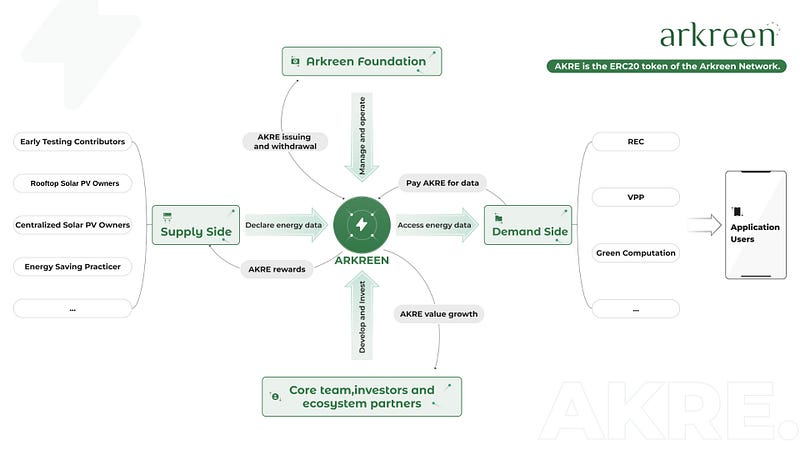
Figure 1 illustrates the Arkreen network, the core team, and other ecosystem partners responsible for the network’s development. User miners (i.e., supplier sides) generate the green data used in the Arkreen Network in exchange for economic gain. In contrast, demand side is made up mostly of enterprises and individuals, who use this data to build applications or services and pay for data usage. The Arkreen Foundation is in charge of overseeing the management and operation of the Arkreen network and is also responsible for issuing incentives to the network’s green energy data suppliers.
Why does Arkreen build on top of the Polygon blockchain?
Polygon is an experimental playground for developers and is suitable for building scalable applications without compromising security. However, these aren’t the only reasons Arkreen and Polygon are a good match. A key component related to our blockchain evaluation process involves intense and selective benchmark measurements of the most adaptable and flexible blockchain platforms. Therefore, when Polygon met our filtering process of these five key requirements, we knew we were choosing the right blockchain to build our platform on:
- Green credentials
As part of a large synergetic effort to combat climate change globally and thus reduce carbon emissions, it stands to reason that our primary goal was to identify and build a Web3 digital infrastructure for globally distributed green energy resource platforms powered by carbon negative. The Green Manifesto: A Smart Contract for Planet Earth this document from Polygon blockchain is what really caught our initial attention. The Polygon core team’s commitment to improving the network climate is outlined in this article. It earmarks the start of an emphasis on sustainability. Polygon already has an extremely low carbon footprint when considering other existing blockchain protocols. Nonetheless, Polygon’s green credentials are what align a Polygon blockchain network with the Arkreen network’s commitments to attracting millions of users (PV solar owners) from carbon voluntary markets to join the network and share their green data to receive incentives, thereby reducing carbon emission practices.
- Widespread adoption potential
As of August 2022, Polygon has experienced massive growth; the project’s user base has doubled, climbing to about 123% yearly. Our primary goal for the Arkreen Network is to achieve widespread adoption and user growth for our products. The Arkreen network platform’s user experience must be as consistently pleasant as possible if we are to achieve massive user growth and scale Arkreen through Web3 and token incentives. This is clearly what will help to build a solid digital infrastructure for globally distributed green energy resources. For the Arkreen network to be more effective and scalable, for this reason, we currently think Polygon is the best chain that matches our needs. Thus, it is obvious that Polygon is paving the way for the public to take notice of its splendid work by achieving security and scalability in the blockchain domain, thereby augmenting widespread adoption. This strengthens our already solid belief that Polygon will continue to rise quickly.
- Speed and scalability
The prime aim of the Arkreen network platform is to be a user-friendly, simple, fast, and affordable network infrastructure for our users or miner owners to send green energy data reports to the Arkreen network and query this data to mint RECs for monetization. Block confirmation times on Polygon are fast — 2 seconds. This ensures a high level of network performance thanks to many sidechains supporting millions of transactions per second (tps). The Polygon scalability solution has so impressed Ethereum developers that they have postponed its plans for sharding, Ethereum’s scalability solution, for a year. We are certain that Polygon’s unique features will benefit our integration and help achieve widespread success.
- Low gas fees
According to recent data, the Polygon Network now charges typical gas rates that are among the lowest of all DeFi protocols, ranging from $0.002 to $0.004. Polygon not only has a low gas fee but also has a thriving ecosystem. Arkreen Network will become an even more alluring option for users thanks to these affordable transactions. They will be able to verify that the funds they sent were not wasted on unnecessary charges.
- Developer friendliness
Another major reason for our decision to build the Arkreen network based on Polygon’s core feature set is that it is ERC20 compatible (EVM), and at the same time, Ethereum software programmers will be familiar with the platform. To become a Polygon developer, all you have to do is switch to the Polygon RPC. Tools like Remix, Web3js, and Truffle, which can be found on Ethereum, are supported by default on Polygon Network.
How does Arkreen’s network deploy on Polygon?
Arkreen miner owners (e.g., suppliers of green energy data) can connect with the Arkreen network to optimally benefit from the network as a result of connecting their solar PV Panels to the platform. The Arkreen owner’s solar PV Panel or any other energy resource is initially connected to the inverter, with a mounted Arkreen-certified Smart Data Logger (aka. Standard Miner). The miners, as an energy oracle, send signed proof-of-green energy (PoGG) data reports to Arkreen Network’s oracle IoT platform. The platform sends a data package (packing all miners’ data at a time) to Filecoin’s green storage system and sends a Merkle root of the data package to Arkreen Network to invoke a smart contract. When an external entity (e.g., enterprises or clients) verifies the data, it first obtains the data index (CID) from the Arkreen Network’s Oracle platform, retrieves the data from the Filecoin Green storage network, and then verifies the retrieved data against the Merkle root on Polygon.
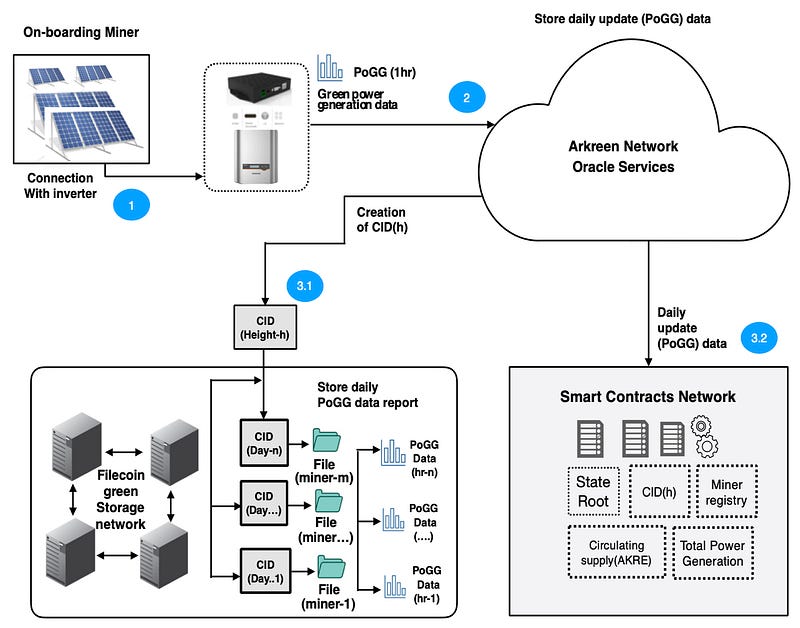
Figure 2 shows how the Arkreen network is built on the Polygon blockchain and how the PoGG report is stored on the Filecoin Green storage system. On-boarding miners, as the initial source for the green energy data (PoGG) data report, can send the PoGG data report to the Arkreen network oracle services through a smart data logger (a.k.a standard miner) connected with a solar inverter. The Arkreen network Oracle service platform sends data to the Filecoin Green storage system and a Merkle root of the data package to the Arkreen smart contract network, built on the Polygon blockchain.
The key value that Arkreen Network provides to the Polygon ecosystem- Accelerating growth through Web3-driven technologies
In 2017, Helium created a remarkably disruptive worldwide IoT network by utilizing Web3 economics and its bottom-up refactoring process of digital infrastructure based on Proof of Physical Work (PoPW). In contrast to a conventional startup mindset, the Helium network employed a token economic incentive system to incentivize the Internet-age consumer public all over the world to take part in network creation by becoming network builders and stakeholders. With close to one million interconnected IoT hotspot miners spread across the globe so far, this outstanding accomplishment was completed with practically no upfront investment costs. Unlike Helium Network, which is powered by Web3 technologies, Web1 and Web2 firms like Sigfox, Ericsson, and Alibaba are whom we would normally have expected to try to establish such a worldwide IoT network, but they have all become abortive due to the exorbitant costs and the lengthy payout periods. Due to the decentralized nature of network construction, Web3 presents a strong solution for infrastructure building, particularly the global physical infrastructure.
Undoubtedly, the Arkreen and Polygon Networks have many interesting commonalities. Polygon Blockchain is a carbon-friendly blockchain with a strong focus on scalability and security to attract larger DApp application developers to their blockchain ecosystems. Given that, Web3-enabled global infrastructure, which was inspired by Helium, has scaled in a bull market can only lead to a very positive conclusion for an upward trajectory in blooming markets. Arkreen Network leverages IoT and blockchain connectivity to penetrate a very mature yet consumer-hungry market first with solar PV panels for Long-Tail market condition adoption. It offers embedded and integrated IoT connectivity solutions for scalability. Using the PoPW incentive mechanism, they encourage more builders to digitize their household solar photovoltaic panels by purchasing and installing data collector devices. This is further implemented through a do-it-yourself strategy, where the builders will register trustworthy green-energy generation data on the Arkreen Network to acquire incentive rewards. Moreover, the Arkreen Network will mimic Web3 methodologies to scale its network to achieve remarkable user growth and consequently attract millions of users to join the network; This is how they can accelerate their carbon mitigation mission globally through renewable energy resources, augmented by the Polygon ecosystem.
We have senior Web2 industry executives on our team who are well-qualified and experienced in accelerating user growth. Arkreen Network is dedicated to expanding its user base by bringing millions of data collector devices online via the Web3, PoPW protocol, and token economy incentives to the Polygon Network. Since the Arkreen network is built on a Polygon, this is undoubtedly achievable, considering the Polygon Network offers lower fees when transacting on-chain; moreover, it processes the transactions efficiently.
By Arkreen on December 10, 2022.