Decoupling from the Grid through Distributed Green AI: The Path to a Global Decentralized Generative Energy Network (DeGEN) and P2P Energy Trading

Introduction
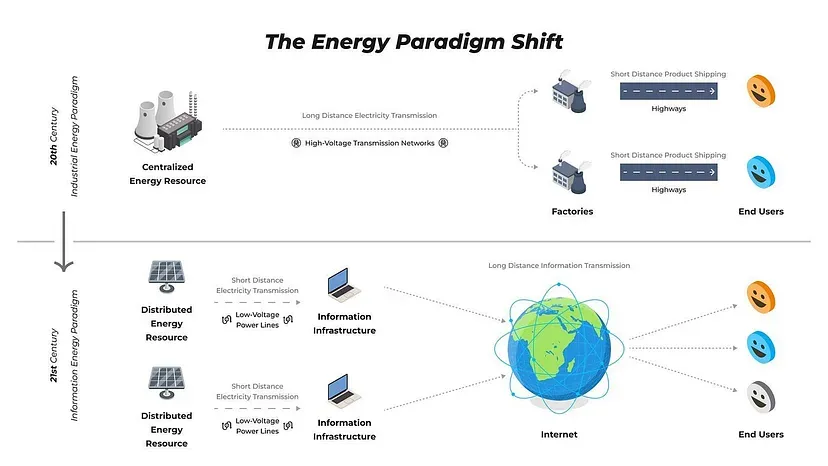
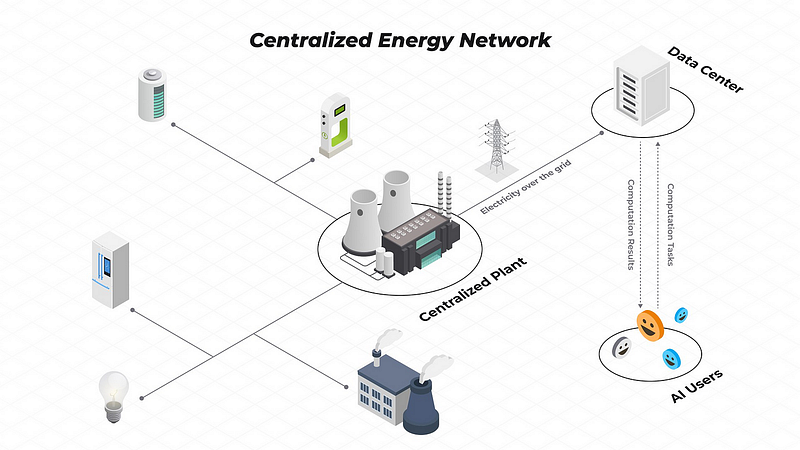
Electricity is the backbone of modern society. For over a century, the traditional energy paradigm has followed a centralized structure: large power plants generate electricity and distribute it to consumers via the grid. This system, characteristic of the 20th-century industrial age, is now being changed by two key trends of the 21st century.
The first trend is a shift in energy demand. Emerging technologies, particularly AI and data centers, are consuming vast amounts of electricity, often exceeding the capacity of existing grids. The conventional solution has been to build more thermal power plants and extend grid infrastructure to meet this growing demand. However, such expansions are both costly and inefficient, and global scalability remains elusive.
The second trend is on the supply side. Driven by environmental concerns, renewable energy is replacing fossil-fuel-based power plants. Solar, wind, and other renewable energy sources are naturally decentralized, but their intermittency and geographical dispersion make it difficult for them to integrate into the centralized grid. As a result, grid operators tend to impose high barriers to entry for Distributed Energy Resources (DERs), effectively underutilizing these green energy sources.
This paradox — where AI’s energy needs are growing while DERs remain underexploited — hints at the need for a new paradigm: a Decentralized Generative Energy Network (DeGEN), coupled with peer-to-peer (P2P) energy trading, that can break free from the limitations of the traditional energy model.
Challenge of the Traditional Energy Paradigm in the AI Era
The traditional energy paradigm, designed for the industrial age, was highly efficient for centralized power generation and manufacturing processes. However, this model is ill-suited for the decentralized and variable nature of renewable energy, especially in the context of AI’s growing energy demand.
High Entry Barriers for DERs
Traditional grids struggle to accommodate DERs. Renewable energy sources, such as solar and wind, are unpredictable and dispersed, which raises CAPEX and OPEX of integrating them into the grid. Consequently, grids often impose restrictive policies and connection fees for DERs.
Pricing Monopoly
Centralized grids wield substantial control over energy pricing and market access. Since DERs must rely on the grid to distribute their electricity, they are forced to comply with the grid’s pricing policies, which stifles competition and innovation.
Limited Globalization
The regional nature of traditional grids reinforces monopolistic behavior, as utilities often have exclusive control over specific areas. This hinders the formation of a global DER network, as successful localized solutions cannot be easily replicated in regions with differing grid policies.
Given the growing energy demands of AI and the underutilization of DERs, a new approach is needed.
The DeGEN Paradigm Shift
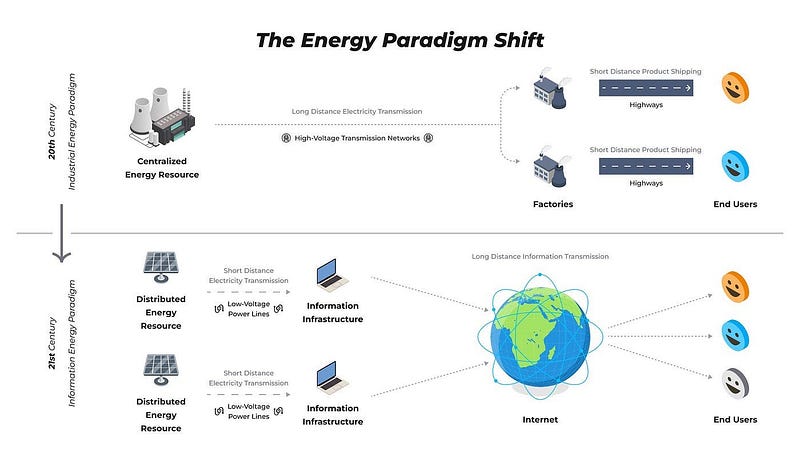
While high-voltage transmission lines transport energy to AI computing centers, the Internet serves as another form of infrastructure that transmits information globally. A pivotal question arises: instead of transmitting electricity from DERs to centralized data centers via local, costly and permissioned grids, could we instead transmit data and computational tasks over the open, global, and low-cost Internet to where DERs are located, and perform AI computations at the energy source?
Since the Internet already reaches nearly every DER site, this paradigm shift would enable global long-tail DERs to become green AI computers. Renewable energy could be consumed on-site for computation, and the resulting data products could be sent to users via the Internet at virtually no cost.
No need for grid approval.
No dependency on grid pricing.
No geographic restrictions.
Instead of relying on the grid, DER owners and operators can provide green AI computation services globally, negotiating pricing directly with AI users. While not a replacement for centralized grids and data centers, this model offers a highly efficient alternative for certain AI use cases, particularly non-real-time AI inference tasks (such as text-to-image generation).
This approach creates a global network of DERs, connecting them with AI users around the world without the need to transmit energy, enabling long-tail DERs to meet the needs of long-tail AI users.
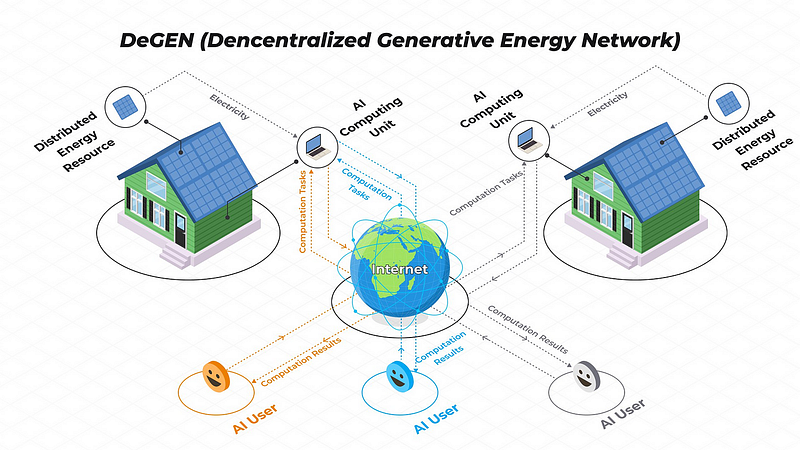
This is the concept of the Decentralized Generative Energy Network (DeGEN). DeGEN establishes decentralized global green energy networks and P2P trading markets by aligning energy consumption demands with energy suppliers. Unlike the traditional model, which is tightly bound to regional grids, DeGEN decouples energy from these grids, greatly enhancing the flexibility of energy networks and increasing the bargaining power of decentralized energy resources (DERs) in a global P2P energy market. By bypassing the complexities of negotiating with regional grids, this new paradigm is easy to scale globally and encourages broad participation in both the energy supply and demand sides.
While the DeGEN concept is revolutionary, there are still key points to address to realize its full potential.
Key Points to Paving the Way for DeGEN
The vision of DeGEN is compelling, but several foundational elements are necessary for its realization.
- DeGEN with a DePIN-based Economic Model
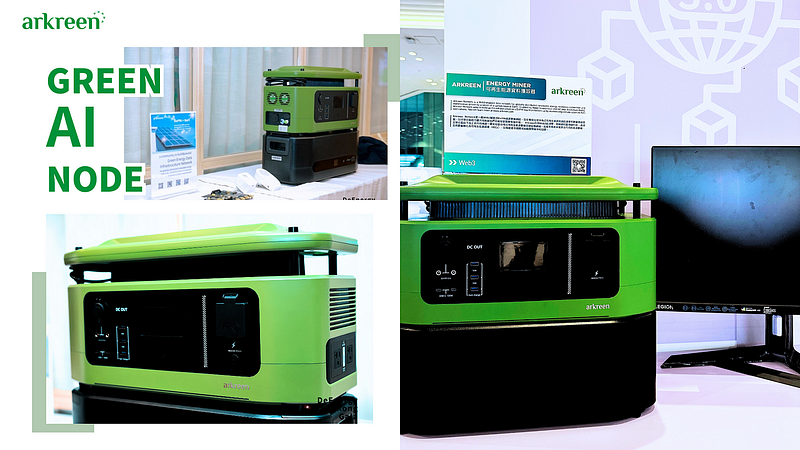
A decentralized generative energy network, i.e., an energy DePIN (Decentralized Physical Infrastructure Network), is essential. Arkreen, an energy DePIN project, has already connected over 100,000 solar photovoltaic (PV) and battery storage systems, enabling efficient renewable energy to support AI computing.
- Energy Storage Battery
Energy storage is critical for DeGEN. To turn energy generation sites into reliable AI computing hubs, storage solutions are needed to ensure round-the-clock operation. For instance, solar PV systems don’t generate power at night, so batteries must store excess energy during the day to support computing at night.
- AI Computing Units
AI Computing Units refer to any hardware capable of performing AI computations. Popular options include computers equipped with graphics cards, GPU arrays, or GPUs integrated into battery storage systems. A decentralized platform is needed to easily deploy AI computation containers across diverse hardware configurations.
- P2P Trading Market
A P2P trading market is crucial for connecting AI computation supply and demand. DER owners can list and sell their green AI computing power, while users in need of AI services can purchase it. A public blockchain with a trust layer (such as TLAY) is necessary to measure computational efforts and facilitate fair trading.
- Composability
The infrastructure should be open to collaboration with other Web3 projects to compose the best-fit solutions for various scenarios. For example, a decentralized AI computation project could offset its energy consumption by redeeming Arkreen’s Renewable Energy Certificates.
Once these components are in place, household solar PV owners could participate in DeGEN by contributing idle computer time or purchasing AI-specific hardware to offer AI computation services via the Internet. Imagine Alice, who lives in Singapore, is seeking an AI service provider to generate an image from the text, “A quick brown fox jumps over the lazy dog.” Bob, residing in Brazil, has a 10kW rooftop solar PV system with a 20kWh storage battery. Additionally, he owns a computer equipped with a Nvidia RTX4090 graphics card, registered with Arkreen DeGEN as a Stable Diffusion computing service endpoint.
Through the P2P trading market, Alice selects Bob’s service endpoint and sends the text “A quick brown fox jumps over the lazy dog” along with the generation parameters for Stable Diffusion. Bob’s Nvidia RTX4090 processes the request in a few seconds, consuming several tens of Wh energy from his battery, which was fully charged by his solar PV system during the day. After generating the image, Bob’s service endpoint sends it back to Alice and charges her in AKRE tokens.
This scenario illustrates how a transparent P2P trading market can facilitate fair exchanges between AI users and AI computing service providers. It exemplifies the emerging paradigm of the Decentralized Generative Energy Network (DeGEN) and P2P energy trading.
Conclusion
The journey toward a global decentralized energy future requires breaking away from the constraints of the traditional grid and establishing a new paradigm. By leveraging distributed energy resources, shifting energy demand to supply-side renewable generation sites, and facilitating P2P energy trading through blockchain, we can create a Decentralized Generative Energy Network (DeGEN). This model not only increases flexibility and efficiency but also democratizes energy and AI landscapes, fostering a more resilient, equitable, and sustainable energy ecosystem.
By Arkreen on September 11, 2024.