Photosynth: When AI Coding Agents Photosynthesize on Arkreen

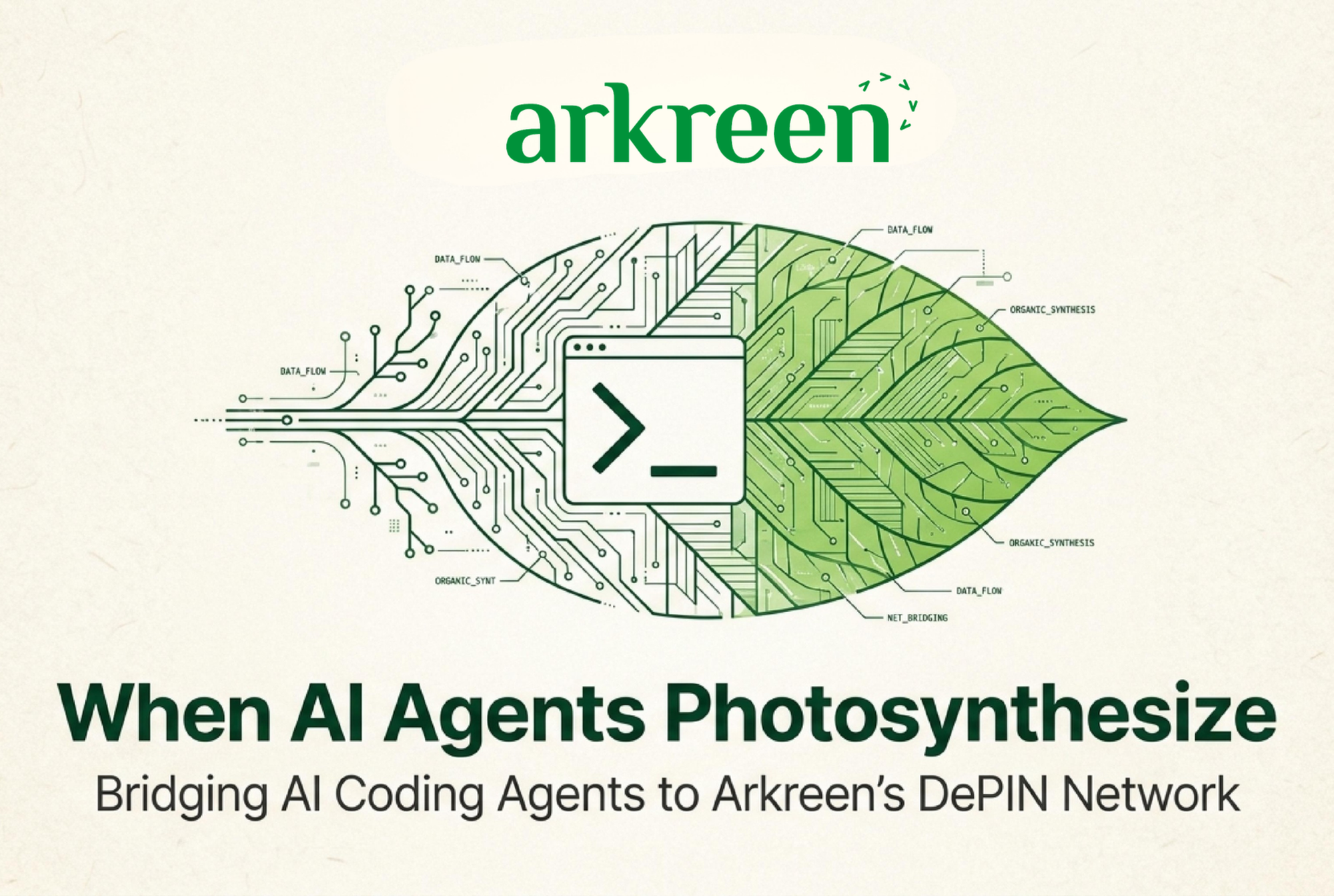
Every line of code an AI coding agent writes is paid for in two currencies: tokens — which the developer is billed for — and electricity, which no one settles. Photosynth closes that second loop. It turns the electricity an agent consumes back into renewable energy on Arkreen, automatically, every period, without the developer doing a thing.
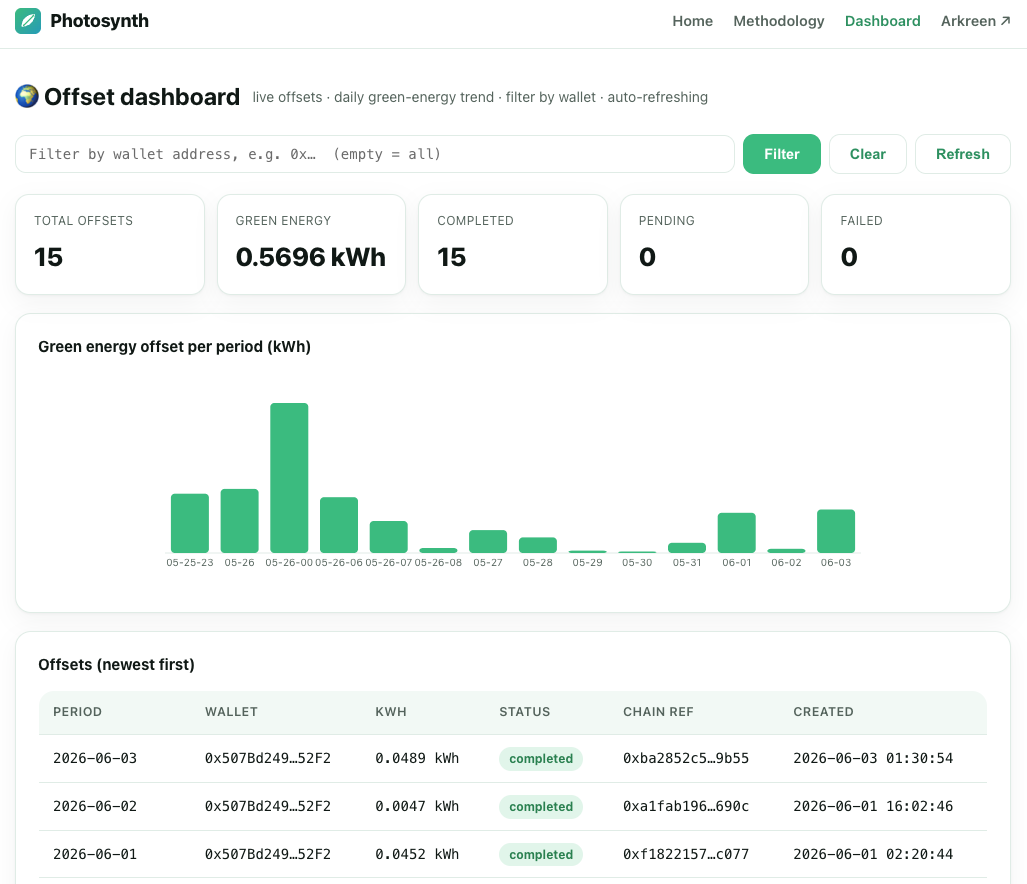
Table of Contents
- The Asymmetry Nobody Was Closing
- The Seam: AI Agents × DePIN Renewables
- What Photosynth Does
- Why Arkreen Is the Only Network
- Honest Methodology
- Privacy by Design
- What This Unlocks for Arkreen
- Installation Guide
- Roadmap
- FAQ
The Asymmetry Nobody Was Closing
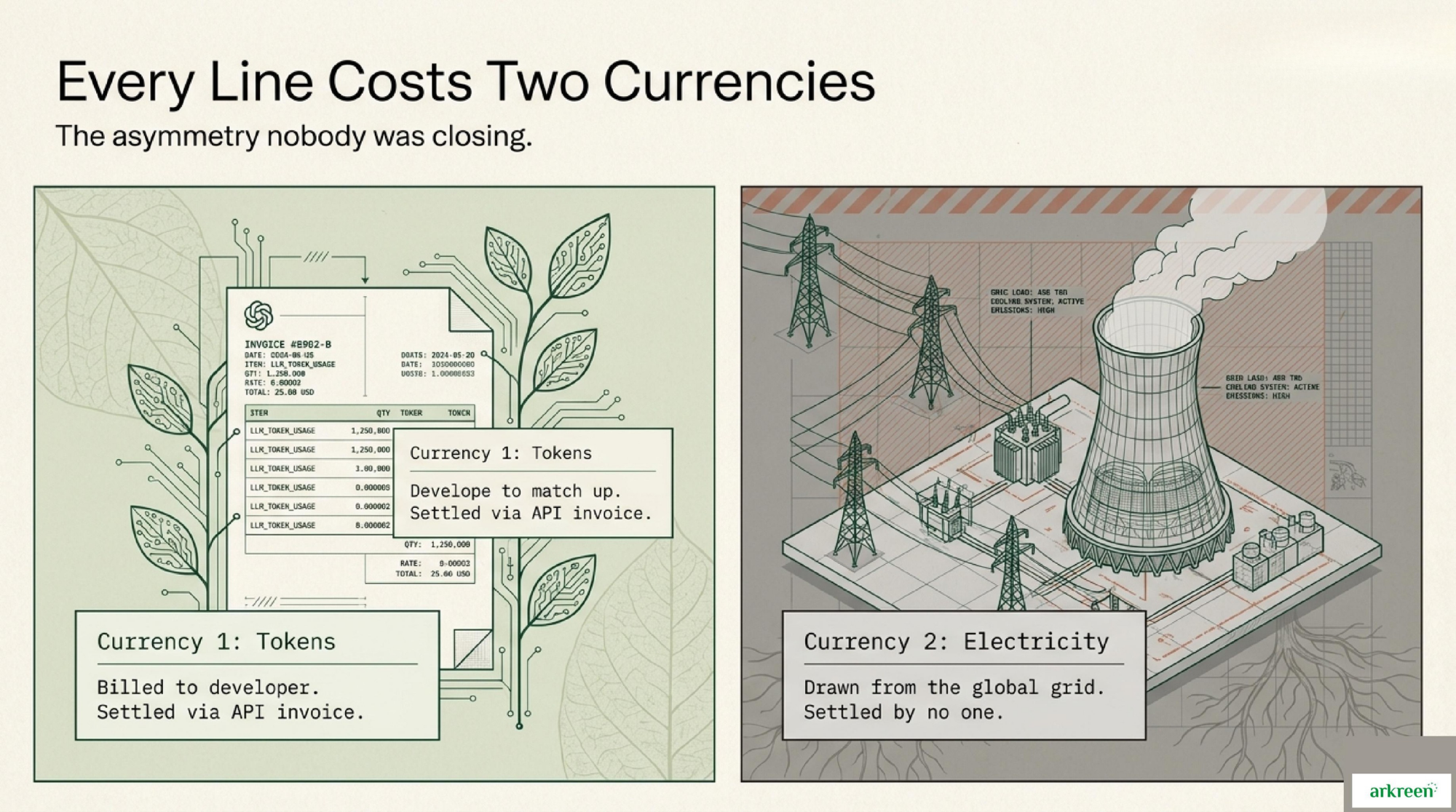
In 2026, AI coding agents are no longer a curiosity. They draft pull requests overnight, refactor million-line monorepos in a single command, and review their own work before a human ever sees it. The bill for that work shows up on an API invoice — denominated in tokens.
The other bill — denominated in kilowatt-hours, drawn from a power grid somewhere in Oregon or Ireland or Singapore — shows up nowhere. There is no line item, no opt-in, no quiet way for the developer who launched the agent to settle the energy it just used.
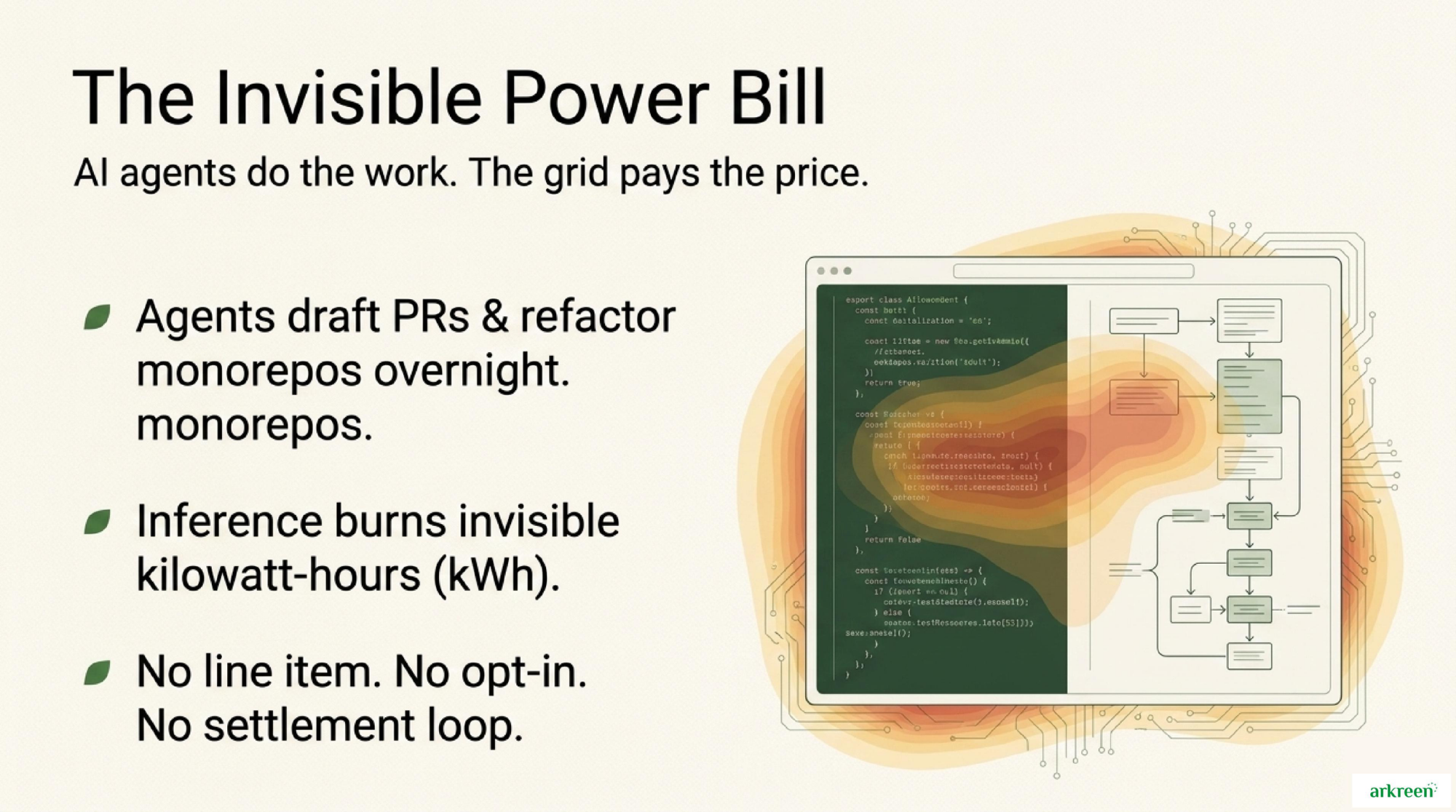
This is the asymmetry Photosynth is built to close. Not by guilt-tripping developers, and not by adding yet another carbon dashboard for someone else to ignore. We close it by rewiring an existing piece of infrastructure — the Stop hook every modern coding-agent CLI now ships — into an automatic settlement loop that retires renewable energy on Arkreen, in kWh, on the developer's behalf.
One install. One wallet. Then the agent quietly photosynthesizes for you.
The Seam: AI Agents × DePIN Renewables
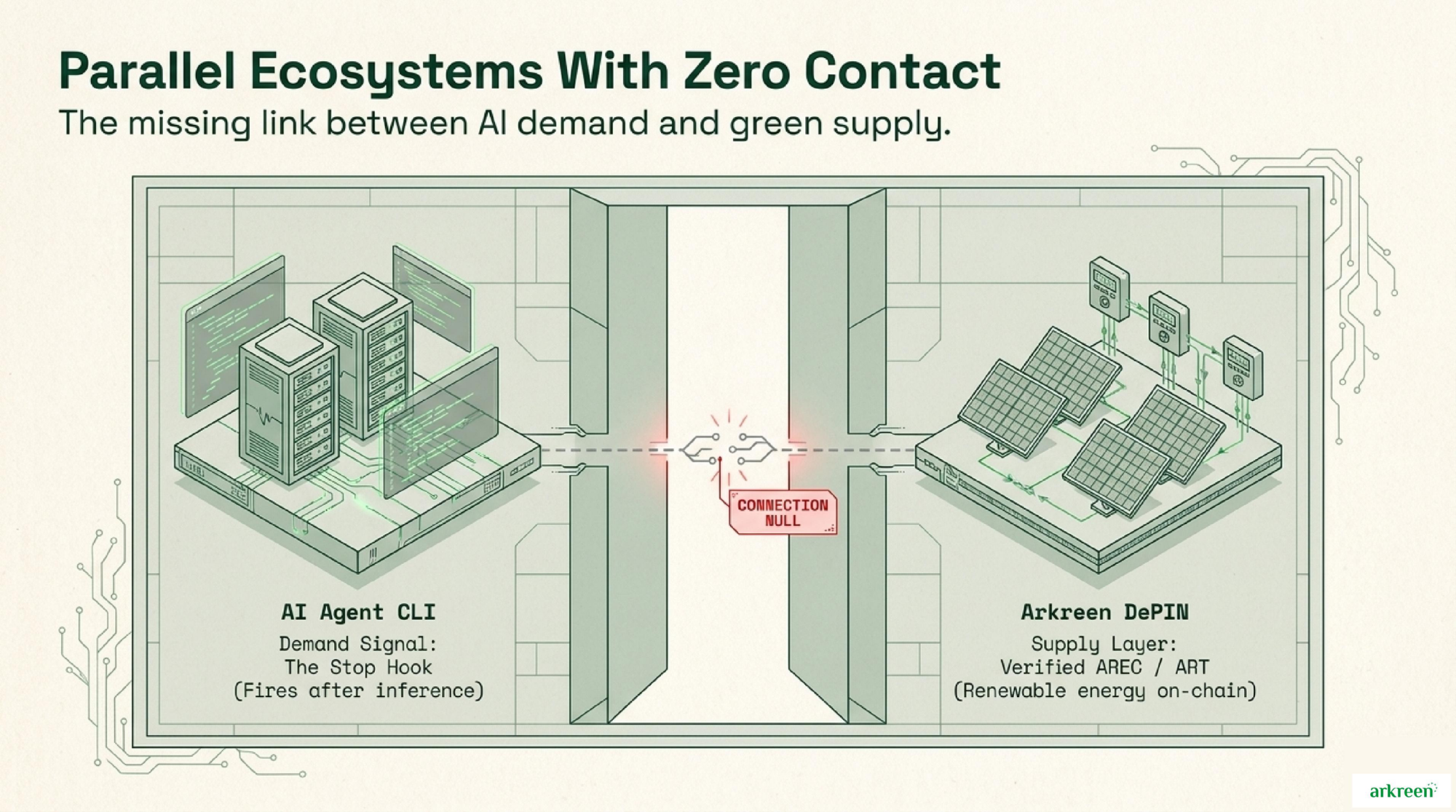
The Demand Side: AI Agents
On one side, agentic coding — Claude Code, OpenAI's Codex CLI, Moonshot's Kimi Code CLI — has standardized around a small, powerful idea: lifecycle hooks. When an agent finishes a turn, the CLI fires a Stop event. A user-supplied script gets handed a path to the session transcript and a few milliseconds to do anything it wants. It is the cleanest demand signal you could ask for: it fires exactly when AI inference has just happened, with metadata describing how much.
The Supply Side: Arkreen
On the other side, Arkreen has spent two years building exactly the supply layer this demand signal needs. Arkreen is a DePIN (Decentralized Physical Infrastructure Network) for globally distributed renewable energy: physical solar plants, IoT meters, and a fleet of Remote, Standard, and Plant Miners feed verified green-energy generation data on-chain under a Proof-of-Green-Generation algorithm.
That generation is tokenized as AREC (ERC-721 renewable-energy certificates) and its fungible counterpart ART (ERC-20). Any wallet can retire ART at kWh granularity on Polygon, with a public on-chain badge proving the climate action.
The Glue
Each side has been building the other side's missing half without realizing it. Arkreen has the supply — miners, RECs, retirement contracts. The agent side has the demand signal — a hook firing every time an LLM exhales a few thousand tokens. Nobody had glued the two together.
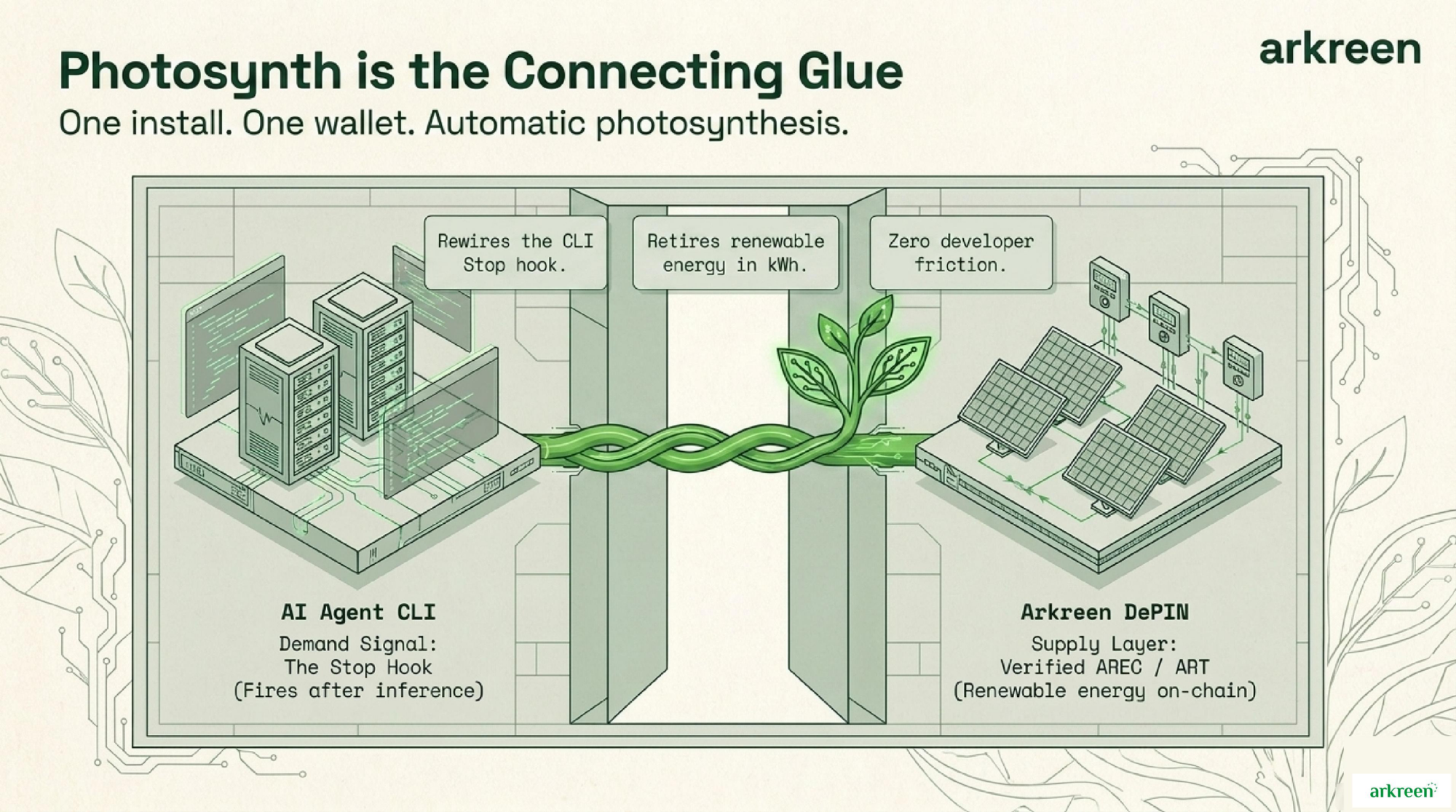
Photosynth is that glue.
What Photosynth Does
The 3-Step Pipeline
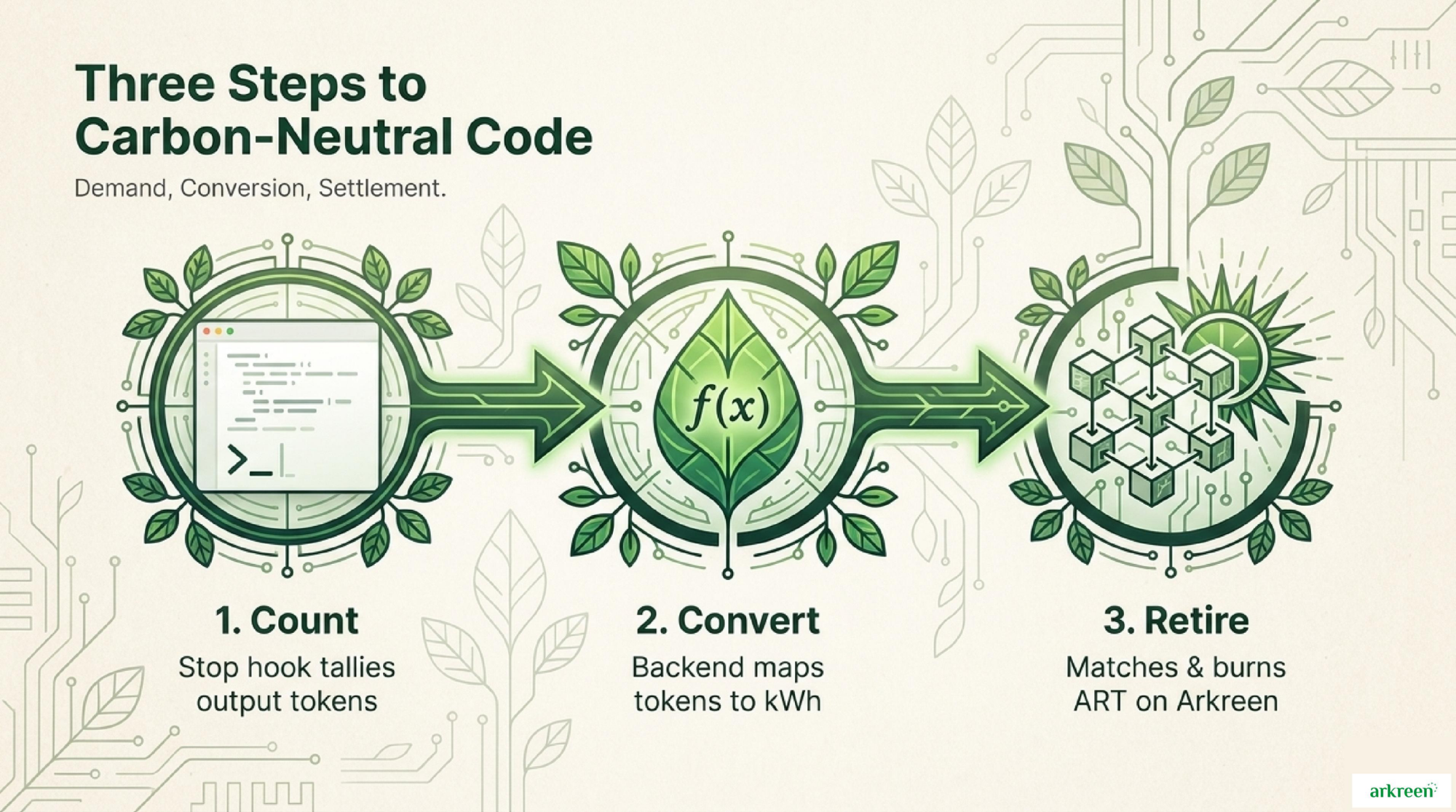
- Tally. A small Stop hook script ships with the plugin. After each agent turn, it walks the local session transcript and tallies output tokens per model.
- POST. Once per period — default daily, configurable to hourly — the script POSTs the tally (only wallet, model-to-token-counts, and a time range) to the Photosynth backend.
- Retire. The backend converts tokens to kWh using a published per-model energy coefficient table, and retires the matching amount of renewable energy on Arkreen, where every offset is recorded against the developer's wallet and shows up live on a public dashboard.
The Developer Experience
Claude Code (CLI):
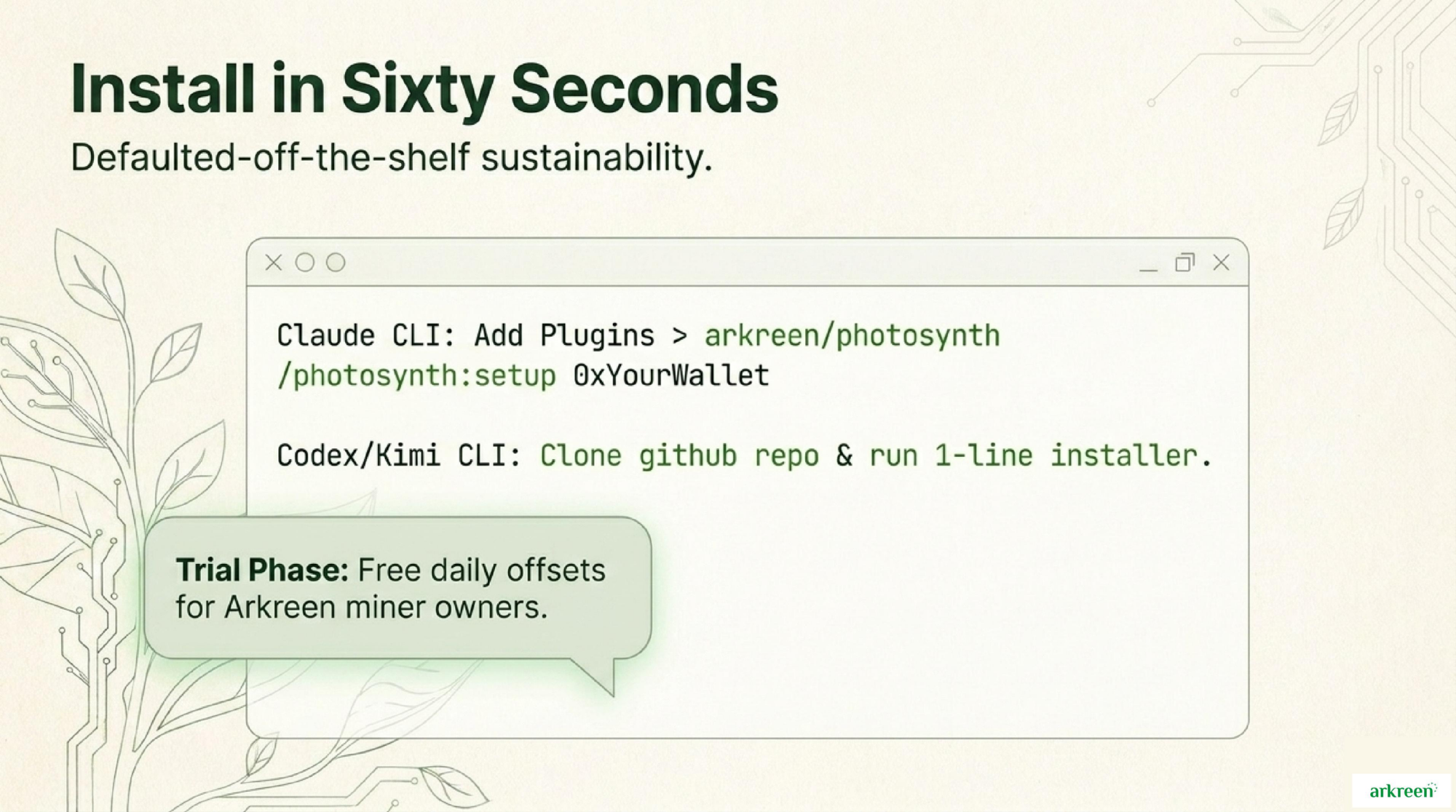
    /plugin marketplace add arkreen/photosynth-plugin
    /photosynth:setup 0xYourWallet
Codex CLI and Kimi Code CLI have their own one-line installers, but the data path is identical — the three CLIs flow into the same backend, the same dashboard, the same retirement standard. Full instructions at photosynth.arkreen.com
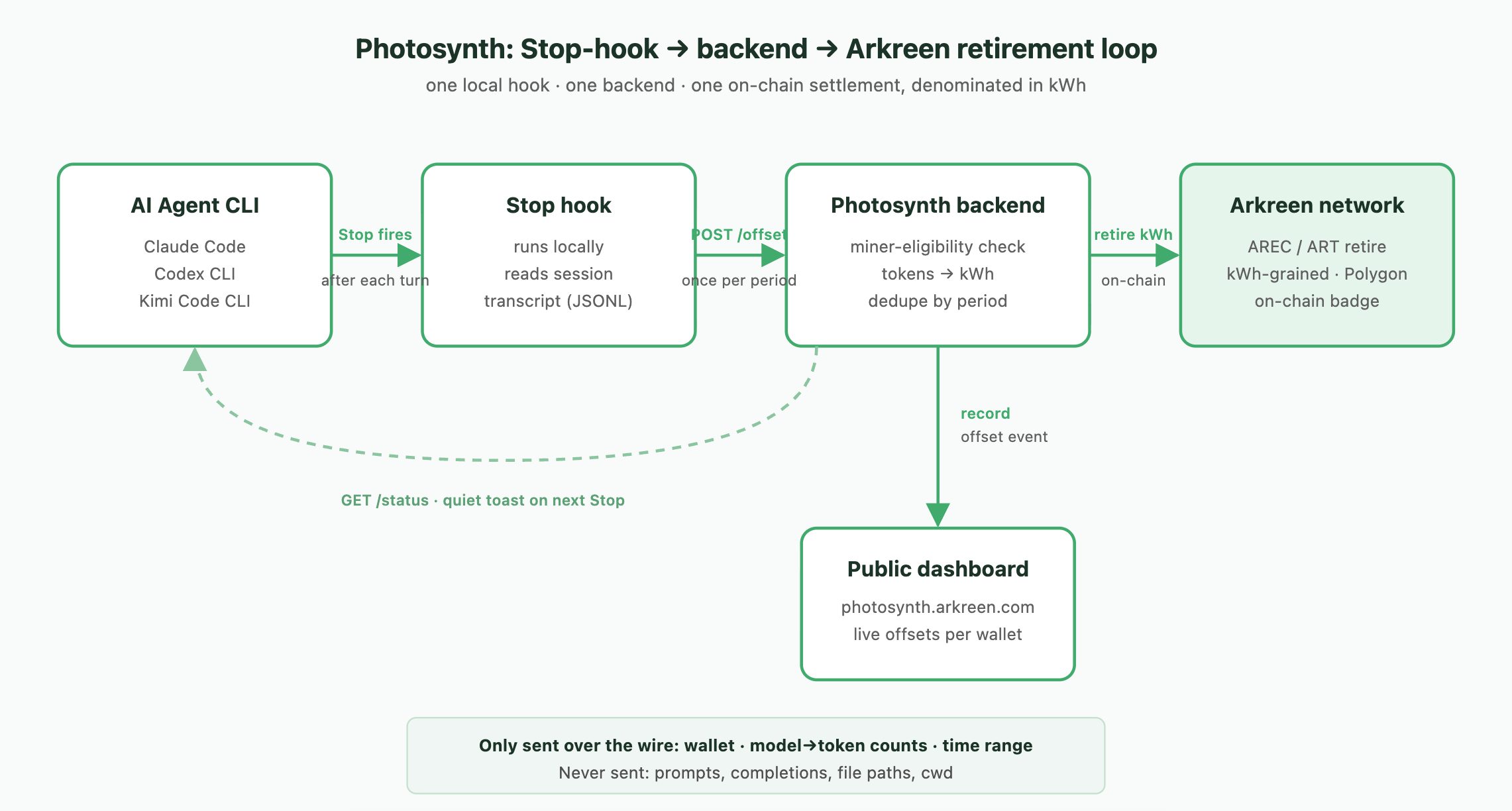
Agent-side portability is not a marketing line for us; it's the whole point. The grid doesn't care which CLI generated the tokens.
Why Arkreen is the only network Photosynth could be built on
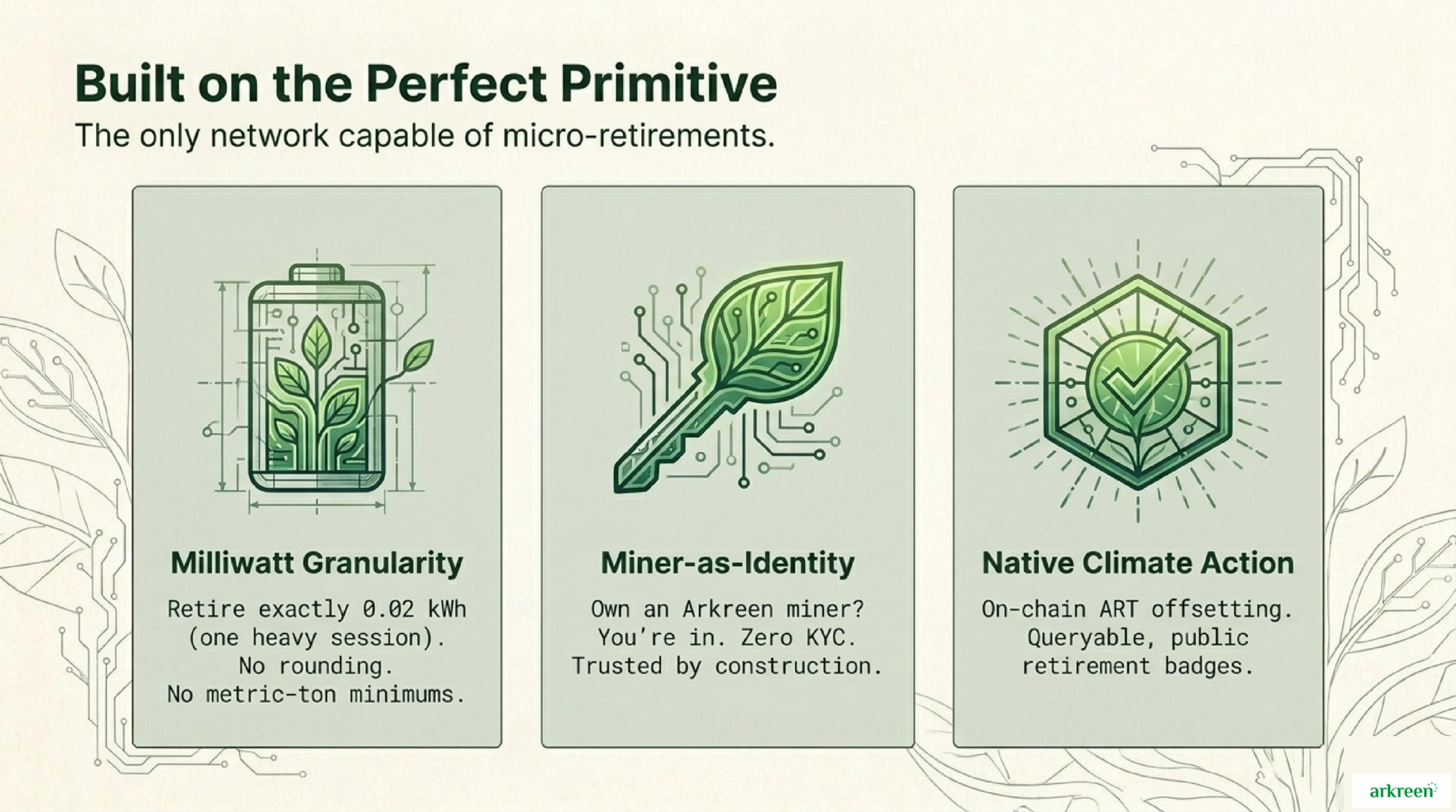
This is not idle flattery. Three concrete properties of Arkreen — each documented in the official AREC overview — turn Photosynth from a nice idea into a working product.
1. kWh-Grained Retirement
A heavy day of agent work generates ~100,000 output tokens. Under Photosynth's coefficient table that's roughly 0.02 kWh — twenty watt-hours. Most carbon registries can't denominate below a metric ton of CO₂. Arkreen's ART represents fragmented renewable energy, and retirement is granular enough to match the physical reality of a single agent session.
2. Miner-as-Identity
During the trial phase, Photosynth opens registration to wallets that already own an Arkreen miner. No email. No KYC. The backend calls Arkreen's public agg_queryMinersEnriched JSON-RPC and verifies your miner stake. The anti-abuse problem disappears without a payment wall.
3. First-Class On-Chain Primitives
Per Arkreen's AREC framework, climate actors offset ART, mint a retirement badge against the climate action, and pay a small fee proportional to the energy retired. Every Photosynth offset slots into that exact flow. The retirement is on-chain, the badge is queryable, and the audit trail is the chain itself — not an opaque spreadsheet at a registry company we have to trust.
Arkreen had already built the settlement layer Photosynth needed. We just had to call it from the right place at the right time.
Honest Methodology
Two principles guide the way Photosynth measures electricity.
Output Tokens, Not FLOPs
Decode — the autoregressive token-generation step — dominates LLM inference energy, and it is memory-bandwidth-bound rather than compute-bound. So we estimate energy from output tokens, not from theoretical FLOPs. This matches the methodology used by Epoch AI, Google's 2025 Gemini energy paper, and the ML.ENERGY benchmark.
Per-Model Coefficients
Anchored to public references. Our e_out table (Wh per output token) currently sits at roughly:
| Model Class | e_out (Wh / output token) | Range |
|---|---|---|
| Opus-class | 0.0004 | 0.0003 – 0.0006 |
| Sonnet-class | 0.0002 | — |
| Haiku-class | 0.00007 | 0.00005 – 0.0001 |
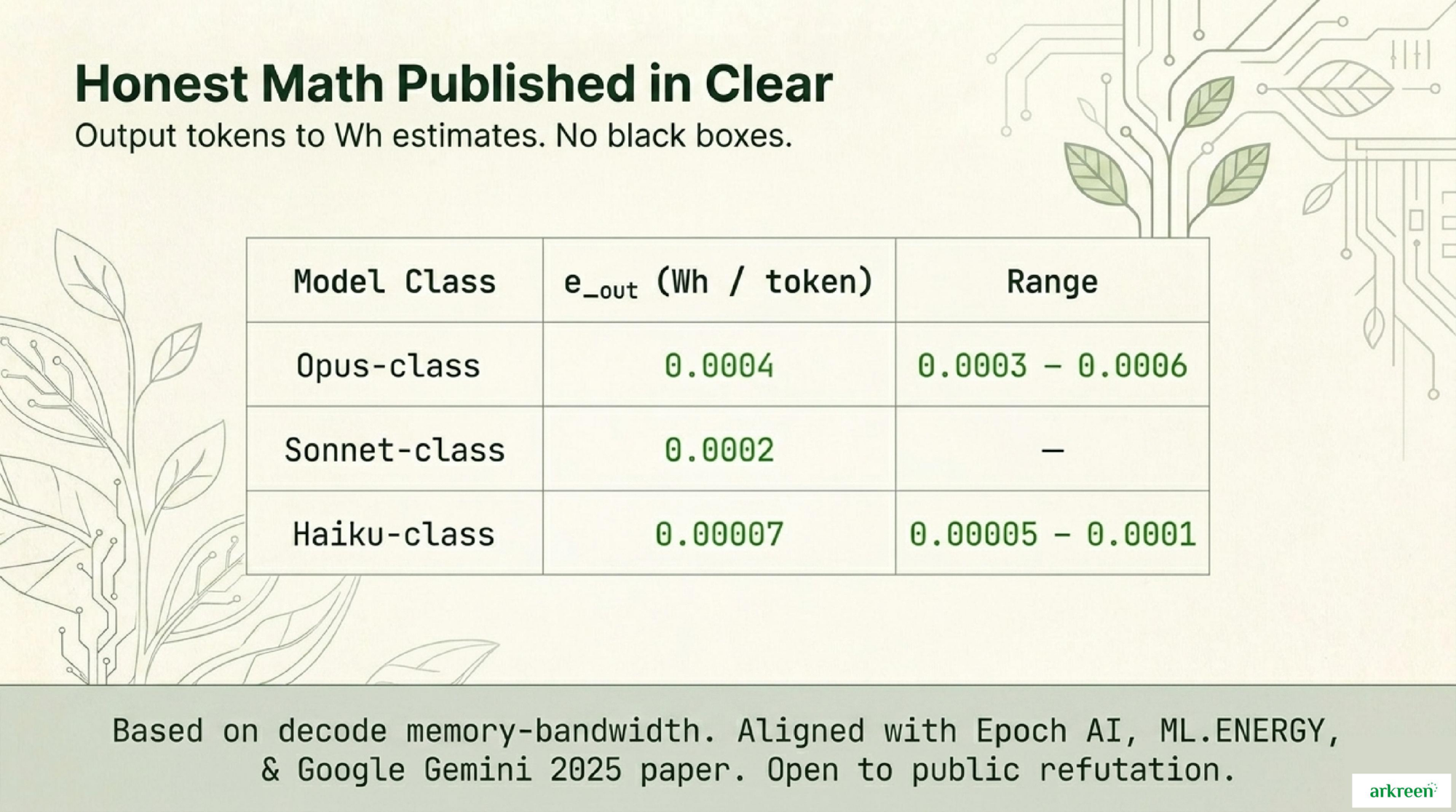
Every coefficient lives in a JSON file on the backend, updateable without a client-side upgrade. The methodology page on the dashboard shows the working, links to every reference, and explicitly labels the uncertainty band.
We treat the numbers as symbolic but defensible. Many "AI sustainability" projects publish a single dramatic number with no math behind it. We publish the math and let anyone challenge it.
Privacy by Design
The Photosynth client reads your local session transcript to count tokens. That transcript contains everything — prompts, code, file paths, your conversations.
The wire payload contains none of it:
{
  "wallet_address": "0x...",
  "local_date": "2026-06-03",
  "time_range": { "start": "...Z", "end": "...Z" },
  "usage_by_model": {
    "claude-opus-4-6": { "output_tokens": 91234 },
    "claude-haiku-4-5": { "output_tokens": 12000 }
  }
}
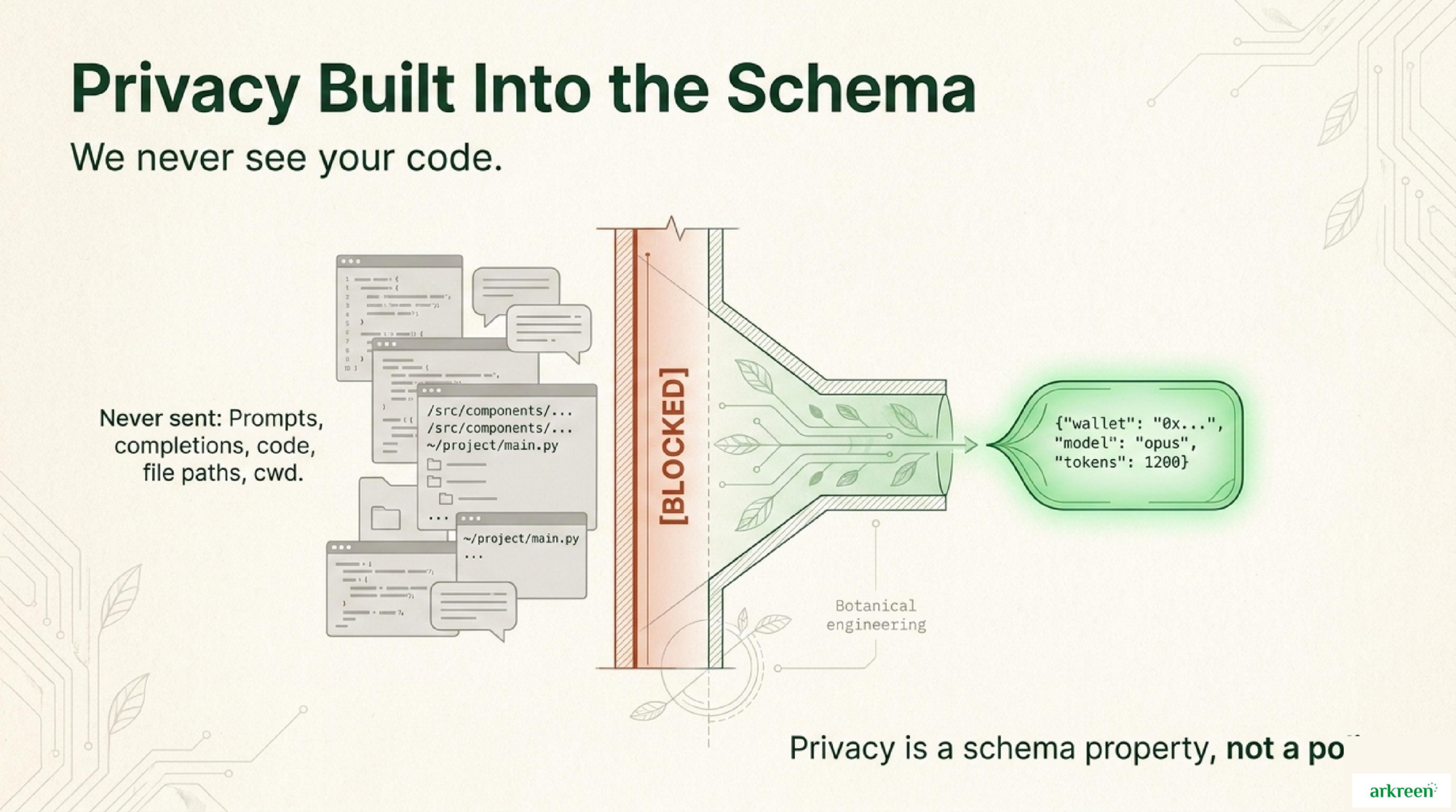
No prompts. No completions. No file paths. No cwd. The hook script is open source and short enough to read in one sitting.
Privacy is not a policy we promise — it is a property of the schema.
What This Unlocks for Arkreen
AI inference is now the fastest-growing electricity demand in the world. Photosynth turns every developer running a coding agent into a tiny, automatic ART retirement event — a continuous, distributed demand signal flowing into Arkreen's settlement layer.
It also rhymes with Arkreen's AREC Green Bot initiative — supply-side AI meets demand-side AI. Two halves of the same thesis:
Every AI agent should also be a climate agent.
Installation Guide
Requirements
- An Arkreen miner (Remote, Standard, or Plant)
- A wallet address (0x...)
- Claude Code, Codex CLI, or Kimi Code CLI
Claude Code (CLI)
/plugin marketplace add arkreen/photosynth-plugin
/plugin install photosynth@photosynth
/photosynth:setup 0xYourWallet
Claude Desktop App
- Click the + button next to the message box
- Choose Plugins
- Add
arkreen/photosynth-pluginas a marketplace - Install photosynth
- Run
/photosynth:setup 0xYourWallet
Codex CLI / Kimi Code CLI
Clone github.com/arkreen/photosynth-plugin and run the matching installer:
- Codex:
plugins/photosynth-codex/scripts/ - Kimi:
plugins/photosynth-kimi/scripts/
Live dashboard: photosynth.arkreen.com/dashboard.
Trial Phase
Offsets are free for wallets owning an Arkreen miner. One offset per wallet per period. Financed jointly by Arkreen and Photosynth.
Roadmap
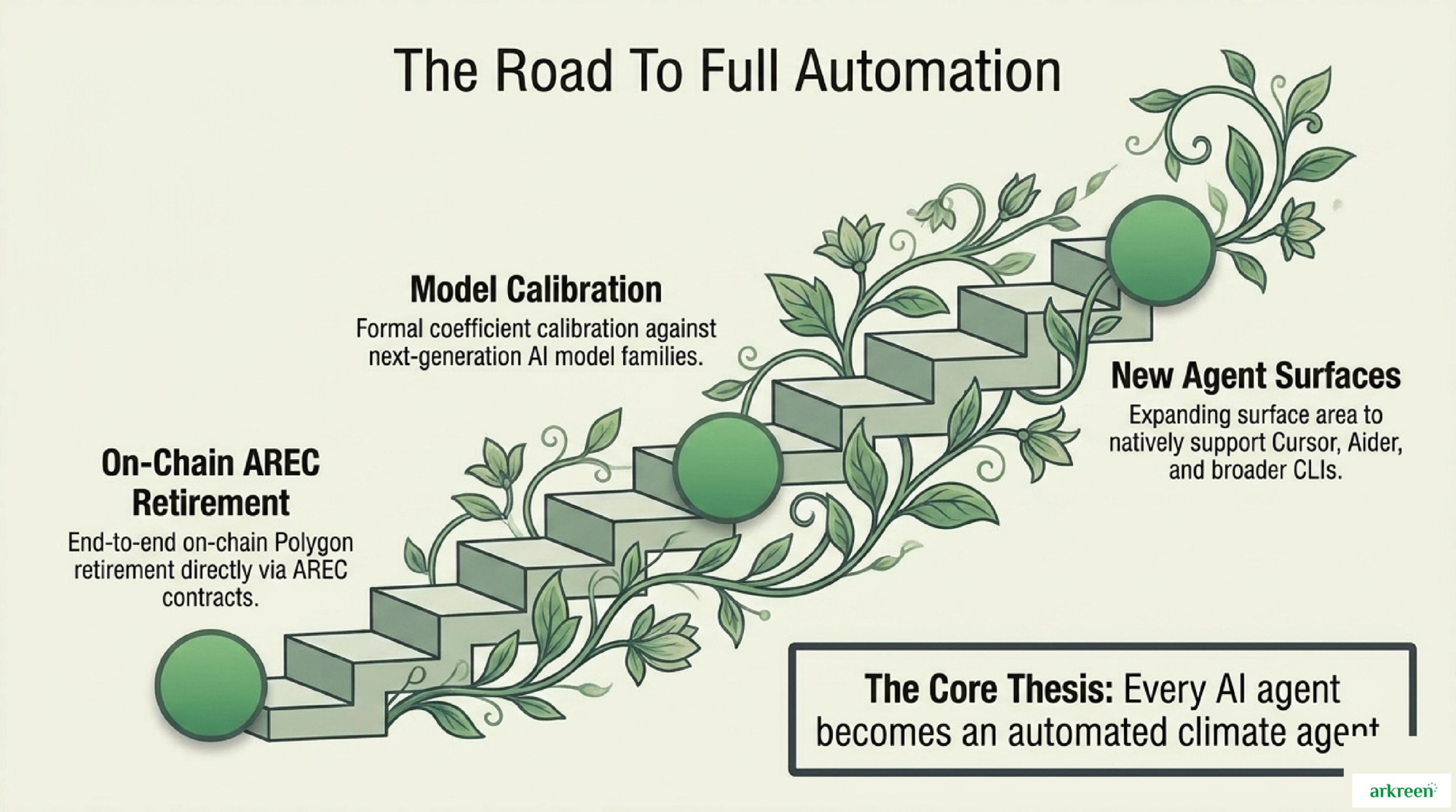
| Milestone | Status | Description |
|---|---|---|
| Virtual retirement queue | ✅ Live | Current trial phase |
| On-chain retirement | 🔄 In progress | Polygon AREC contract calls |
| Coefficient calibration | 📋 Planned | Next-gen model families |
| More agent surfaces | 📋 Planned | Cursor, Aider, etc. |
FAQ
Q: Does Photosynth slow down my AI agent?
A: No. The Stop hook runs after the agent turn completes. It takes milliseconds.
Q: What data does Photosynth send to the backend?
A: Only your wallet address, token counts per model, and time range. No prompts, no code, no file paths. See the privacy section above.
Q: How much does it cost?
A: Free during the trial phase for Arkreen miner owners.
Q: Which AI coding agents are supported?
A: Claude Code, Codex CLI, Kimi Code CLI. Cursor and Aider are on the roadmap.
Q: Is the plugin open source?
A: Yes. github.com/arkreen/photosynth-plugin
Every line of code your agent writes burns a little electricity somewhere on the grid. From today, with one install, that electricity comes back to the planet as renewable energy on Arkreen.
Let your agent photosynthesize.
Resources:
- 🌐 Website: photosynth.arkreen.com
- 📊 Dashboard: photosynth.arkreen.com/dashboard
- 💻 GitHub: github.com/arkreen/photosynth-plugin
- 🔗 Arkreen: arkreen.com
Built with Arkreen, AREC, and a soft spot for the third law of thermodynamics.