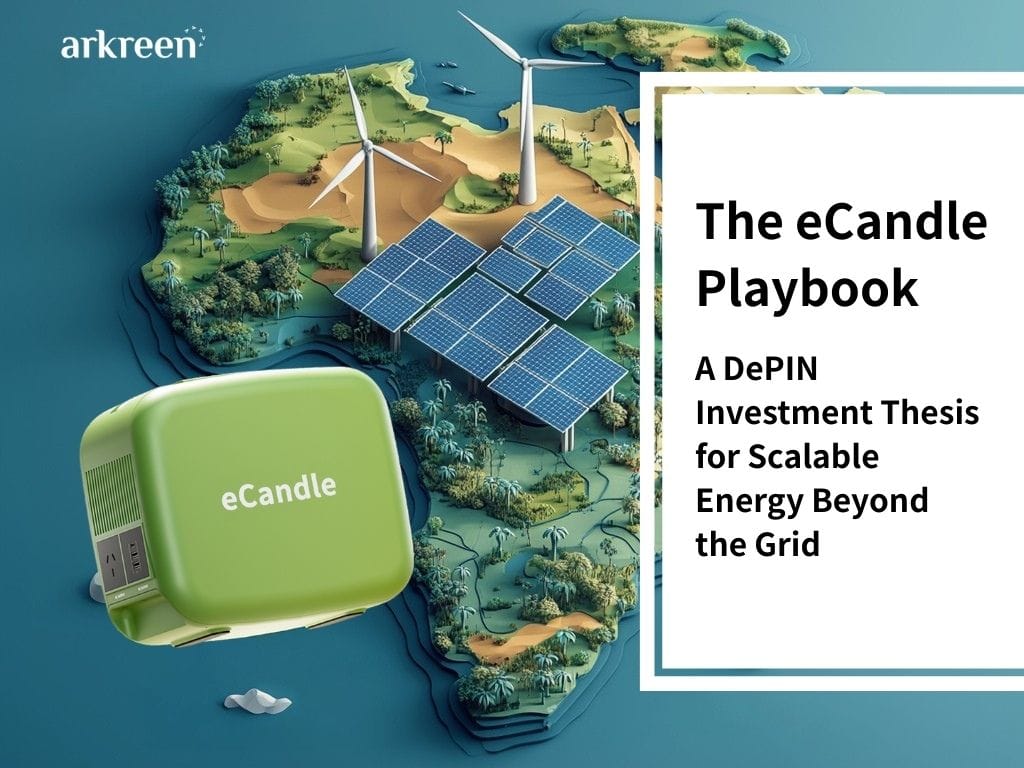
The eCandle Playbook: A DePIN Investment Thesis for Scalable Energy Beyond the Grid

Executive summary
DePIN for Impact reframes decentralised energy as an investable, repeatable asset class. Arkreen’s operational model pairs battery hardware, solar, local payments, and on-chain settlement to deliver verifiable cashflows, social value, and fast scaling potential in grid-fragile markets. For investors and strategic partners, this is about unit economics, predictable uptime, and low-friction distribution rather than abstract ideals.
Why this model matters to investors
- Predictable unit returns, not speculative token bets. Each deployed kit produces measurable micro-revenues that convert to stable on-chain receipts and transparent splits between partner, operator, and caretaker.
- Capital efficiency at micro scale, with low initial hardware cost, short payback windows in high-adoption micro-economies, and compounding replication effects across contiguous sites.
- De-risked social underwriting, because revenue comes from everyday transactions: phone charging, light time, refrigeration and POS continuity. Social impact is not a subsidy, it is revenue-aligned utility.
- Operational defensibility. Rugged hardware and local serviceability reduce replacement and churn risk, making cashflows durable even in harsh environments.

The investable product, redefined
Hardware baseline
- Rugged battery optimised for dust, heat, and irregular servicing. Field-proven durability is the difference between sustained returns and stranded assets.
- Solar and controlled sockets sized to local load profiles for maximum utilisation.
- Edge firmware for load management, telemetry, and payment-triggered energy release.
Revenue rails
- Local payment integration so customers pay in familiar currencies and apps.
- Backend conversion to stable coin and instant on-chain split distribution.
- Transparent reconciliation with auditable on-chain receipts for investor reporting.
Distribution stack
- Local partners for site hosting and caretaking.
- Token-incentivised deployment to align rollout velocity and quality.
- Governance primitives enabling progressive local representation as networks scale.
Unit economics, simply laid out
- Partner caps a deployment kit.
- Arkreen plus local partner installs at revenue-ready host sites.
- End users pay micro-fees via mobile payment apps.
- Payments convert to stable coin and trigger immediate revenue splits.
- Income flows back to capex builder, operator, and caretaker, with on-chain proof for audit and compliance.
Why this matters: measurable, time-stamped cashflows allow standard financial instruments to underwrite and securitise DePIN portfolios.
Where this scales fastest, and why
- High-opportunity markets with dense micro economies, strong mobile payment adoption, and fragile or unreliable grids.
- Africa and select Southeast Asian markets present high customer adoption velocity and replicable host models like shopfronts, service stations, and community hubs.
- Contiguous site clusters unlock aggregation benefits, enabling mini-grid integration and demand-response services as volume and telemetry mature.
We started with Kenya as the proof-of-concept because it matches all the variables above.

Operational challenge modes investors should watch
- Logistics friction: customs, routing, last-mile handoffs.
- Host selection: sites need steady demand or reliable caretakers to perform.
- Serviceability gaps: slow parts flow and weak training could increase downtime.
- Payment settlement friction: conversion and gas costs adjust margins.
Mitigations: pre-qualified logistics partners, caretaker revenue monitoring during ramps, local training and education programs, and low-cost payment rails with predictable conversion.
Partnership opportunities and what we bring
- For strategic capex builders: portfolio-grade DePIN lots with verifiable cashflows, packaged for fund structures or tokenised assets.
- For payment providers: regional volume, new merchant classes, and on-chain settlement use cases.
- For NGOs and community organisations: co-funded deployments that produce both social outcomes and revenue governance.
- For hardware and service partners: scale contracts, firmware co-development, and aggregated spare parts logistics.
Arkreen is a coordination layer, on-chain protocol and infrastructure of DePIN for Impact.
Growth levers for scale
- Cluster deployments to reduce logistics and service costs per unit.
- Standardised caretaker contracts to reduce host-selection variance.
- Aggregation into mini-grids and demand-response venues to monetise flexibility.
- Securitisation of deployed kits into investable tranches with verifiable on-chain revenue histories.
Each lever increases capital velocity and reduces marginal cost to deploy the next unit.
Signals of success partners should monitor
- Uptime and utilisation metrics at cohort and cluster levels.
- Time-to-payback per kit, measured in real transactional days.
- Revenue split stability and on-chain reconciliation rates.
- Organic host replication rate, i.e., hosts recommending new hosts.
- Cost per serviced incident and mean time to repair.
Success is not press coverage, it is replicable performance across many small sites.

Immediate asks for partners and capex builders
- Capital partners to fund the next tranche of deployable kits, structured as portfolio lots or tokenised revenue shares.
- Payment and conversion partners willing to co-design low-fee rails and instant stable-coin settlement.
- Logistics and service partners to lower last-mile costs and guarantee parts flow.
- Pilot host networks and NGOs for geographic anchoring of initial clusters.
If you can underwrite predictable cashflows, lower operational friction, or scale distribution, you accelerate both impact and return.
First mover advantage
This is an execution problem solution, not a theory. Arkreen has the hardware choice, the payments architecture, the firmware, and the first kits in motion. The remaining work is disciplined scaling, partner orchestration, and converting small, verifiable revenues into portfolio-grade returns. Capex builders and partners who want predictable, auditable, impact-aligned assets should talk to us now, because the next decade of infrastructure is built from many small, durable units, not a few giant projects.