Hong Kong Web3 Festival Day 2 | DePIN Enablers’ Panel: Helping the real world embracing Web3

Updates on Sub-stage 3:DePIN- Web3 & Physical Infrastructure Networks
Hong Kong Web3 Festival Day 2 | DePIN Enablers’ Panel: Helping the real world embracing Web3
Updates on Sub-stage 3:DePIN- Web3 & Physical Infrastructure Networks
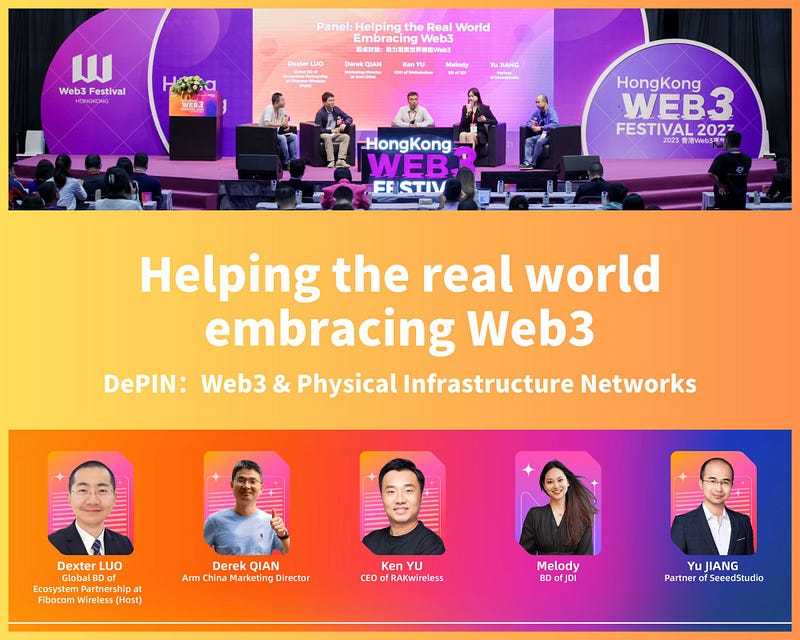
Dexter LUO (host): Good afternoon everyone! I have never seen so many DePIN builders taking a group photo before. We are also grateful to Dr. Xiao Feng for explaining DePIN’s enabler to everyone in the form of the final panel. How do we build the DePIN track? How can we help the real world embrace Web3?
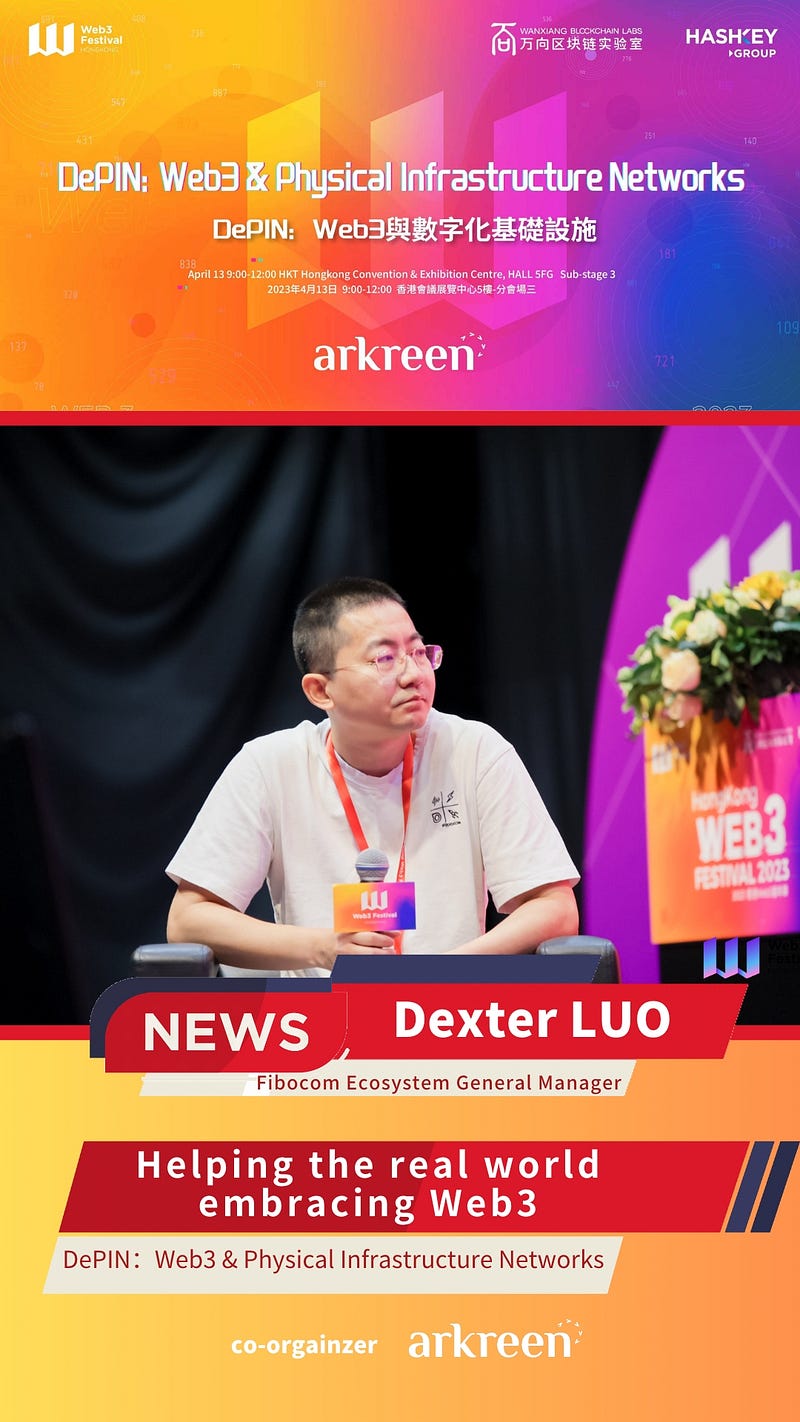
Dexter LUO (host): I am host Dexter LUO from Fibocom. We are a company that continuously focuses on providing IoT solutions. Simply put, we are the “N” in the DePIN, which stands for the infrastructure network. I will now pass on the valuable time to our four very important speakers. As a network builder veteran and a new player in Web3, I am very grateful for this opportunity to represent everyone and ask many questions to our four experts and teachers. I also welcome everyone to cherish this opportunity to learn. Now, may our four guests please introduce themselves and their respective companies.
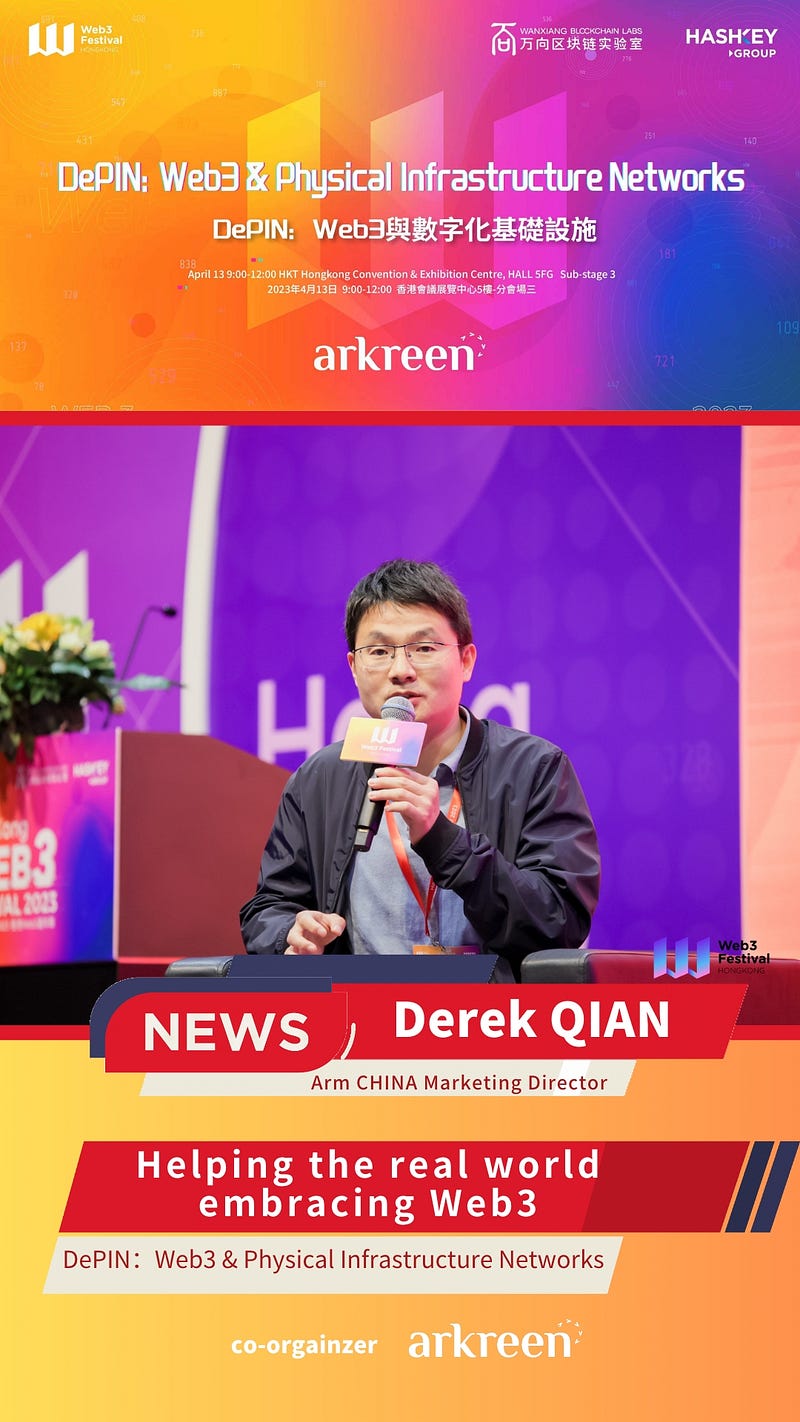
Derek QIAN: It’s an honor to participate in today’s Web3 DePIN event. I’m Derek QIAN and I’m responsible for marketing and ecosystem-related business at Arm CHINA. This includes broad cooperation with internet companies and the expansion of the Arm IP product ecosystem. Arm is not just hardware, but it involves the entire semiconductor industry. Arm is located at the upstream of the hardware industry and is a provider of IP. Many devices are based on Arm devices to a greater or lesser extent, and we may have a lot of connection with the DePIN project in the future. We are also exploring how Arm’s technologies can support the development of DePIN technology, and we hope to have better discussions and cooperation in the future.
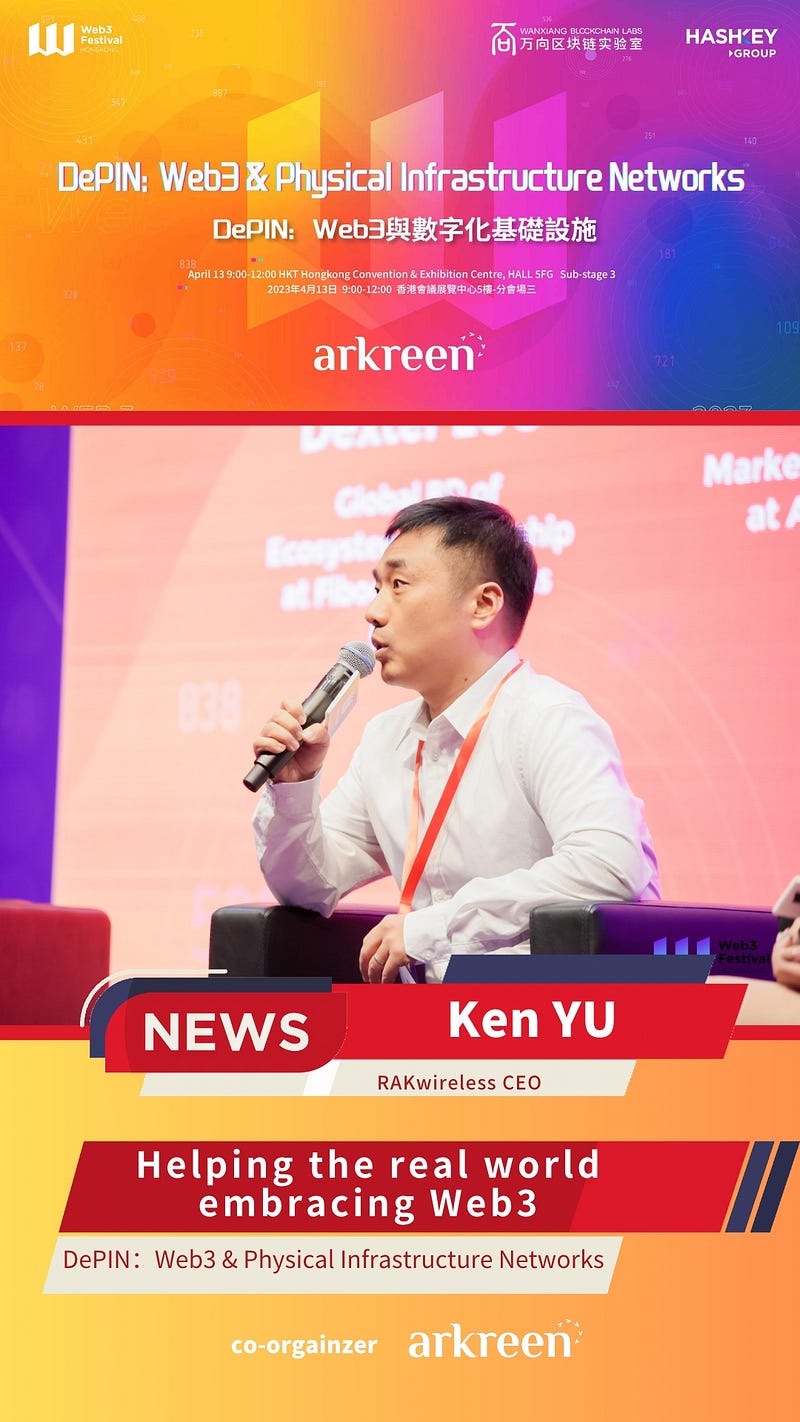
Ken YU: Hello everyone, I’m from RAKwireless. We entered Web3 mainly because of Helium. We were originally a manufacturer for Helium OG. As a company focused on the construction and production of IoT communication networks and hardware products, we are very pleased to be here today and have the opportunity to discuss with everyone. Thank you.
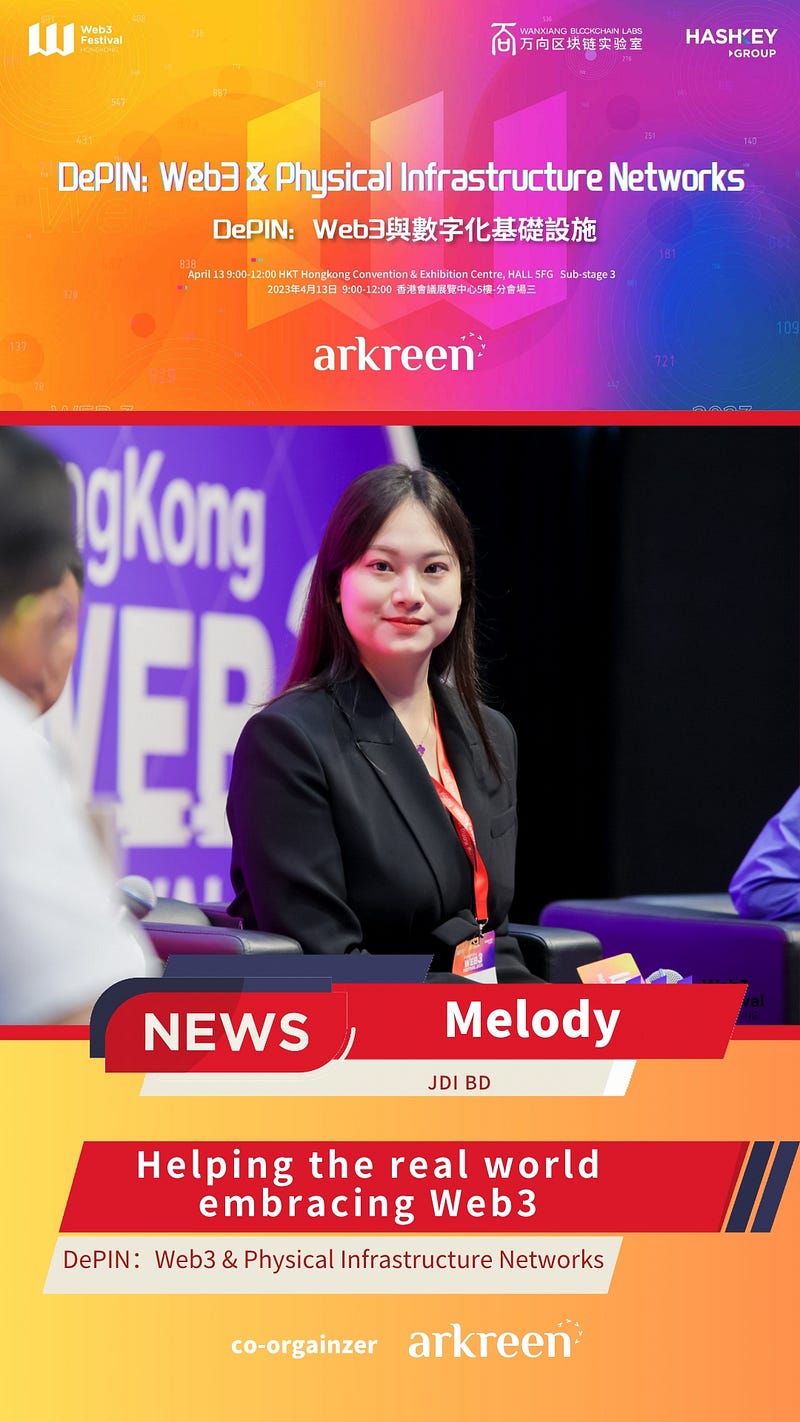
Melody: Hello everyone, my name is Melody and I am currently serving at JDI as the Hong Kong representative responsible for market development and investment in the Asia-Pacific region. Let me briefly introduce the company I work for, JDI. Since its establishment in 2019, JDI has achieved significant success in the cryptocurrency industry. Over the past three years, JDI has accumulated rich experience in providing services to the Helium community. Bobber has provided Helium with over 400K hotspots, and we will apply this experience to more projects. Today, our collaboration with DIMO and Wicrypt is constantly exploring the development of decentralized wireless networks. As we continue to develop new hardware with DIMO, we are proud of our achievements, but we also know that there is still a long way to go. Our vision is to bring more change and value to DePIN and Web3 through high-quality hardware and partnerships.
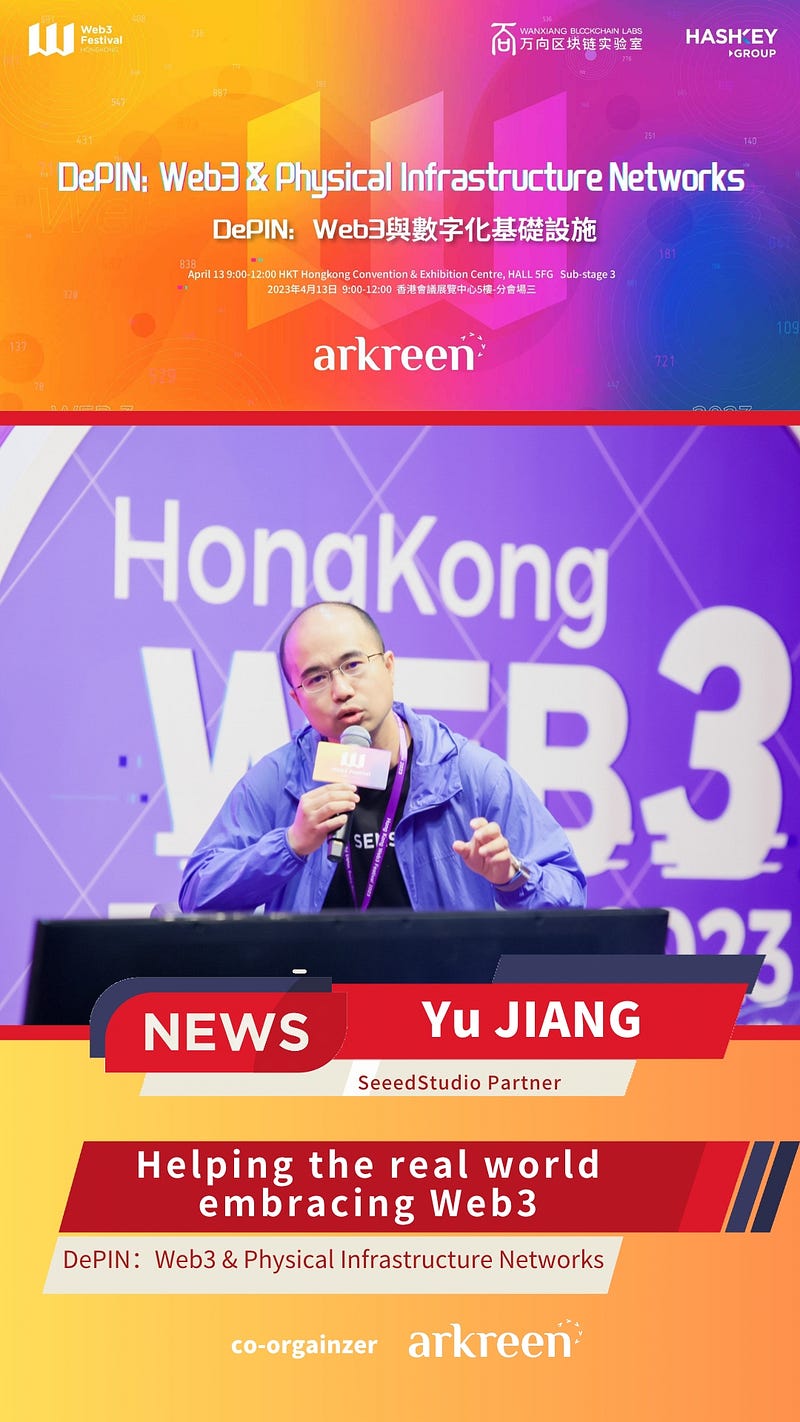
Yu JIANG:Hello everyone, I’m Yu JIANG from SeeedStudio. Over the past 15 years, we have been rooted in open-source hardware, providing one-stop IoT solutions for innovators in the IoT industry and digital transformation departments of Fortune 500 companies worldwide. Our relationship with the Web3 world also started with Helium. We started with Helium connectivity, then worked on IoT sensor collaborations with WeatherXM, and later collaborated with decentralized storage and computing platform Flux. We gradually got to know more friends in the DePIN field and hope to exchange more experiences with everyone. Thank you.
Dexter LUO (host): Very good. Just now, all four of our guests as enablers have had many great project attempts. Many of you mentioned a few keywords, one of which is “hardware”. We come from DePIN, a real and reachable world, but how can we truly integrate this world with Web3? In terms of hardware production, design, and manufacturing, do any of you have any experience to share? Are there any specific cases that you can share with everyone? Let’s first ask Ken.
Ken YU: In hardware manufacturing, the key is still in what you are good at. I was fortunate to come into contact with DePIN in infrastructure, starting from LoRa to Helium, including WiFi, but actually, the focus of each networking technology is different. For example, in 5G, the know-how of the base station is very deep. So if you can focus on what you are good at and provide good products, while also dealing with the good crypto cycle, this is a problem that hardware manufacturers must solve.
Melody: JDI is currently working closely with DIMO and Wicrypt to jointly promote the development of the DePIN projects. These two projects will have a profound impact on the Web3 ecosystem.
The DIMO project opens up a completely new path for the automotive industry by decentralizing vehicle data. Currently, nearly 10,000 cars are connected to the DIMO network, covering nearly 70 common brands. The DIMO token ($DIMO) has successfully listed on Coinbase, further increasing the project’s liquidity and attention. DIMO uses blockchain technology to allow car owners to have complete control over their vehicle data, opening up new business models, including smart insurance, vehicle health monitoring, and car sharing.
Wicrypt focuses on building a global decentralized internet access network, using innovative blockchain technology to ensure the security, privacy, and autonomy of user data. Wicrypt’s decentralized network allows users to freely access the internet worldwide while also having complete control over their data, providing a solid infrastructure for the Web3 ecosystem.
Through cooperation with DIMO and Wicrypt, JDI has helped build a more stable, secure, and efficient decentralized network infrastructure. This will further promote the development of Web3 technology, allowing more people to benefit from it and providing a more transparent, autonomous, and free internet environment for the real world.
Yu JIANG: Just now, Ken mentioned that because hardware is not something that one company can do everything for, so you need to focus on doing what you are good at. In terms of sensors, we mainly focus on outdoor sensors that are harsh on the environment, such as weather stations. WeatherXM is a decentralized global weather infrastructure. In order to make the data accurate, we have built the high-speed wind tunnel in the South China region to calibrate each factory’s weather station, with the goal of making the sensor data real, accurate, and effective, and able to serve various industries that require this accurate data, such as insurance and agriculture.
At the same time, as a company that has been rooted in edge computing for more than two years, we not only provide basic hardware but also provide supporting software that goes beyond hardware. For example, the Flux project, which initially rooted in geeks, and many people who joined the Flux project needed to be proficient in Linux. Based on our hardware, we provide a software experience that goes beyond hardware, allowing ordinary consumers to also apply such hardware, thereby lowering the threshold for the DePIN project and allowing more people to participate. These are some of our experiences.
Dexter LUO (host): Everyone has raised some great points, covering many aspects of daily life in the real world, such as transportation and environmental monitoring. I have some specific questions. RAKwireless has been involved in the actual DePIN project for quite some time. You mentioned how to integrate hardware manufacturing with token economy or coordinate them well. Have you encountered any problems in this area before, and how did you solve them? This information can be helpful for other DePIN projects in the future.
Ken YU: Actually, we started working with Helium at the beginning of the crypto cycle when it was just starting to rise. By 2022, the whole crypto trend was going down, so there was a lot of pressure on the supply chain. The crypto price was dropping very quickly, but the supply chain needed to be prepared for three months in advance. How do you deal with the rapid decline in crypto prices to address a three-month supply chain? This is a challenge. As a hardware manufacturer, if you look at NVIDIA’s financial report, the growth curve is very interesting. They are actually using one year’s profit to fund the next three years. In other words, the money earned this year is not for this year’s benefit, but for leverage in the future. This is also addressing the whole supply chain cycle.
During this cycle, you need to focus on what you are doing. You can have both crypto and non-crypto projects and strike a good balance. Second, it may also be a learning experience, and next time we will have more experience. During NVIDIA’s financial report growth cycle bull market, compared to the previous cycle, they have also made a lot of improvements themselves. So perhaps we can handle this kind of situation even better in the future.
Dexter LUO (Host): I understand that creating a Token can be done quickly, but developing a scalable commercial hardware product requires a certain amount of time. There are significant challenges involved in getting everything to match up properly. It’s very interesting. The second question is for Melody. JDI is involved in many different DePIN projects, including communication and intelligent transportation. In the future, with the direction of Web3, which involves the integration of Web3 and the physical world, what are your plans and strategies for the DePIN direction?
Melody: JDI’s future plans are to continue to innovate and optimize our devices. We are also collaborating with DIMO to jointly develop some stable and high-quality projects. Currently, the token we are collaborating on with DIMO has been listed on Coinbase, which has improved the promotion and liquidity of the project. In addition, we have had three years of social service experience in cooperation with Helium, reaching 60,000 community users. Using this experience, we will collaborate with more projects to make the decentralized network more powerful, and promote the development of the entire Web3 and DePIN projects, committed to moving forward in this area.
Since we believe in “actions speak louder than words”, we will provide high-quality hardware for everyone in the DePIN and Web3 environment and social ecosystem. Our vision is to contribute to the development of blockchain decentralization through high-quality hardware and cooperative relationships. We also believe that the decentralized network environment will play a significant role in the future, bringing greater value to our society and individuals. Therefore, JDI is also committed to the entire society, making the real world better embrace the Web3 environment.
Dexter LUO (host): Thank you very much. One sentence really struck a chord with me, which is that we must take action. JIANG has not only taken action and put his ideas into practice in hardware research and development, but also has a lot of experience in designing over a thousand hardware products and projects. Regarding hardware production design for DePIN and non-DePIN projects, what design experience do you have for these product categories? And what are the similarities and differences in business processes or ecosystem construction that can allow experience from non-DePIN projects to be successfully applied to DePIN projects?
Yu JIANG: First of all, the primary contrast in the storyline of DePIN, as opposed to previous hardware we’ve encountered, is the distinction in target audiences, catering to both enterprises and end consumers. For example, Helium. Helium’s essence is to build a base station. In the past, base station builders were telco operators with professional teams who built the iron towers and were maintained by professional teams. But today, we use a decentralized approach, and who builds this network? It’s ordinary people.
There is a huge difference between a professional team and ordinary people, so from a hardware perspective, first of all, your hardware not only needs to achieve performance and parameter indicators, but more importantly, it should be easy for ordinary people to use. This is the first step. Secondly, we need to leverage the power of the community, especially in our DePIN community, where there are many enthusiastic volunteers. Many of the people who joined the project in the early stages were geeks who knew technology well. They can drive the community to set up and maintain the process well, and we need to give them more authorization, rely on them, and do it through DAO. The audience is different.
Secondly, when talking about Web3, we have to talk about security. Today, the safest thing we have is the bank card in the Web2 world, and the cold wallet in the Web3 world. For example, Arm, many security chips are based on Arm’s S series. But when it comes to security in DePIN, in my opinion, it not only refers to the security of the hardware itself and the security of the private key, but more importantly, our hardware itself can support its POX together with the project. This “X” can be POC, or it can be prove of location, but our hardware itself needs some professional design and mechanism to better support the infrastructure to operate safely and stably.
Thirdly, a very big difference between DePIN projects and non-DePIN projects is that non-DePIN projects are basically case by case. Project A or B will not be related to each other, and what A company and B company do are their own business. But DePIN projects are particularly prone to generating mutual links and interactions between projects. For example, when WeatherXM started its project, it did not use Helium’s network, but a P2P network. It depended on a gateway at home, and thus the farthest range of the weather station deployment is usually within a 200-meter radius.
This creates two problems. First, it limits the deployment of weather stations, and many valuable places cannot be deployed. Second, an unavoidable issue is that a small number of bad actors may be gaming, and they may have bought 100 weather stations in their homes. You cannot prove their location because there is no GPS coverage indoor.
By connecting to the Helium network, the weather station can be deployed at more valuable locations through the long-distance, low-power transmission methods. Secondly, the Helium gateway, as Dr. Xiao Feng mentioned, is a stable and trustworthy facility for proof-of-coverage, I can indirectly verify that a location is correct and genuine based on the packets received from the gateway. This can greatly assist in the smooth operation of the project.
Thirdly, the field of Web3 is still relatively avant-garde. There is a certain correlation and overlap between people and projects. By bringing these projects together, they can help each other grow. This is another unique aspect.
Dexter LUO (Host): As a “primary school student” of Web3, I just remembered four points that JIANG mentioned earlier. Firstly, for users, user experience should be good because hardware is more than just a hard box. For consumers, it should be easy to use and maintain. Secondly, the power of the community. Thirdly, there must be a guaranteed level of security, which must be safe and reliable. Fourthly, it is very interesting that there is a certain degree of reuse. We have encountered many projects and found common economic models or reusable parts in the hardware product form of the DePIN project. As a common cornerstone of our ecosystem, Arm is basically the part that all enablers reuse. The IP provided by Arm and downstream chip industries are all applications that we need.
May I ask Derek? Just now we mentioned a lot of DePIN’s business directions and application scenarios. We know that directions like ChatGPT and AIGC are very popular, and these demands have enormous requirements for computing power. Earlier, a guest also mentioned how to build a computing network or a distributed computing network. If you were to undertake a distributed computing project for DePIN, what approach would you take from your perspective?
Derek QIAN: Thank you. Artificial intelligence is indeed very popular, and I believe it will play a big role in blockchain applications and Web3 applications. I will talk about three aspects: first, how to design the project itself; second, whether the designed thing is feasible; and finally, some of my own thoughts and suggestions.
Firstly, ChatGPT and AIGC are the applications of large models. It is basically divided into two levels, one is training, and the other is inference. As you all know, the large models now require a lot of parameters, more than 170 billion. Therefore, in terms of computing power, it requires even tens of thousands of NVIDIA’s high-performance cards, which cannot be afforded by individuals or small organizations. Therefore, artificial intelligence, especially the training part of large models, should still be handled by large institutions. But this does not mean that our DePIN project cannot land in this field. Instead, we can still design a lot in inference.
I was chatting with a friend. He said he bought a PC for his son, which is very expensive, more than 3,000 USD, and uses a high-end NVIDIA4090Ti graphics card. But will he use it all the time? The time he uses it may be very short. For individuals, this is actually a waste. Because our DePIN is a decentralized physical infrastructure, our first idea is to use the idle resources of the PC users’ cards. How to use the resources can refer to Helium’s project. Helium uses LoRa protocol devices to a certain extent to revitalize them, and we can also revitalize these devices, design a new protocol, and build a public chain, so that all users can participate. Now that 5G is popular, transmission may also play a role in promoting it. In terms of feasibility, there will be a certain degree of solution in both the collection of computing power and the transmission delay.
In addition, Web3 pays great attention to the participation of individual users. In terms of distribution, not only platforms but also user participation should have benefits. If there is a public blockchain, issuing corresponding tokens will encourage users to connect their devices to the network.
How to design it? In short, design a reasonable public blockchain for idle devices so that everyone is willing to participate. After you finish playing games, do not turn the PC off, consuming a little electricity, and finally get some considerable income. This design is basically based on the method of Helium, but it may be necessary to design a new protocol and a new chain to manage these devices.
The second question is whether it is feasible or not. Protocol interconnecting is difficult. NVIDIA NVLink is a very high-speed and low-latency protocol. In terms of inference, its data volume is much larger than the computational power and bandwidth required by our IoT devices. It’s feasible via 5G, but in actual operation, it may not achieve the desired results. Another issue is scalability, especially when the model is split into multiple parts to execute on multiple PCs. What will happen when it was nighttime and the owner don’t want to keep it on because it’s too noisy. During the process, when it was nighttime and the owner didn’t want to keep it on because it was too noisy. So scalability may still be a problem, and I believe that it may not be as easy to solve as with IoT devices at this stage, so feasibility may be an issue.
From Arm’s perspective, we certainly hope that more computing devices can be better deployed, and Arm will also be the most suitable device for deployment, from servers to the IoT field, there will be more deployments. People have their own approach, and we believe that if it goes on, security will be a major concern. Now, everyone is talking about Layer 2 stuff, and to be honest, it may ultimately involve how to bring data back to the level of Layer 1. Traditional security algorithms may not meet the requirements, and the final solution may need to be a secure computing model that combines basic computing power.
That is to say, you can use distributed CPUs and other things to provide public blockchain computing power while adding an algorithm for running privacy computing next to it to form a comprehensive hardware platform. My suggestion is to create a new form of hardware computing that may meet our distributed computing scenarios. Because Arm has been expanding its scenarios in recent years, from mobile to server CPUs. In terms of Web3 applications, we may need to design from the top level and create a distributed hardware model that is suitable for Web3, at least with two components: CPUs that provide basic computing power and the fusion of privacy computing. To ensure data security, a reasonable blockchain should also be designed on top of it to perform distributed processing.
Of course, there is also a bit of self-promotion involved, hoping that everyone can do more innovation based on the Arm platform.
Dexter LUO (Host): Thank you very much. I asked a relatively open-ended question on a whim, but Derek gave a very detailed answer. After the meeting, I will briefly summarize it and it feels like we have completed a DePIN project’s BP. I’m curious if there is such a distributed DePIN project that can be used as a reference for everyone. If not, we can discuss this issue in depth later.
The last question, as a pioneer in the DePIN enabler ecosystem, you not only have a lot of project experience, but also from a practical perspective, will DePIN really change something or truly improve benefits?For example, the efficiency of real-world operation, the community, or developers. This question is quite broad, as we are all experienced and practitioners, please share your thoughts.
Ken YU: Like any other technology, DePIN is about what we ourselves want to do and what benefits people can get. When we talked to Helium, they also said that their current focus is on how to use the network, and if you buy data using HNT, its value will actually be higher than Bitcoin. So at this time, we can’t do much in the market, but we can drive use cases on top of this network, and there may be a lot we can do in this area. For example, we and JIANG have some agricultural projects, including building automation. Whether you are running an enterprise network or a Web3 network, you have to run these applications, so the focus should be on the application, which is the real benefit. Technology just increases your adoption rate.
Yu JIANG: During the three years of the pandemic, I actually had no way to experience the Helium network. In October of last year, two things had a great impact on me during my trip to the United States.
First, it was my first time going to the top floor of a Wall Street building. I had never been to such a financial company before. The company sold insurance and needed to deploy sensors in remote areas to prove that an incident was natural rather than human-caused during claims processing. He said that there was no network coverage in the wild, so I opened the Helium map and found coverage there. This is what Helium did in poorly covered areas in the real world.
Second, I put sensors in the trunk of the rental car from the moment I got off the plane, driving through four or five states from the east to the west.. The maps with signal coverage were all drawn out. The Helium network in Europe and the United States has now achieved realistic coverage on a large scale and the coverage is quite good.
Four or five years ago, one of the world’s top three express delivery companies came to us and said that they needed to monitor the entire process of transporting the written exam paper from China or other countries back to the United States or the United Kingdom for grading by a US English test agency. This was previously impossible as trackers cannot cross all countries. Now, with Helium’s help, everything is connected from the Americas to Europe. This is an improvement. In addition, from another perspective, in the field of low-power and wide-area networks, Helium may have created the only network that can be connected globally. This is also an innovation and an improvement.
Dexter LUO (host): Thank you for sharing with us. After listening to the specific business scenarios today, it was discovered that DePIN is not purely about creating something from the perspective of token incentives, but rather it began with ideals and ended with usefulness. This was evident in Ken’s mention of how Helium’s fees for operators are cheaper than traditional licenses, and in JIANG’s introduction of how sensors can be used with corresponding infrastructure anywhere. This concludes our interactive session for today’s topic. Behind our exhibition hall, we have booths for companies involved in the discussion, some of which have physical products. We welcome you to come and discuss with us after the event and participate in the construction of DePIN. The roundtable discussion concludes here. Thank you to our four guests!
By Arkreen on April 20, 2023.