Hong Kong Web3 Festival Day 2 | DePIN Builders’ Panel: Build for the next bull narrative

Updates on Sub-stage 3:DePIN- Web3 & Physical Infrastructure Networks
Hong Kong Web3 Festival Day 2 | DePIN Builders’ Panel: Build for the next bull narrative
Updates on Sub-stage 3:DePIN- Web3 & Physical Infrastructure Networks

Host: Thank you. Next, we will have a panel discussion composed of the major builders of DePIN: Build for the next bull narrative, building the next bull market narrative together. Today, we are fortunate to have Patty Tu, Sr.Director of Wanxiang Blockchain, as our moderator, along with:
- · Laser Ding, partner of arkreen
- · Yifan Wang, co-founder of Geodnet
- · Sherlock Shi, CEO of Meson Network
- · Jeff Yee, CEO of Airwaive
- · Charles Yan, technical advisor of Compower
- · Daniel Leon, Head of strategic alliances & partnership of Protocol Lab
They will jointly explore how to lay the foundation for the next bull market. Please welcome our guests to the stage.
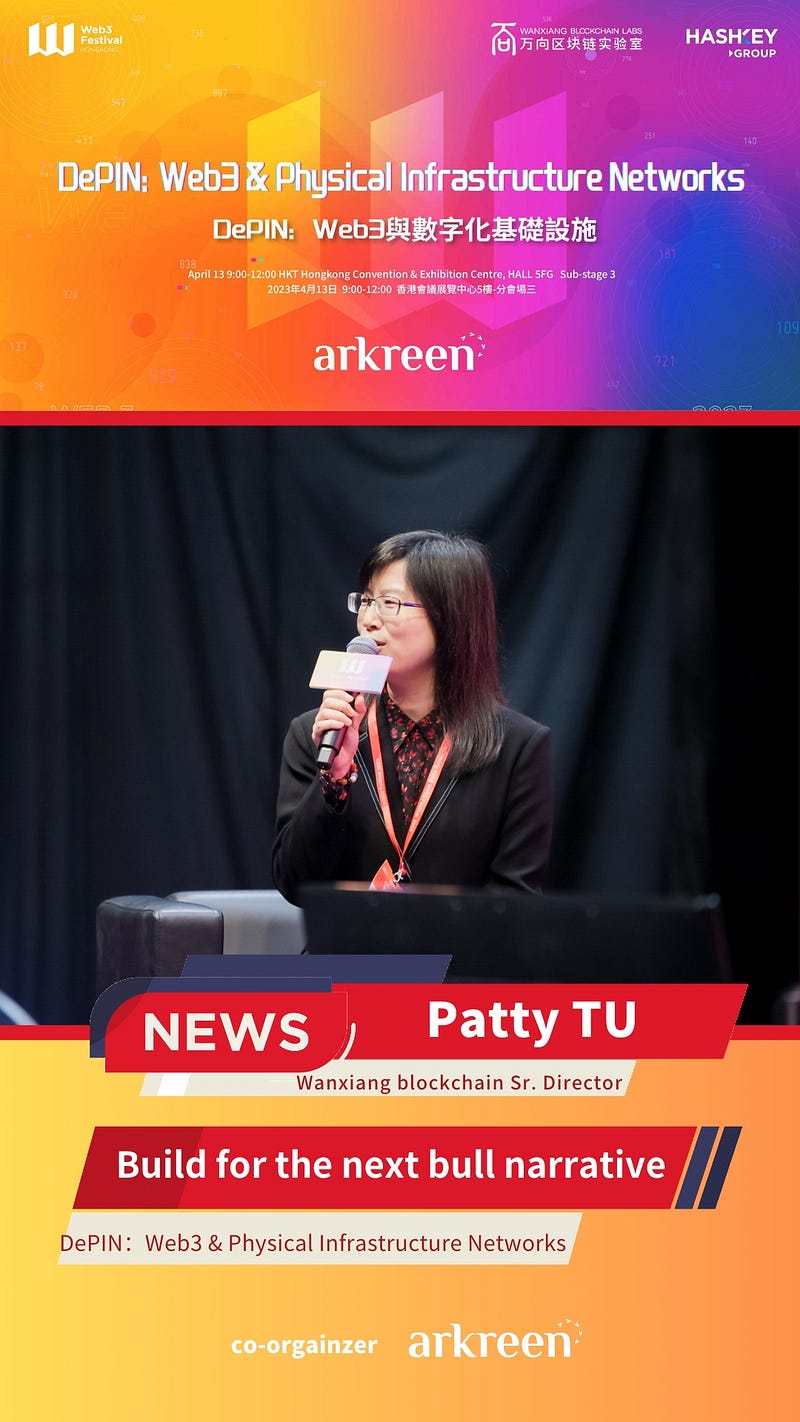
Patty Tu (Host): Hello everyone, I’m Patty Tu from Shanghai Wanxiang Blockchain. I am part of the team based in Shanghai, and we mainly provide blockchain technology services and system solutions for various industries. Most of our applications are related to hardware and real-world assets. Today, I am delighted to host this DePIN panel. As you may have heard, DePIN stands for Decentralized Physical Infrastructure Network, which usually consists of two parts: a distributed hardware network and a backend network supported by blockchain. We are honored to have six senior industry practitioners in the DePIN field to share their insights on this new track. Before I start a very interesting question list, allow me to invite all guests to give a brief introduction of themselves and their DePIN experience and projects. Let’s start with Laser, followed by Yifan, and then in seat order.
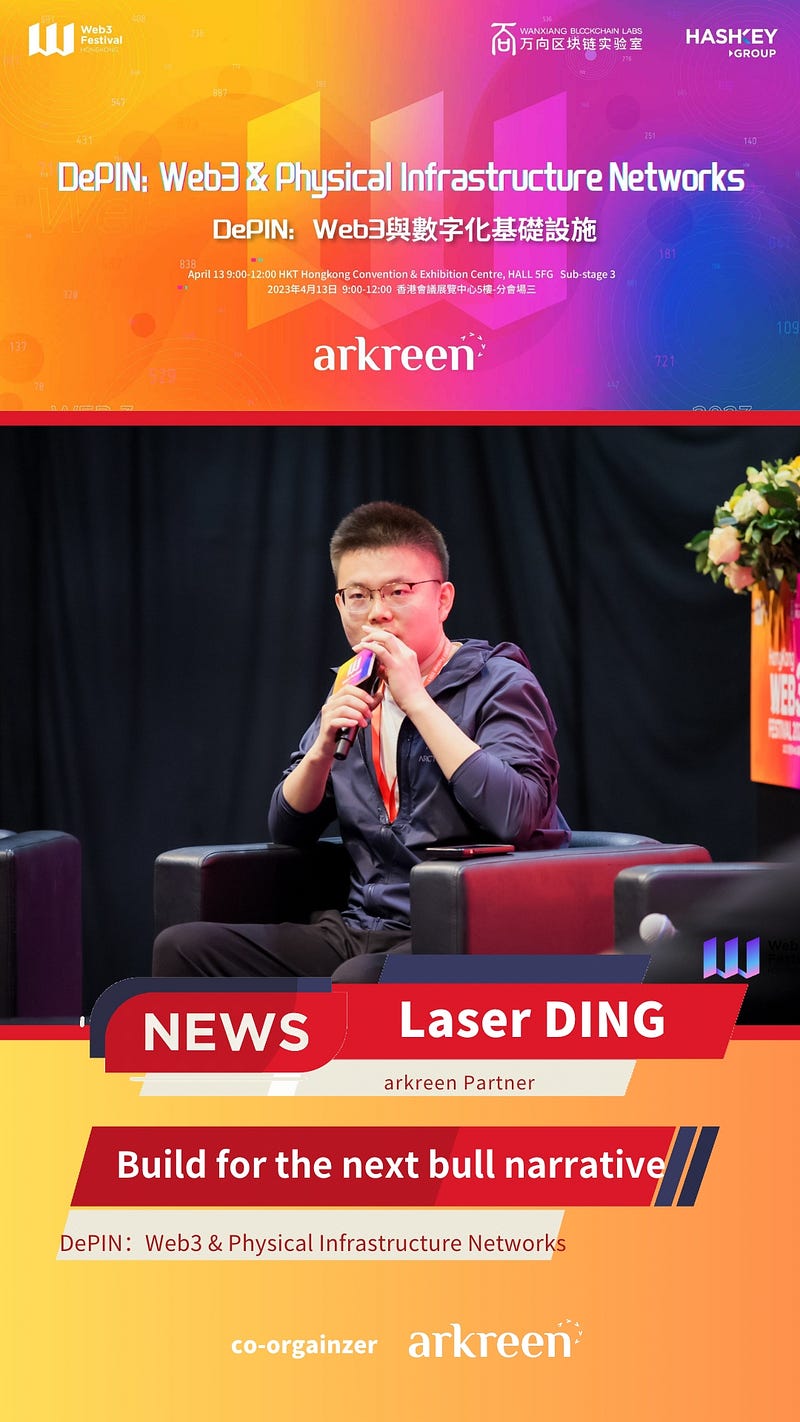
Laser Ding: Thank you, Patty. arkreen is a global energy data network builder, and we hope to establish connectivity among different energy devices, especially in renewable energy, to achieve interconnectivities among energy data for carbon neutrality. The data we collect can be converted into green certificates, with a global market size of approximately $10 billion. We mainly focus on the home scenario, using the DePIN economic model to achieve the interconnecitivities of clean energy use and data management.
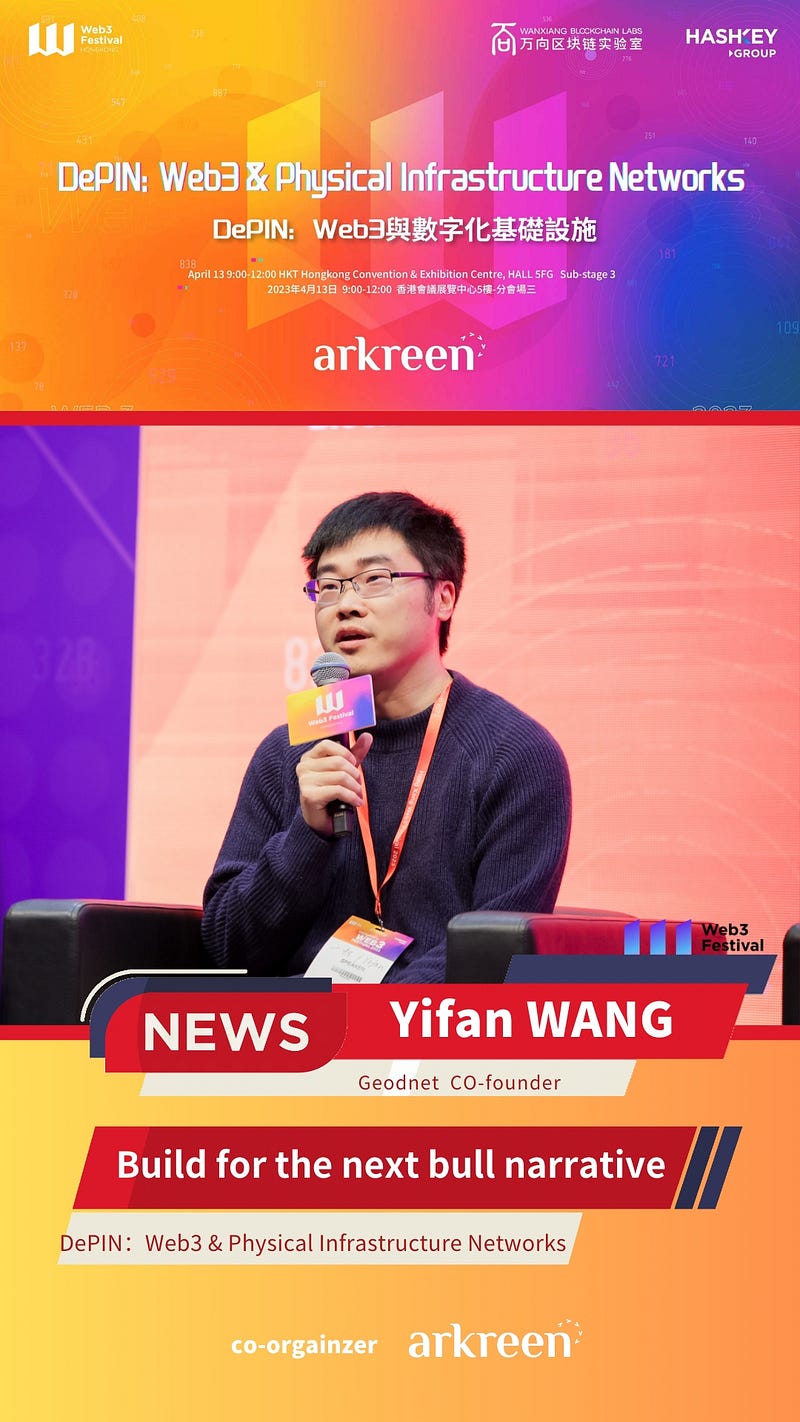
Yifan Wang: I am the technical director of Geodnet. Our network is a GPS reference station, and after processing GPS signals, we can provide users with more accurate GPS location information. There are many applications, such as agriculture, construction, transportation, and other industries, that may require centimeter-level accuracy. Our goal is to build a global high-precision GPS reference network, and by the end of this year, we hope to become the largest GNSS network in the world.
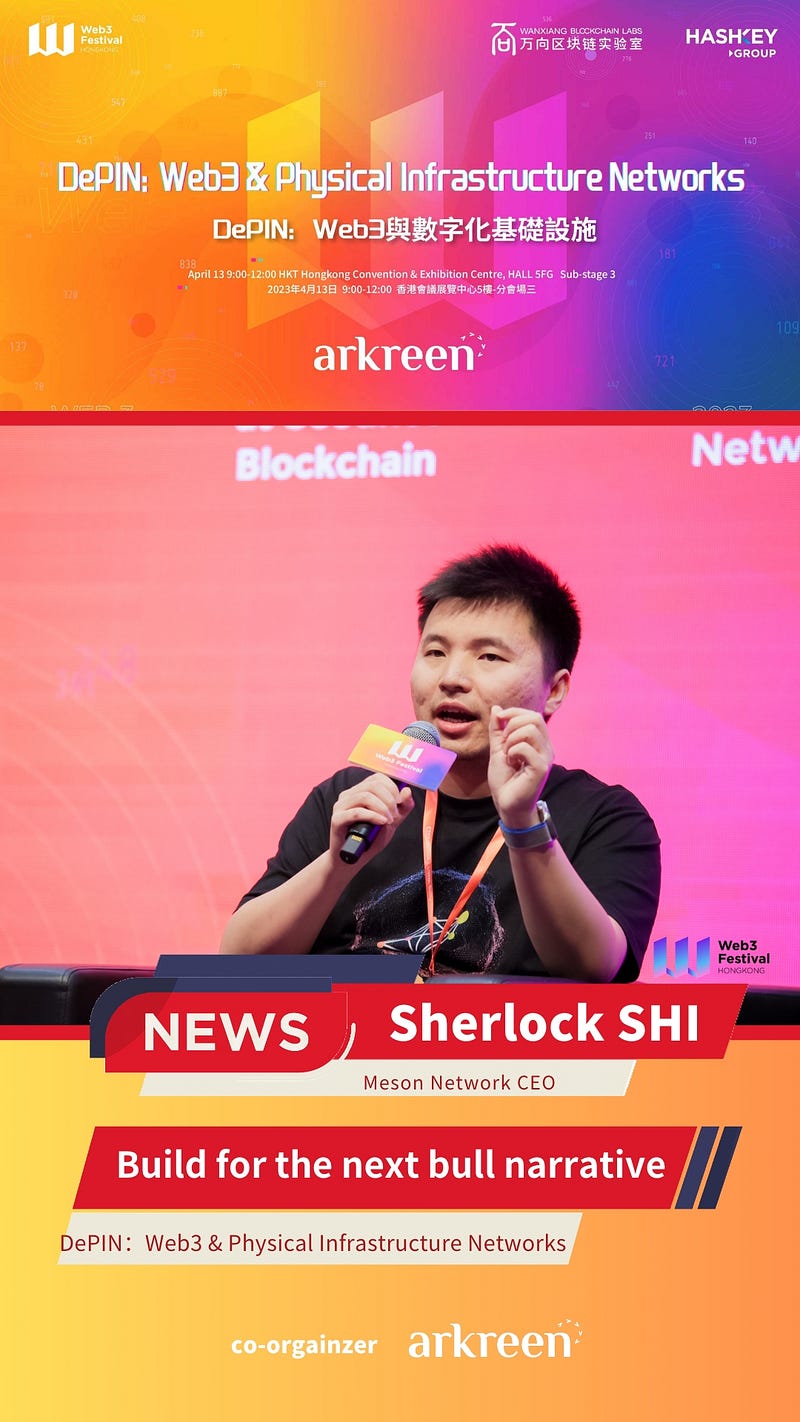
Sherlock Shi: I am CEO of Meson Network, and we are building a bandwidth market for the web3 world. We use tokens to incentivize users to aggregate bandwidth resources and provide services for the storage and streaming applications of the blockchain world. We are currently running a testnet, and you are welcome to visit our website and experience our services.
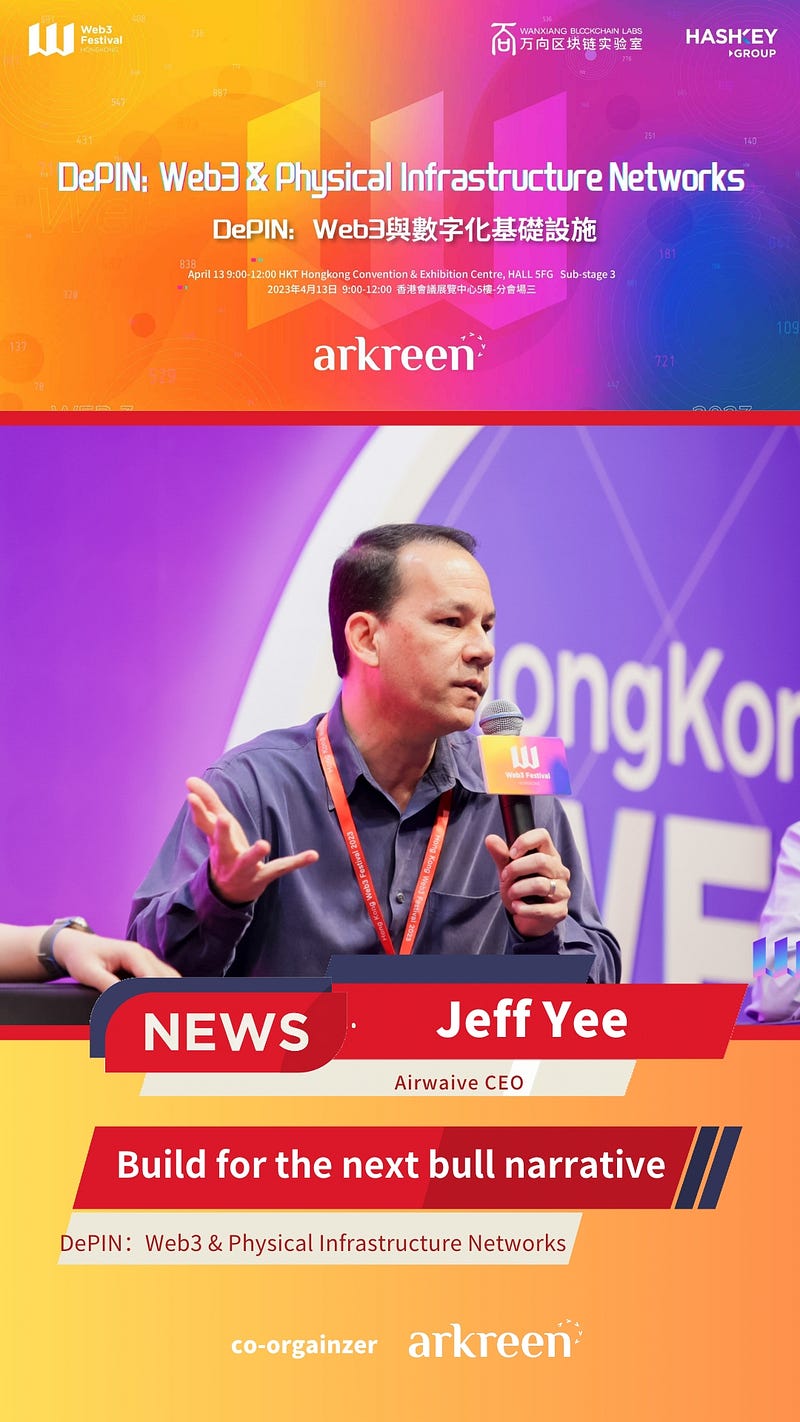
Jeff Yee: Hello everyone, I am CEO of Airwaive. We are a wireless infrastructure builder, aiming to help wireless operators interact and provide services on their websites, and we help them deploy wireless networks.
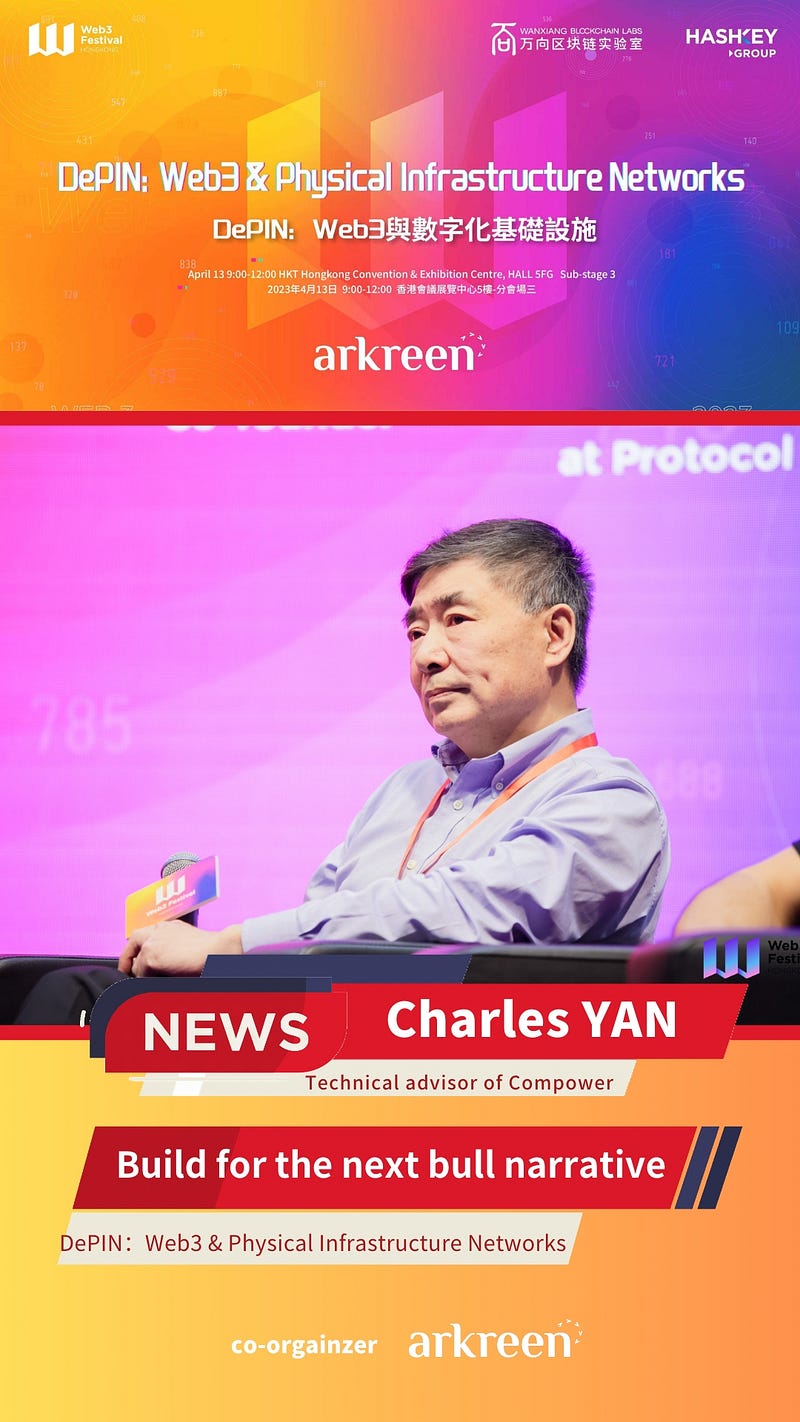
Charles Yan: My name is Charles Yan. The DePIN project I’m introducing is Compower Network, a distributed computing power network built through the DePIN method, providing customers with computing power as a public good, just like electricity utility. The electricity infrastructure is the core driving force of the physical world, and the computing power infrastructure is the core driving force of the digital world. In the early 20th century, almost a century ago, enterprises had to build their own power plants and operate, maintain and repair them, making the high cost of the electricity for enterprises and low service reliability, and consequently cannot meet production requirements. At that time, there were dozens of different voltages and frequencies in the entire electricity infrastructure, and one electrical appliance had to have dozens of models. Today’s computing power infrastructure is similar to the electricity infrastructure of 100 years ago. Enterprises do not have standardized computing power public goods available, and they are usually forced to use multiple computing solutions, from self-built physical computers/networks to virtual machines on public cloud and so on. Regardless of the industry, customers must maintain a highly skilled IT team to build, operate, maintain, repair, and support multiple computing systems, which is exhausting to meet production reliability requirements. Due to the lack of unified standards for multiple computing solutions, like electrical appliances one hundred years ago, applications cannot be built just once and deployed to arbitary computing nodes. Today’s computing power infrastructure, in particular, cannot meet the demand for edge computing and the data security requirements of ‘data localization laws.’ Compower has already realized the platform for building computing power as a public good infrastructure. Why does Compower consider using DePIN technology to build it? Because DePIN can help us accelerate the construction of the distributed computing power network infrastructure we mentioned, and with DePIN’s ‘zero friction’ mode, it makes the cost of computing power public goods even cheaper.
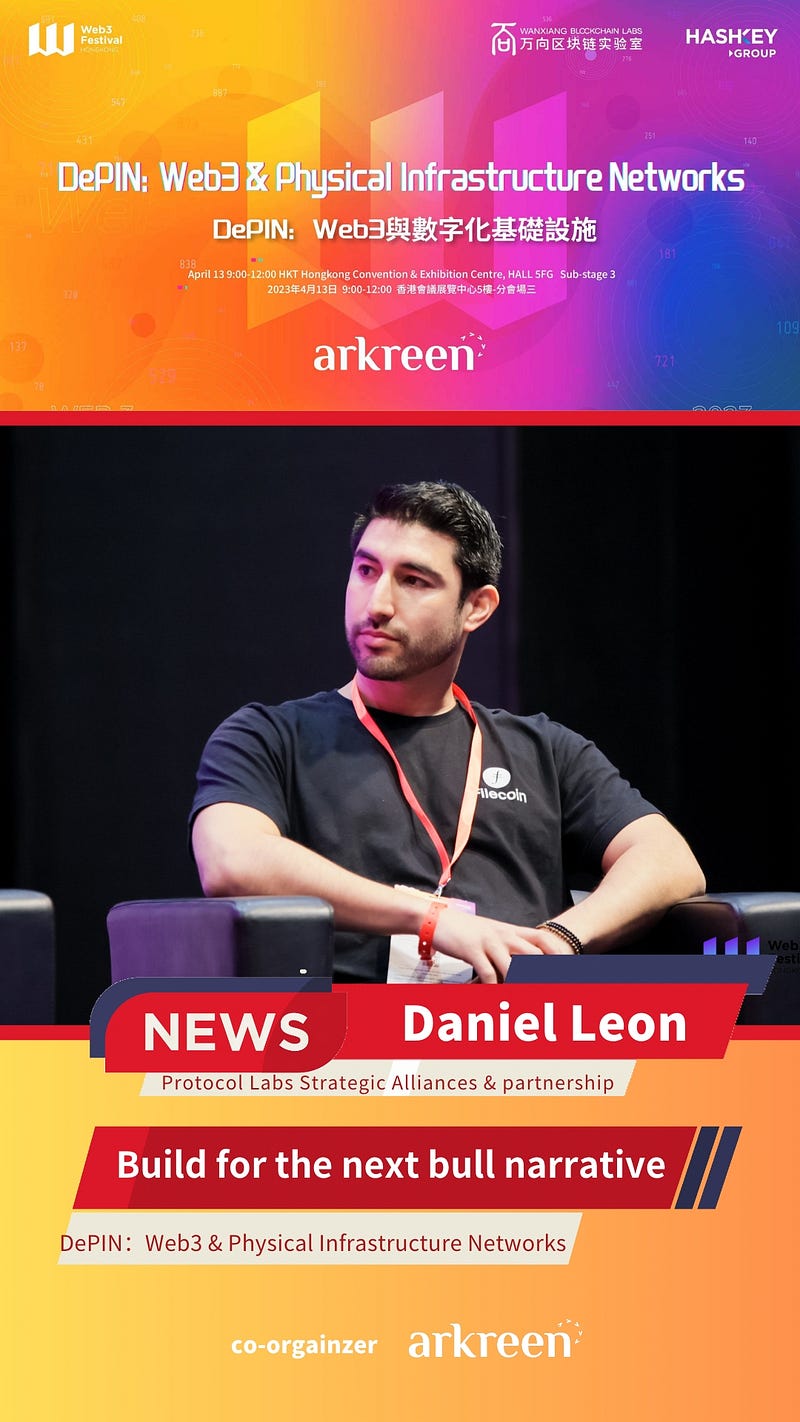
Daniel Leon: My name is Daniel, from Protocol Labs. We are a research and development laboratory, and we work closely with Filecoin network. Because Filecoin is currently the largest decentralized storage network in the world, we have about 3,800 storage service providers distributed in about 44 countries worldwide. I’m very happy to be here.
Patty Tu (Host): Thank you everyone. Today, we will be covering a lot of discussion topics in a very limited time. Let’s begin with the first question: “What are the most important advantages of DePIN applications?” First, we will hear from Yifan, followed by Charles.
Yifan Wang: Firstly, the network can be rapidly and massively deployed. As a small service provider, we already have over 3,000 miners working on our existing network, operating across multiple countries. So, geographical location is not a limitation for us. Secondly, as DePIN network is built using blockchain technology, there are already mature financial tool infrastructures available on the blockchain. These financial tools can be directly integrated into the DePIN network, and there are already established methods for doing so. For example, in our network, miners can be paid using our own tokens or other tokens. This is very convenient. Thirdly, due to the trend towards decentralization, there is less need for many service providers in between, which allows more people to participate directly and efficiently.
Charles Yan: For Compower, DePIN can help accelerate the construction of a distributed computing power network. Additionally, it can increase the profits of all participants and reduce the costs of computing power network users because its model is transparent, “zero-friction,” and “zero-exploitation.” There are no intermediaries, so profits can be maximized. For participants, they can also feel more comfortable participating directly in the project’s construction. Furthermore, I will provide two recent practical examples to illustrate the benefits of DePIN. You may have recently seen reports about Twitter’s core code being leaked on GitHub. GitHub is a centralized management and deployment platform, making it difficult to ensure the security of customer data and digital assets without deploying on a distributed computing power network like Compower in a DePIN way. The second example involves Tesla engineers sharing private videos and pictures recorded by Tesla owners’ cars within the company. Although Tesla’s car network is distributed, it was not constructed using DePIN, and there was no independent proof that Tesla employees could not access customer data, resulting in a serious privacy breach. Implementing DePIN using a distributed deployment and management method can maximize consumer protection and user security.
Patty Tu (host): Thank you both. Next question, “Please help explain how blockchain and tokens incentivize users to build the DePIN network?” Let’s start with Daniel, followed by Sherlock.
Daniel Leon: Last year, there were some turbulent events in cryptocurrencies and blockchain, which gave us more motivation to develop capacity, making our network more secure, and adding more hardware. This is what we have been working on for the past few years. The second step is to put this effective data into the network, compute and analyze it, and then issue FVM, which also requires blockchain technology to build.
Sherlock Shi: I have two points to share with you all. The first point is about why we use tokens. For the Internet products that have both the supply and demand sides, we need certain means to incentivize early adopters. Taking Uber as an example, it is a very good business model, and in the early days, they used cash incentives to invite more people to become Uber drivers and join the ride-hailing platform. Those who wanted to ride with Uber also received discounts. Before Uber dominated the market, they continued to consume a lot of cash as subsidies. However, this is relatively difficult for a startup, and most of them find it difficult to reserve enough funds to subsidize both sides of the market. Tokens can solve this problem by serving as an early realization carrier for the future network value, allowing many teams to incentivize users with their own project tokens instead of cash.
Secondly, there is a “chicken-egg” problem in matching supply and demand. Is it better to have a lot of Uber drivers first and then a lot of Uber passengers, or vice versa? The emergence of tokens can help decouple the matching of supply and demand in the time dimension. For example, in 2016, no one knew what Ether was or what demand it would have, and the Ethereum Foundation had no money. But the network could still run, nodes could still run, until people gradually discovered Ethereum’s use cases and generated a lot of demand in 2017.
The second point I want to share is about which user group should be covered by tokens on the supply side. From the perspective of resource aggregation, the advantage of token is covering those valuable users in the long tail who have not been properly incentivized. Take Meson as an example, medium-sized bandwidth resource providers have long been covered by salespeople in the Internet world. However, the weak point is the large number of users in the long tail, with low unit prices. It’s difficult to integrate with sales models. Meson provides a set of access standards that allow users to contribute their own resources to the network and receive tokens as incentives. In this process, users do not need to know a salesperson from a tech giant, or sign various contracts, they can complete the process themselves in less than 5 minutes. As this process gradually accumulates, the supply side will gradually attract some medium and large enterprise users to join, and the role of tokens in it will gradually shift from early incentives to a medium of resource transactions, capturing value from the demand side.
Patty Tu (host): Thank you both. The next question is, “What are the biggest challenges in creating the DePIN network when connecting the real world to the digital world? How can these challenges be overcome?” Jeff, please start first and then Laser can share further.
Jeff Yee: One challenge is physical in nature. It’s difficult for large publicly listed companies to directly use tokens to create a physical network, which addresses problems such as GPS sensing, power supply, interoperability, etc.. The second challenge is geographical location. Where to build an IoT network, electronic instruments, and so on. The third is interoperability. Network interoperability, such as how IoT devices communicate with the network. We are about to transition to 5G networks and other networks, which may introduce data transmission problems. How can we encourage institutions to join the ecosystem and how can we allow commercial companies to benefit more or reduce their costs through token economics models? These are the challenges we will face.
Laser Ding: Jeff’s insights were very helpful. Airwaive has already deployed in several locations worldwide. For arkreen, one challenge is regulation, as Sherlock mentioned earlier. Tokens are a fantastic tool, but they have some side effects. We don’t know how the regulation will develop. We see that regulatory development in the global arena is very different. Some people very welcome cryptocurrency. In addition, we need professionals to solve hardware issues and find the best suppliers, ensuring timely delivery. There are also some market challenges. For Web3.0 and Web2.0 users to enter the DePIN project, there are currently some obstacles. However, as the market develops, we will spend time educating our customers about the market so that they can eventually adopt our project. This could be a significant choice in Web3.0.
Patty Tu (host): Thank you! The theme of our panel today is “Build for the next bull narrative”. Let’s talk about how DePIN will develop in the coming years. I’d like to invite Sherlock and Yifan to share their thoughts.
Sherlock Shi: My answer is simple. All kinds of resources that can be standardized are worth innovating with a token incentive model. If it is a resource or facility that exists in the physical world, then it is worth promoting with the DePIN method.
Yifan Wang: I think it can be divided into short-term and long-term goals. In the short term, for most DePIN projects, the first goal in the next year or two is to expand and increase the scale. Once the scale is expanded, it will be ubiquitous. For example, with our GNSS service, we hope to achieve global deployment. By the end of this year, we hope to deploy more than 10,000 reference stations, and in the coming years, we may expand to 100,000. Secondly, we currently have three enterprise users who have subscribed to our data services, which is a good thing for us. But we hope to have more enterprise users in the future, especially in the construction, agriculture, and transportation industries. I think we can achieve our goals in the next few years. Looking at the long-term goals, with the help of AGI/AI, we are beginning to consider not only providing services to humans but also to robots with artificial intelligence. We need to consider how to incorporate AI robots into our protocol design and service network at the design stage. Finally, we are now operating critical infrastructure and physical facilities, so security is of paramount importance to us. How can we use blockchain technology to protect these physical infrastructure and ensure theirsecurity? Blockchain can ensure that data is transparent and tamper-proof. So, how can we use these attributes, including the advantages and attributes of blockchain, to ensure the security of these physical infrastructure in actual operation.
Patty Tu (host): With the help of many outstanding technologies like AI, excellent builders like you, and numerous co-builders connected by DePIN networks, we hope everyone can work together to make DePIN the next trend of the bull market. Next, let’s move on to the final question, “What advice do you have for those who aspire to innovate or start a business in the DePIN field?” Please share your thoughts, starting with Daniel:
Daniel Leon: Yes, we have different resources. If you visit our website, you can see that we have an open and public base station and channel, which enables us to cooperate with our ecosystem and the community. Recently, we launched a decentralized storage alliance that integrates the capabilities of suppliers like AMD. This system enables us to shorten the distance between Web2.0 and Web3.0. If anyone is interested, they can join our network and enter our ecosystem.
Charles Yan: My advice is to first select a PIN (Physical Infra Network) project with commercial value that can independently become a profitable business and then use DePIN technology to turn it into a DePIN project. In my opinion, DePIN is an accelerator that can help you speed up the construction of your PIN, increase its usage, and therefore increase its profits. During the Web3 Festival, I heard of a common problem, that the number of devices of a PIN is growing rapidly, but the usage with commercial value is relatively small. Compower’s PIN itself has been recognized by the market and customers and is a business with great commercial value and profitability. Compower will use DePIN technology to build a distributed computing power network that can provide computing power public goods services, and it will focus on incentivizing “builders” with target users while also encouraging participants who bring in users.
Jeff Yee: My advice, from the perspective of innovative enterprises, can be divided into two parts. The first part is suitable for all startup companies, even for Web3.0 enterprises, and is essential because it has a period of growth and development, but with this help, you can accelerate business development. Second, for small and medium-sized enterprises, they may have more innovative capabilities than large enterprises because they are market-sensitive, response very quickly, and turn direction very quickly. On the other hand, you also collaborate with partners to see which hardware can be plug-and-play. This is very important, and understanding your customer is also very important.
Sherlock Shi: My advice for those who are about to enter the DePIN industry is to pay attention to coordinating supply and demand and try to use models that can amplify network effects. Secondly, pay attention to exploring the demand side. For most Web3 projects, need to know when to find users, use networks, and pay for them, how and where the value of the network truly comes from.
Yifan Wang: For startup companies, I suggest you find the problem that you really care about, which may exist in physical or network space, but no matter what, find a pain-point and work hard to solve it. Through this method, you may find your first customer. For example, Geodnet is very concerned about the accuracy of GPS positioning because traditional GPS only provides a rough positioning, but it cannot achieve centimeter-level accuracy. We need centimeter-level accuracy, especially in fields like construction and agriculture, so we must spend time solving customers’ pain points.
Laser Ding: Yes. The opinions provided by everyone are very reasonable and rational. If you want to enter the DePIN industry, you must have the drive. My advice is “just do it!” Austin from Solana once said that DePIN is to traditional infrastructure while DeFi is to traditional finance. I think this statement is completely correct because DePIN provides a true paradigm shift, which is very important for us to build traditional infrastructure. I am pleased to see that there are not too many attendees today, which means that we have not missed a very important opportunity in the industry. So far, this is not a particularly popular topic, but it means that for everyone, this is an early opportunity, especially in Asia, because all DePIN projects require hardware support, and as long as you pay attention to the customer’s pain points, you can solve the problem.
Patty Tu (host): Thank you very much for everyone’s insightful and impressive sharing. I believe that everyone has learned a lot from it and has been deeply inspired. I also believe that everyone is full of expectations for the DePIN track. Time has passed quickly, let us end our session here, and look forward to further communication with everyone in the future. Thanks again, everyone!
By Arkreen on April 23, 2023.