DePIN in 2023: Dive into the DePIN Rabbit Hole

Here is the full text of Arkreen Talk “DePIN in 2023” twitter spaces discussion
DePIN in 2023: Dive into the DePIN Rabbit Hole
Here is the full text of Arkreen Talk “DePIN in 2023” twitter spaces discussion
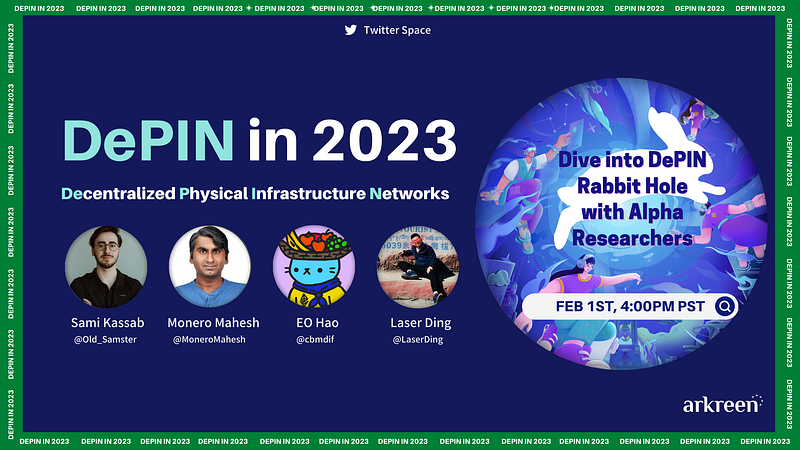
DePIN is the 1st rabbit hole by @arkreen_network and we are glad to have @Old_Samster from @MessariCrypto , @codeboymadif from @fmgroupxyz, @MoneroMahesh from @EV3ventures, and @LaserDing from arkreen shared their insights about DePIN future!

Hong Kong Web3 Festival 2023
The first global DePIN event will be hosted on 13th April in Hong Kong by HashKey/Arkreen. Builders, investors, and hardware manufacturers will join this event to promote DePIN with you! Feel free to join, and details can be found at the link: https://www.web3festival.org/hongkong2023/home?lang=en-US
If you are interested to discuss on stage or sponsoring this event, please feel free to contact us: [email protected]
(Below is the full text of “DePIN in 2023” )
Karl J. Weaver: Let me start off again by saying welcome everybody to DePIN 2023 dive, more like a deep dive into the DePIN rabbit hole with alpha researchers. My name is Karl Weaver, I’m your head of community growth here at the arkreen network. I’d like to start out, well, first of all, I would like to thank everybody here. But let me start by discussing maybe just a minute about our network. Arkreen network is a web3 enable data network for globally- distributed residential solar PV connection and monetization to boost a carbon neutral earth, and enabled by web3 economies, more crypto economy, and IoT and blockchain technology. Arkreen is building a network to economically collect distributed global energy generation data and convert that data into renewable energy certificates or credits for sale to anyone who wants to claim it for carbon neutrality.
In this first section, I would like to ask a brief intro for all four of our speakers today. so what i’d like to do is ask you one by one to give yourselves a brief intro, tell us about your story, your experiences and what you bring here into DePIN ecosystem and I will start with Sami Kassab, key DePIN researcher at Messari crypto. Sami good morning, maybe you can start by telling us a little bit about yourself.
Sami Kassab: Hey, Karl. yeah, thanks for having me. I’m an enterprise research analyst at Messari, I specialize mainly in physical infrastructure networks as well as bitcoin, but previously I was working as an airspace engineer and the commercial defense aerospace industry for about five years, so mainly focused on working on hardware on the design side of things. But you know when 2020 hit, I basically fell down the crypto rabbit hole, got really into bitcoin and then you know discover the other opportunity out there. I ended up finding helium and helium really caught my attention because during 2020 this was around the time where you know, their network was growing at a pretty rapid rate and what kind of clicked for me was that you could use the same, basically incentive mechanisms that we’re working you know for DeFi, for coordinating DAO and what not, you could use those same incentive mechanisms to you know to coordinate and incentivize people in the real world to build like physical networks. And so once I kind of realized that I started looking around at more storage networks and then I saw what was being built with these sensor networks like HiveMapper and DIMO and you know my conviction just started growing with the space. Now I pretty much focus full time on what we’re calling DePIN so decentralized physical infrastructure networks. and yeah, I mean, the space is growing at a pretty rapid rate. That’s kind of a little bit about me.
Karl J. Weaver: You got in on the ground floor. Fantastic. I would like to ask Mahesh Monero or should I just refer to you as Mahesh. Mahesh, good morning. Maybe you can tell us a little bit about EV3 and about what you’re doing now.
Monero Mahesh: Hey, what’s going on guys, yeah, happy to be here and I appreciate you guys pulling all this together. And I think at the end of the day, coordination in the space is going to be so important as time goes on and as markets continue to stay tough, but thankfully, it’s a great group of people and very exciting space. So you know just give a brief introduction. I’ve been an investor for my whole life, which you know I broadly define as seeing as making good probabilistic decisions with limited information and you know historically I think I came about it from a different lens, which was that I saw investing as like really driving societal change and over the last like 30 years, capital markets have gotten so stronger, which lets investing become less structured as a discipline and that combined with you know the scale of the technology and the ability to build businesses that reach entire populations as opposed to just countries, meant that I always had a bit more of a philosophical approach towards investing than I think a lot of the rest of the world did that said, you know I always knew I wanted to be an investor. So the first thing I kind of did going into college and out of it was to try to understand how everyone else thought. So I went to Harvard undergraduate, studied economics and religion and really was trying to get a good sense of what the economic thought was an academic sense that people were kind of using to build the financial economy. And then from there I spent a couple of years at Goldman (Sachs) and then a couple of years at Apollo (Capital) really learning how big TradFi by investors think about investing and then my last role at Apollo, I was doing a ton of telecommuted work and again. Like Sami had the benefit and good fortune of stumbling across Helium which was again one of the first or honestly the first of these token incentivized networks. And I was just honestly blown away by how quickly they were able to build something that had real scale, especially in the history of telecom if you really look at it. Networks take ten to fifteen years to build and usage tends to take even longer than that. So at the end of the day. what they did was something that was absolutely incredible and that really attracted us to the space. So you know we raised a small fund called escape velocity to really invest ideas around DePIN more broadly. Decentralized Wireless has always kind of been our first core area and most of the investments we’ve made to date have been decentralized wireless focused. But by the same token, we’ve just been blown away by the number of sort of different interesting and out there ideas that we see is moving into the space meaningfully in the next couple of years and we think the result will be you know the world and infrastructure as a whole will look very different 5 to 8 years from now than it does right now. And, the last thing I’ll just mention here is I also like one thing that I love about this space is just the people, you know we tend to see the same four to five faces on every call, but I’ve just been blown away by the talent sort of looking at the space and really building it, and that’s a big part of investing why we ended up investing. But I’ll leave it at that.
Karl J. Weaver: It’s a great introduction. It’s a great introduction. thank you and our third speaker is Mr. EO Hao. He is the founder of Future Money. EO, good morning, you are you there?
EO Hao: Yes, I am. good morning, Karl.
**Karl J. Weaver:**Ah, good evening, because I know you are in North America, so good evening.
**EO Hao:**I just want to thank you all for like having me here today. My name’s EO and I go like my twitter name here is code boy made in the future. One of the reasons is that we have this unchain music record level called made in the future. so music and content is always one of the verticals that you know we invest into. The other one, you know in that very cool that we’re looking at right now is what people call DePIN right now. The reason why we’re in this space is because we started out investing, syndicating and even investing other funds since 2017. And we’ve always been a big believer of being a contrarian in crypto. we are you know very fond of like going to spaces that are less crowded um, that, you know. not many bigger fans are looking at right now. uh, we are always, you know love this thesis and this year we think DePIN is one of the emerging sectors that looks exactly like, you know what I just said. The reason why we are bullish about DePIN we’re interested in sectors because I think first of all, it fits into our thesis. We think the future that unemployment will actually be solved by having a lot more people work for crypto networks instead of going to work for companies and these crypto networks are in different professions and different disciplines, right. And the second thing is we think DePIN networks are very you know business centric, miner and user-centric rather than protocol developer-centric, which is very easy for people like us to understand and easier for us to analyze because we obviously we’re from a serial and entrepreneur background we’re from a business background. And third thing is that you know we have our LPs (limited partners), a lot of them come from a hardware background, so it’s easier even for us to understand the DePIN business better than a lot of other people. So two things we invest in the area. The first one is infra right. so we want to like make sure that we’re investing things that can help people build better DePIN projects down the road. So we invest in hardware vendors that could possibly become a brand like Bitmain in bitcoin network. The second thing is purely network. so we’re still looking at some deals and will probably announce them very soon.
Karl J. Weaver: Excellent. excellent. it’s really good to have so many distinguished panelists. Finally, Laser Ding is one of the founding partners of the Arkreen network.
Laser Ding: Glad to be here and really honored to speak with Sami, Mahesh, and EO I will keep my introductions short. so I previously worked in WanXiang and Hashkey, so we are kind of the first institutional investor in Ethereum. I started got connected with the blockchain industry since 2015 and right now I’m fully built this arkreen project, so we are focused on this kind of inspired by the Helium, similar to Sami, Mahesh and EO. So I think we all join here the all speakers guests and listeners here are, you know, inspired by Helium and what they have done. So arkreen, we want to build a helium like network, data network in the renewable energy. We think you know the long-tail residential renewable energy market really needs to be bootstrapped by the web3 methodology, that’s all.
Karl J. Weaver: Excellent. Ladies and gentlemen, I’m going to move on to section two here. So for this part of the DePIN 2023 arkreen talk we’ll be asking each of you panelists questions about your current efforts in DePIN and maybe projects that you like to discuss and any observations that you have as well. so you can do we can do more of a deep dive into your observations. Let’s start by asking Sami Kassab. Hope I’ve got your spelling correctly of Messari a question about DePIN in 2023. Well, we are in 2023. take it away, so let me basically say a little bit about this, which is as the head of DePIN in Messari, I’ve read your documents very, very good, Sami. you’ve written a lot of in depth reports and helped the whole DePIN industry grow while obtaining much insight and we are honored to have you participate today and we are eager to know more about your latest DePIN research. We noticed you have a deep insight into the demands revenue side for DePIN ecosystem, If you would like to share any conclusions there as well. We’d love to hear that as well. Take it away, Sami.
Sami Kassab: Thanks Karl. Basically the past few months, I’d say the past month, I’ve been thinking kind of at a higher level about DePIN and I’m trying to come up with like a framework and definition for it as well. So like one of the questions I’ve been thinking about is like how to break deep and down into like various other sub categories. But before that I was thinking about. okay, so like what should be considered a DePIN project. And I’m sure everybody has like their own views on this, but I consider a DePIN project to be like a project that kind of taps into existing nonspeculative demand. and so like what I kind of mean by that is that these projects they’re addressing like a real world need for either a product or service that already exists. And so the initial framework that I came up with was kind of breaking deep and down into like four major subcategories. First one being server networks, most people are familiar with this because this is one of the oldest infrastructure sectors in crypto. So this will include like your storage, your compute and your bandwidth networks and what’s unique about these is that they are tapped. They’re like basically tapping into idle resources. and so I think that’s what really allows them to stand out and offer you know more cost-effective services compared to traditional providers. The next one is wireless networks, everyone’s really familiar with this. These are your DeWi protocols, which pretty much just want to revolutionize the way that these communication networks are built and operated. The next category I have is sensor networks. These are one of the newer. This is like a newer sector that we’ve seen emerge recently. basically, you have this different networks of interconnected devices which they are embedded with sensors and what they’re doing is they’re basically collecting real time data from the physical world and then they’re processing and analyzing that. And then lastly you have energy networks, which is probably you know the newest or the latest to emerge on the scene. you know most people should be familiar with this because that’s what Arkreen is doing, but basically they’re trying to pool controllable energy resources to provide like the flexible power supply and demand to an energy grid. So essentially, there’s trying to balance the supply and demand of a grid and one thing I think is really interesting here is just kind of like the TAM or the total adjustable market for the DePIN industry. so I was doing some research basically looking into like the traditional industries that some of these protocols are aiming to disrupt and from some of my research I was finding that like the estimated TAM for DePIN right now is around 2.2 trillion. Most of that comes from you know like the traditional telecom industry as well as you know cloud service providers, those are kind of like the largest industries out there. But you are like in the next few years you should see or it’s projected that kind of like sensor network analytics as well as like the virtual power plant markets are going to be growing, and so in 2028, you should see about like a 10% CAGR And so the DePIN market is kind of estimated to have a TAM of like 3.5 trillion and so none of this includes a fifth category that I was kind of thinking about for a while and that’s like blockchain node infrastructure. Technically, this is physical infrastructure. It can include protocols that are providing like RPC services, staking services as well as like indexing and so examples of these protocols can be Pocket, Ankr, The Graph maybe even some liquid staking derivative protocols. But then you really start to get into okay, like if those are DePIN networks, then isn’t every L1 also a DePIN network so kind of have to draw the line somewhere. But I guess one thing that I also just mention is there’s been a theme that I’ve kind of been seeing emerging from like the server network sector and it really seems like the base layer of like some of these storage and compute protocols is starting to reach maturity. And we’re starting to see the next layer of that stack emerge, which is like these dev platforms, and what they’re doing is like they’re aggregating these decentralized infrastructure networks and making them very simple to use. So this is a problem that a lot of these like server networks have been experiencing is just like low demand and that’s because it’s been so difficult to actually utilize these services and to build on these services or build on those networks. And so you know I’m pretty bullish about what we’re seeing in the server sector because I think that’s going to slowly apply to like other DePIN sectors or sub-sectors where like when we do see these protocols reach maturity, you will start to see like these access layers. these aggregators, these platforms emerge, that kind of make it kind of abstract to weigh all the complexity. Like at the end of the day, kind of help increase demand and accessibility. And then kind of last thing you asked was regarding demand-side revenue. so just to give a little bit of the backstory here. I went to twitter and I asked just to get people’s opinions on what they thought about demand side revenue as a metric for DePIN networks. And kind of the consensus here was that it is a valuable metric to look at and it’s especially valuable when you’re trying to like analyze the basically like the real end-user demand that basically like what are end users willing to pay to utilize its network, and the reason is debate kind of popped up was because I was doing a lot of research on Filecoin and you know the protocol labs team doesn’t really like the demand side revenue metric and the reason for that is because Filecoin as is right now is basically subsidizing storage fees. So like storage providers are eating the cost. And if you look at the demand-side revenue, they’re saying it doesn’t really accurately reflect demand for the network, which is fair. But at the end of the day, like it’s very difficult also to determine if a network has project market fit when you’re just subsidizing the main service that your network is offering. And, I think at the end of the day, and this was kind of seen like after what happened with pollen. But these networks need to rely on like paid usage in order to be viable and sustainable in the long term. so kind of the consensus there that came to was you know demand-side revenue is an important metric to analyze these networks, but it should be used in conjunction with other like key metrics depending on what the protocol is.
Karl J. Weaver: Wow, it’s a lot of very deep insight, Sami. fantastic. Let me move on to Mahesh. Now truly the research from Escape Velocity 3 . It’s inspiring and in-depth.
while touching on all the latest frontrunners in these emerging sectors, EV3 seems heavily focused on the DeWi and DeEnergy, which is nice, Space, Mahesh, can you explain the investment thesis driving decisions these days? Can you also share the story behind your investment thesis? well, your investment thesis. Escape Velocity is such an interesting name for V.C and a research firm. I’m just kind of curious what inspired you to create the name as well, but please take it away Mahesh.
Monero Mahesh: Thanks a lot, a lot of questions. Maybe I’ll hit the third one first because it’s easy to answer, but Escape Velocity is actually a term in physics as some of the engineers around here might know that describes the speed that you have to be going at to break out of earth orbit. I need to break the gravitational field and break out of that gravitational field and move into space at which point there is no force anymore and we just see that as super analogous to our investments and networks because there’s this like similar idea that you need to bootstrap its initial creation with a fair amount of capital of front. but especially for these token-based networks and especially to decentralized physical infrastructure networks. If you really good bootstrap that’s this initial capital and do it right. these things can run forever into perpetuity and they have permanent financing through their token. So we thought it was a really interesting name to sort of capture the sentiment that we were going after, which was to say that yes, we are investors and we are partners, but at the end of the day, the reason the space is as interesting as it is because you can achieve the creation and growth of just absolutely massive networks, absolutely massive assets for countries without needing a huge amount of capital. so that’s kind of the name just in terms of you know what we do and what we’re about. We really started Escape Velocity about four months ago having spent a huge amount of time within the DePIN space and most importantly within DeWi, we really got into the space in mid to the end of 2020, still working at our corporate jobs. I was an investor at Apollo, which was a private equity firm. And, You know, I was spending a lot of time in telecom realizing in working with private equity investments that it was a troubled space. There was a lot of going on but the incumbents I’m thinking MNOs are like (I’m thinking AT&T & Verizon) over-levered and they were not generating as much cash flow as one would think. And then there are these like massive requirements on these businesses as a function of spectrum license requirements and just taxes as a whole, the government demands a lot from them. And so what we realized was, or what I realized that at Apollo I was that like the secular way of creating and growing these businesses. which is through huge amounts of debt financing just isn’t something that’s going to work, especially as you move to a more 5G-driven world. The big difference between 5G from 4G being that, you know 5G is built using small cells, 4G is built using towers, so you need devices to be far more proximate than we’ve ever been before and we sort of saw that trend alongside the trend of a very fundamental thesis, which is that assets are more valuable than when they’re digital. I mean, you take the same financial asset, you tokenize it and you can do so much more of it. so this crypto trend, there is telecom trend. And lastly, at the end of the day, there was this infrastructure trend of you know the world is seeing increasing demand for the core digital commodities over the last five years, those being compute, storage and bandwidth, as Sami kind of laid out and we just think that demand is going to compound at you know, 20–30% over the next five decades to come, and the infrastructure to facilitate that demand we think has to be built in a peer to peer way. And generally peer to peer networks tend to be best built through crypto mechanisms because, at the end of the day, it’s the best way to incentivize really broad swaths of people to think similarly and to reward them in a similar way that creates a really fair outcome for everybody. So you know that’s really where our conviction in DeWi came from at a high level and you know having spent a huge amount of time in the space. We started to see a lot of the other green shoots that were emerging and Sami mentioned, a lot of the really interesting ones, there are energy networks, that I think a lot of people are spending time on, we’ve been spending a fair amount of time recently on surveillance networks and ride-share networks thinking about how do you actually decentralize physical infrastructure that exists today that doesn’t make economic sense anymore. I mean when you look at Uber, Uber today charges drivers of 40% fee on all commissions that they earn, but then they subsidize drivers 40% as well. So like Uber’s tokenomics if that’s what you want to call them I mean how they identifying people are fundamentally broken already. Point being, there’s a really interesting opportunity to rebuild these in a peer-to-peer way that because of the shared worldview that everyone kind of subscribes to within these networks, you can catalyze amazing action at massive scale in a way that’s kind of never been done before. And again that’s really what we see combined with the digital commodities themselves as driving the next ten X in global GDP and as investors you know that is what we’re looking for. We’re really looking for where the world’s next phase of growth is going to come from. And you know as far as we can tell, it’s going to come from these digital commodities distributed in a peer to peer way. As Sami said, there’s so much excess capacity in the world right now and you know everyone has been so focused over the last 8 years on making Amazon bigger and bigger and bigger and making transistors smaller and smaller and smaller. But the fact is, you know the amount of idle resources out there that we could plug into day one if we could figure out how to utilize is far greater than anything we could get through investing hundreds of billions of dollars in making transistors smaller or making you know Amazon server farms bigger. So that’s why we’re so interested in the space and I think as he mentioned as Karl mentioned, you know we’ve raised about a twenty five million dollars fund, which is on the smaller side for venture as a whole. but on the bigger side for DeWi because at the end of the day I think a lot of these ideas are at the earliest stage and don’t need a huge amount of capital to really get to critical scale. And we’re super excited to see projects in energy, Arkreen being one, one you know there’s a bunch of others: react network, Anode all of which kind of launched in the last few months. We’re seeing stuff in delivery thinking about food delivery networks. I’m not going to disclose any of those yet because they’re still a little bit under wraps, but by the same token, some really smart people buildings in the way newly staff. And then more broadly like think about surveillance networks. New York city has like five million cameras that are in commercial properties today that are pointing at the street. I mean, if you could find ways to repurpose those cameras into a network like there’s an amazing amount of stuff you can do with that, but literally to bring it all back at the end of the day. I think we are just very bullish on the fact that we have created a lot over the last 20 years. We as society and we haven’t monetized it necessarily in the most efficient way to the point that there’s a huge amount of slack today and the reformation to go monetize that excess capacity as well as the use of sort of new incentive models in order to build businesses we think are sort of two of the biggest tailwinds to push the next 50 years of growth that we could ever find and again, That’s kind of why we went all in here.
Karl J. Weaver: So 2023, it really is the year that we see disruptive innovation occurring in the DePIN sector. That’s exciting. It’s exciting to hear. It’s exciting to see. Thank you very much. I appreciate that Mahesh. I’d like to ask the third speaker, Mr. EO Hao. Let’s ask you of Future Money your thoughts about the rise of DePIN. And we know you’ve been in the crypto space since 2017. you have your own VC business, and recently you’ve been pretty bullish on DePIN. And you’ve output some very insightful thoughts as well as the other panelists here on these trends. We wonder if you could double down your focus on the DePIN sector and give us your….you mention about your thesis…well maybe give us a little bit of your thoughts about your thesis on DePIN future growth. Let’s start from today 2023.
EO Hao: Yes, sure, Karl. I like to say that I read a lot of research in the space, including the ones you know, drafted by, you know, written by Messari and also by EV3. I really appreciate like what they have done. I probably like, say, something different and something you know from my own point of view. So there are several trends that we are right now seeing and we think these are becoming you know our like golden rules of like picking the right DePIN business. The first one is that you know starting from 2023, we’re seeing that. you know DePIN networks and projects, they are, you know, have this trend of like you know depicting a bigger and bigger you know targeted user base TAMs., whatever you call it. It’s no longer just like in a very like vertical business, but people are talking about like different devices, different scenarios, probably something yeah, you know, that everybody can use, everybody will use every day. And I think. you know if you pay attention to your life, your daily life and you know the things that you use every day, there will always be you know ideas. there always be opportunities if you want to do something you want to you know provide a better-incentivized model or a better business model on it. That’s the first thing. So you should broaden your horizon and you know that’s why we suggest a lot of entrepreneurs to do. The second thing is that you know after Helium’s rise after you know the recent Pollen (Mobile) situation, I think a lot more projects they are you know redefining their business model. I think business model is very important for DePIN right. If you are, you know paying people with your tokens to build physical structures, you’re going to pay back these miners with something you know from externality, not just from you know the tokens, the price appreciation. Especially given the current you know contraction in our monetary policy, something that is not going on forever you know. You have to be more particular and specific in terms of your economics. So looking for better business models is becoming more and more essential, right, and I think I agree with you know there are more and more like you know local services and you know business models, maybe all to commerce models will be revolutionized with the DePIN model. For example, Uber, for example, food delivery, for example, local services. I mean, there’s a lot of things that can be that already are proven with you know solid business model. We just need a better unit economics, the decision be better like you know scale economics and these things can be better done by DePIN model. And the third thing is that we think another trend, the last trend is that things are becoming smarter in the future. right, so imagine what hardware are not smart enough in the past and now they’re smart enough. For example. a smartphone, right, we used to have very like, you know the old type Nokia type of phones, but now we have iPhone. And iPhone is a different totally different thing, different species. And imagine like, you know, what other the things can be made smart. So there’s one thesis that we are very bullish about is that you know the hardware has to be relevant or enabling more intensive computation because with computation, you can like increase the value of the network, it will have a network effect. If the device is not enabling computation. it’s just simply something you can purchase at BestBuy. It’s not really you know building a network, so we are very strongly bullish about you know smart batteries and the ecosystem that it unfolds. Right, so we’re not looking at you know just like energy, it’s like an ecosystem built by smart batteries. We think batteries need to be smart. Like after smartphones and a better storage network because given like you know everybody has to take back their own data, you have to have your sovereign control on data. we think the hardware stack of computer needs to be rebuilt and the storage is very, very in need here. And also some other types, for example, better computation hardware for ZK Proofs for a lot of other jobs, specific jobs need to be rebuilt. So this is the third part. We think smart devices is very very interesting. These are the three trends I want to share it.
Karl J. Weaver: So Web3 DePIN really allows everybody to take back control of their data and their destiny. Would that be I think that’s correct in saying? It’s very, very very interesting. Thank you very much. The last or the final one will be Laser discussing. Perhaps Laser you can tell us about the vision of why arkreen networks. Well, by the way, I pronounced arkreen, which means really the green ark. Anyway, how arkreen embarked on a web3 journey that encompasses a deep DePIN focus for arkreen green energy networks.
Laser Ding: Truth. Because arkreen is a green ark, so it’s easier for you all to remember. Yeah, so sorry for the so many advertisements here. So I want to talk about DePIN first because I know there are some debates about the name of this sector, but I personally prefer DePIN because I think just like DeFi the decentralization is a key pillar of this whole web3 blockchain industry. So I think, this DePIN, decentralization is the first feature that should be pointed out here and the next thing I think is important is the physical infrastructure. Different projects here as, Sami mentioned earlier you know. the DeWi, DeEnergy and different sensor networks. so they all have very close relationships connections with the physical work, so there should be hardware and but I think the most important feature of the DePIN is the final end, and so which is a network, the sector or scenario, different projects is building on. It should have the network effect finally, so it is just like arkreen. We focus on this DeEnergy trend because I have noticed that the energy sector there are several also 3D trends: one is Decarbonization and another is digitalization. the third one is a decentralization. So just like the main reason for this DeEnergy trend I think is because the climate change, so the decarbonization is the primary driver of this trend. So because of decarbonization, more renewable energies get on-boarded on our utility grid. So digitalization is a requirement and which also causes
decentralization because more and more distributed renewable energies like our rooftop solar panels, it are installed in millions of houses. So the decentralization and digitalization are also happening here in this energy sector. And energy sector is really a physical infrastructure. It has like almost more than one hundred years history. And I think it’s pretty old for this system, so you can see that the US and the EU, they also passed laws like the inflation reduction act to say to make this system to make this infrastructure more a modernization of this infrastructure, so this is the reason why we think this is a mega market opportunity for us to jump in this energy trend and we can you know, connect as more devices as we can. like the residential solar roof panel, solar panel. So I think when we connect like Helium, we reach a kind of quantity like one million residential rooftop solar panels, then we can have that kind of network effects and we can bootstrap this network data network and we can help the individuals to monetize their data. So this is kind of the business model for every DePIN project. You have to use token incentives to bootstrap this market and then when you reach the network effect, and there will be external incomes. so I think and I notice that other assistants also published research about public goods. So I think DePIN is really, you know for this public goods scenario, I personally think that public good is that kind of scenario which is low, internality and high externality, which means this scenario is kind of has for personal, each individual. it has low utilities for each individual but high utility for the outside world. So it is it’s just like renewable energy. I mean, for each house homeowner, the solar panel installed can save money, and save electricity bills but it’s not a that big issue, big bandwidth for them. But it’s a very, you know, a big influence for this whole society, for the whole world. So we can use this DePIN model to incentivize more individuals to join this network to build to install more solar panels. And so we can create then we can create this externality to help the society to you know to move to the de-carbonization direction. So I think, just like you mentioned earlier, I think there is a iPhone kind of moment for this whole physical and digital world. There is an integration innovation in this sector. For this DePIN, we are actually combined kind of integrate hardware and digital tools and data analytics. So we based on IoT blockchain and also the taking knowledge proof in the future. So based on all these you know the digital tools and physical tools, we create this data network for every sectors kind of have the public good features.
Karl J. Weaver: Excellent analysis Laser. What I’d like to do now is get into our third section. This is our final section here. It’s more of a group discussion in this final section of questions really one or two maximum. I’d like to ask a few questions for any panelists, so this is open for any panelists to jump in and just answer. Panelists are encouraged to comment, perhaps give multiple viewpoints regarding the DePIN an environment for 2023 and no answer is wrong either actually. So can you introduce one of the most interesting DePIN projects that you, any one of you panelists, have personally been involved in up to now and why you have the passion for that particular project; anybody is welcome to just start explaining.
Sami Kassab: Yeah, I’ll go ahead first. I can just talk kind of high-level about some interesting things I’m seeing just in general in DePIN sector. The first thing I’ve been kind of paying attention to has been as value capture mechanisms in these networks, and so the standard one in most DePIN projects has been the burn & mint equilibrium model. So it’s pretty self-explanatory. It’s basically a two-token system where you know you need to purchase this data credit and in order to do so, you need to burn the networks native asset and so essentially you know you’re reducing the supply. And therefore technically you’re increasing demand or at least that same fixed amount of demand is now chasing fewer tokens. But one thing I found interesting is that there have been some networks that have been looking into the buy back and make token model. And so essentially what this does is instead of burning, It sends the asset to the protocols treasury where then it can be repurposed for like a variety of different things ranging from potentially even providing like liquidity to a DEX for example, because that’s been you know an area where a lot of like DePIN networks in the bootstrapping phase have been struggling with is just getting sufficient liquidity on exchanges. And so there’s a lot of, you know a lot of ways that networks can help. You know put that value that would have originally been burned to productive use to grow the network and for grants and for other purposes. So that’s one area I’m interested in continuing to watch because, you know, I don’t think the BME (Burn & Mint) model has been shown to be the best way to proceed with value capture and as a token model because really we haven’t seen any like DePIN network really achieved like enough usage to actually like go and be deflationary yet. So you know basically, I still think there’s room for a different token model to come in which might be better. and so that’s something exciting that I’ve been paying attention to.
Monero Mahesh: Can I hit the other side of that, I’ll jump in and hit the other side of that. I think Sami made a bunch of really good points around token structures. I think the second of the other side of that is governance. Right, you know I think one of the really interesting things that happened in the last cycle were projects that got the minimum scale had communities that were government done. And we sort of started to see the first instance of like what does it actually look like to govern a decentralized network at the end of the day where someone doesn’t take control, someone doesn’t have their hands on the wheel necessarily all the time .And I think we realize that a lot of the models that we were using don’t work and I’m really excited for over the next couple of years. I think a lot of those fundamental models are going to be changed and revised in very basic ways that I think this idea of like a one token, one vote system that most networks use today. I mean, if you really think about it at a fundamental level, all we’ve done is create a system of property rights, property rights for voting, right, it’s just like the US in the 1650’s, like the landed gentry who can afford whatever the coin is, whatever the money is are the ones who have the power to vote. sure, I think there is a financialization aspect of voting because at the end of the day, you need to show or you do need to give a sense for what the value you contribute to the network is, flash what the value you get out of it is, and price discovery is a great way to do that. But by the same token, like the idea that one vote for one token really just means that either a couple of people will control networks over time or you can run these really sorts of interesting and bad ways of attacking protocols, you know using governance attacks to hack their treasuries and then draining them. So for me, I think one of the things that I find really interesting about the space and about the decentralized infrastructure networks, in particular, is like, how do you really create a model of governance that one scales over time and two can actually stand the test of time. And I think the second part of that is something that we are really starting to see the old models fail at and in my opinion, the couple of things that we really need to do to make that happen is one we need to create better incentivization mechanisms to make sure that the people that are voting in government actually care about the network and are there for the long run. So one thing that we’ve been thinking a lot about to their credit Helium was one of the first projects to think through this was can you tie token votes for some degree to lock-ups, which is to say, if you have two different people, one of them is willing to stake their tokens on a two year lock up, one of them is willing to stake their tokens on a ten-year lock up. the second person should have more voting power. So we’re thinking through ways of making things like that the actuality of how these things are run because at the end of the day for these networks to work. It’s not just about the business model and the revenue, but it’s actually about the governance that holds it all together. And I think that is something that no one has gotten right so far. Everyone is iterating on and there are some really interesting innovations coming out in the next year, or year and a half that we think will really make the model of decentralized governance that can stand the test of time as opposed to one that stands to drive value to the people that understand how to manipulate the system.
Karl J. Weaver: Powerful, we are listening and learning powerful stuff, powerful, powerful. Does anybody else want to jump in?
EO Hao: I probably want to jump in. So to answer your question, first of all, I am very interested in the energy sector what can DePIN do about energy. The reason behind that is after all these projects we have seen, we have participated with we think regulation is a rising issue, right. You obviously want to do something the governments wants to see and probably we’re guessing like probably energy like you know Web3 enabled energy network is one of the things that governments want to see, like compared to like the centralized stablecoins. for example, right. And this is the first time that web3 is actually doing something you know in alignment with the interest of Government. I mean given the aggressive energy renewable energy policies of California and other states. So we’re very excited to see you know what these projects and founders can really do in this aspect. you don’t, you not only have to, you know you do have to understand both tokenomics and also the regulations. tax rebatements, you know everything, you know that is really really in the real world. You have to understand very well in order to do a project like this. That’s number one issue. Second thing is I think for the economics and DePIN, it’s also like evolving. Most of the DePIN projects, they have two tokens, like Sami said. One is like the volatile token, the other one is most likely a stable coin. So will that be the case like in 5 years where we still be like, using a credit like a quasi-stablecoin for our you know work we have done or are we going to adopt US dollar; I am very eager to see a solution in that aspect. I think these are very tricky but interesting problems to solve. That’s my opinion.
Laser Ding: Yeah, I want to respond to EO’s opinion, yeah, that’s true. That’s because I think the energy sector is definitely a highly regulated sector. We might be higher and stricter than the DeWi, the wireless sector and it’s reasonable to know to have a very in-depth understanding of the local regulation policies. And that is I think it’s more related with the business, you know, the external income. So we prefer to focus on the device connection, the data collection, So more on the back end, yeah.
I think the energy and wireless or the telecom industry are all embracing this deregulation trend and which is kind of like unbundling It’s like it’s monolithic a big giant industry before and it’s because of digital tools, digitization and the decentralization, tools and it’s happening. So these two big sectors is unbundling So there are many many emerging here. So that is also the reason why arkreen is jumping in this sector. And I mean there is so many projects in this DeWi and for the energy sector I think we should have more and more builders in this structure to accumulate to accelerate this you know the DePIN model in this energy sector.
Karl J. Weaver: Thank you very much. Thank you very much. I’m wondering if we’ve got time for one more question and everybody’s time frame, I’m trying to respect everyone’s time frame here. Perhaps one more question, which is which potential use case scenario of DePIN, either already existing or you think in the future gets you investors and researchers most excited. Which one of these use-case scenarios get you excited?
Sami Kassab: Sure, I’ll go ahead. The use case that really just kind of amazes me the most and gets me the most excited is something that Mahesh also talked about quite a bit. But essentially it’s the server networks which are monetizing and leveraging the idle storage, compute and bandwidth resources out there. I think one really interesting, like web3 case that I recently came across was GenesysGo’s Shadow Drive. There is a decentralized storage network on Solona. I believe they basically partnered with the team that’s building the Solana Saga and they’re going to be able to monetize the unutilized storage on the on the phone itself. So that right there I thought was like a very interesting use case and something that’s getting me excited, but more specifically like under the server network umbrella is like compute networks. I think we’ve all especially recently just seen like, you know how much compute demand is going to be driven by AI, but even on top of AI, you have like other emerging trends such as like the IoT movement and even like the metaverse movement. And just in general, like the sheer amount of demand that’s gonna be coming in this decade is probably going to outstrip the supply of computing sources that are offered by centralized cloud providers. So you know, just to keep it short here to everybody else’s answers and I think what’s gonna be critical is using these decentralized compute networks in general to bridge the gap between compute supply and demand and they’re going to be able to do this by tapping into the hundreds of millions of underutilized consumer GPUs are out there. And I think one project that is kind of demonstrating this perfectly has been the Render Network. Recently they’ve I believe it was a partnership with Apple where they’re able to utilize the iPad M1 processor, also any iPad with an M1 processor in it can basically serve as a render node on the network. So like this right here is a really good example of just showing how some of these decentralized networks will be able to tap into these consumer devices, where they have really strong processors that just aren’t being utilized. The same thing could go for like you know these X boxes and play stations out there, which have you know really solid hardware, but most of the time they’re just sitting there idle. So that’s something I’m really excited about and basically continuing to monitor.
Monero Mahesh: I’ll keep mine very brief and just jumping off Sami. Look, I think we looked at a lot of the same stuff and are excited about a lot of the same things. The two other sort of areas I’ll mention are you know one of these emerging use cases like delivering networks could be super interesting, especially in the midst of like this web2 incumbent having gotten this because they are really running into issues in terms of how they think through their fee structures. I mentioned a couple numbers earlier about Uber, DoorDash doesn’t look that different, GrubHub doesn’t look that different. So there’s a lot of fundamental change coming to that industry and we’re excited for it. And the second thing is, look at the end of the energy networks are really interesting. I think we have seen some really smart founders in the space. you know we appreciate Arkreen holding this talk. I see you know Jason from React (Networks) in the audience here as another really smart guy. you get to know if you don’t know, if you haven’t had the chance yet. But at the end of the day. like it’s a bunch of really smart founders moving into these couple of areas as well as the ones Sami mentioned. That to the extent that they are able to actually execute on divisions that they put forth. The world is going to look really really different 10 years from now. We’re super excited. Yeah, I would just add on to that.
EO Hao: I think I’m more excited about the smart battery ecosystem as a mission we have been looking at projects that are you know creating next generation of batteries that are you know imagine a use case where you can become the user of arkreen network or react network to charge your batteries and use that battery to charge your electric vehicle and by driving that electric vehicle, you can actually earn tokens. You know, sort of kind of like use cases. I think that will be interesting to a lot of people given the rising amount of EVs (Electric Vehicles) in our life in the future. I think that’s going to be something you know a massive population will be dragged into the web3 world that would be a killer use case.
Laser Ding: Yeah, for me I think the scenario use case that got me most excited definitely energy. And I think the other thing that gets me very excited because I think more and more people are joining this trend, especially smart guys, Sami, Mahesh, EO and more and more builders, projects are emerging in this sector different industries, but all belong to the DePIN and we can see today we have so many friends here and especially in the Energy Sector, We are very lonely, you know, only have React (Networks) and Arkreen here. So we hope more and more people will focus on this energy deregulation and. you know decarbonization, digitalization, decentralization trend. So we might. you know, have a very good year for this DePIN in 2023. So hope DePIN will be the big narrative in the next Bull market.
Karl J. Weaver: Ok everybody. Well, I’d like to personally invite any one of the speakers to approach Arkreen talk to have a one-on-one down the road, please just feel free to reach out to me and anybody else in the audience that’s doing a cool DePIN project. Please reach out to us. We are very interested in all projects related and I want to thank our distinguished panel for coming and really spending some valuable time. I think this is a valuable discussion today and I appreciate everybody’s time and energy, a lot of useful viewpoints here. So I think we’re going to wrap it up now and I want to thank everybody and have a great rest of week.
About Hong Kong Web3 Festival 2023

The inaugural Web3 Festival, co-hosted by Wanxiang Blockchain Labs and HashKey Group and organized by W3ME, will take place on April 12–15 at Hong Kong Convention and Exhibition Centre (HKCEC). This four-day event, hosted on five center stages across an area of about 9,000㎡, will see over 10,000 attendees, 300 distinguished industry speakers, about 100 Web3 projects, community partners and media partners around the world congregate to network, share, and learn through high-level content and panel discussions.
Web3 Festival will bring together the world’s brightest minds, top Web3 projects and leading venture capitals presenting content-rich discussions and topics centered around Web3. Hong Kong regulatory representatives will also dive into and interpret the latest digital asset regulation policies. Adhering to the Web3 spirits of openness and cooperation, we will invite partners to plan and organize part of the activities together for mutual development.
By Arkreen on February 19, 2023.