Arkreen Expands the Energy Onchain Protocol to Arc

Making renewable energy an onchain native asset on Arc
Renewable energy is produced in the physical world.
For it to participate in an open digital economy, the electricity needs a verifiable digital representation. That representation needs to be issued, exchanged, used and retired through protocols that applications and machines can access.
Arkreen has been building this infrastructure through the AREC Protocol.
The next step is to bring it to Arc.
The Arkreen Protocol Arc Expansion Plan will extend the AREC Protocol to Arc Mainnet, allowing renewable energy to become an onchain native asset within Arc’s stablecoin-based economic environment.
As part of this expansion, Arkreen is also introducing Arkreen Energy (ARCE), the Arc-native utility token used to support protocol fees and value capture as Arkreen energy asset applications are deployed on Arc.
The protocol comes first. ARCE follows because the utility token is an integral part of how the protocol operates.
Turning renewable energy into an onchain native asset
Renewable energy is generated across millions of distributed locations: solar panels, batteries, microgrids and other energy resources.
These resources are often fragmented. Their data may be difficult to verify, their environmental attributes may be hard to monetize, and their economic value may remain local even when global demand exists.
Arkreen connects distributed renewable energy resources with digital infrastructure.
The AREC Protocol uses verified renewable energy generation data to support the issuance of onchain energy assets. Through Arkreen applications, these assets can move through a complete lifecycle:
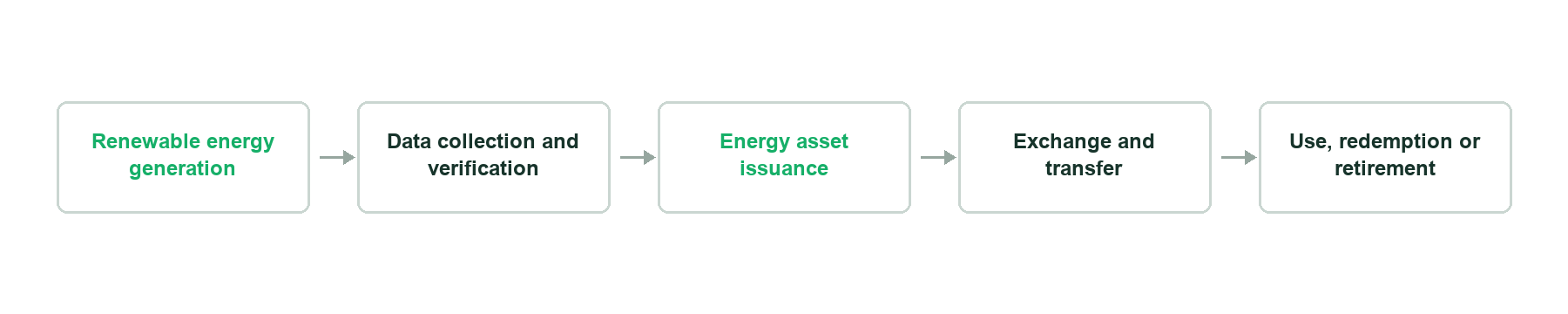
AREC can represent a renewable energy certificate as an NFT. It can also be transformed into ART, a fungible representation designed for greater liquidity and composability.
By expanding this protocol to Arc, Arkreen aims to make renewable energy assets accessible to applications, markets and autonomous economic actors operating within the Arc ecosystem.
Why Arc
Energy assets need more than a blockchain on which to exist.
They need a shared economic environment where issuance, ownership, payments, trading and settlement can interact.
Arc is designed as an Economic OS for programmable financial activity. Its stablecoin-native architecture makes it particularly relevant to energy markets, where participants need predictable pricing and settlement.
On Arc, Arkreen can connect:
- renewable energy generation data;
- energy asset issuance;
- USDC-denominated asset transactions;
- energy marketplaces;
- asset redemption and retirement;
- machine payments;
- ARCE protocol fees;
- ARCE/USDC liquidity.
USDC can provide a stable unit for pricing and settlement. Smart contracts can coordinate issuance, exchange and asset use. Uniswap can provide liquidity between the settlement currency and Arkreen’s protocol utility token.
This creates an environment in which renewable energy can move from a verified physical activity to a programmable financial asset.
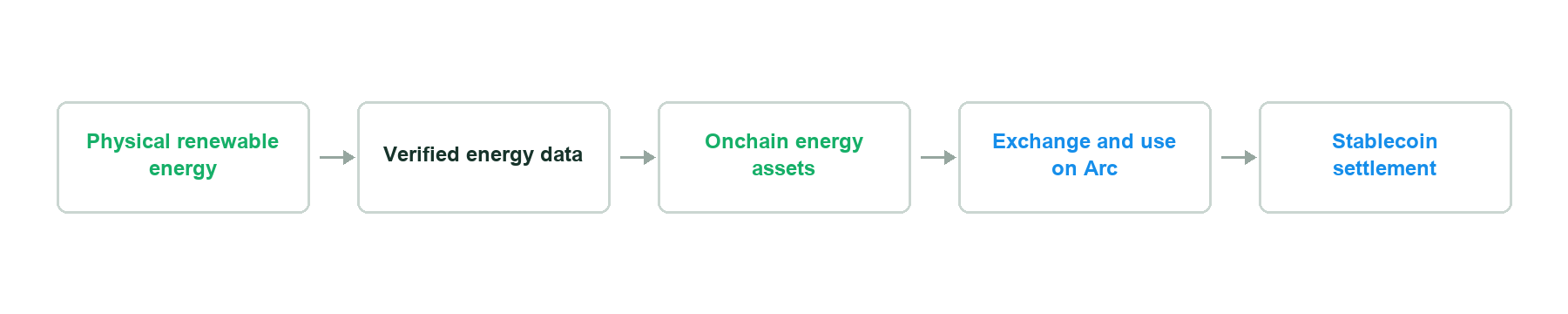
Arc gives the different parts of this process a shared coordination and settlement layer.
Expanding the AREC Protocol
The Arc expansion will bring the core functions of Arkreen’s onchain energy protocol into a new ecosystem.
The planned protocol scope includes:
Energy asset issuance
Renewable energy providers will be able to use verified generation data to issue eligible energy assets through Arkreen-supported contracts on Arc.
Energy asset exchange
Energy assets can be transferred or exchanged through Arc-based applications and liquidity infrastructure, with USDC serving as the primary settlement currency.
Energy asset use
Companies, applications and autonomous machines can use energy assets for services including renewable energy claims, consumption matching and other energy-related activities supported by Arkreen.
Redemption and retirement
Energy assets can be redeemed, retired or used to document the completion of an environmental or energy-related action.
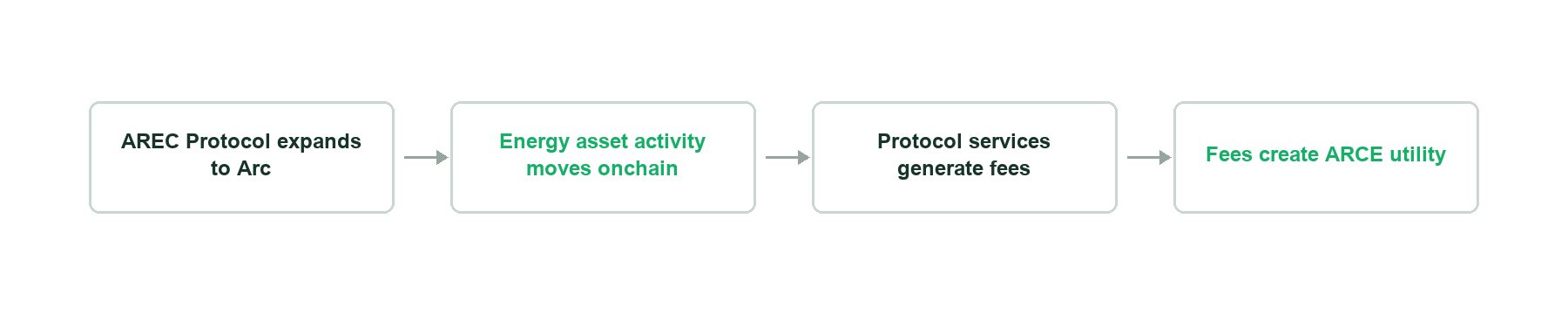
Each stage creates protocol activity. That activity generates service fees and connects the use of renewable energy assets with Arkreen’s utility token economy.
Why the protocol expansion requires ARCE
The Arkreen utility token is already part of the AREC Protocol’s economic design.
On Polygon, AKRE is used to pay protocol service fees for:
- issuing renewable energy certificates, ART and other eligible energy assets;
- trading green and energy assets;
- redeeming, retiring or offsetting those assets.
Arkreen’s utility token documentation defines these fees as the connection between green asset activity and the token economy.
When the AREC Protocol expands to Arc, the same utility is needed on Arc.
ARCE is introduced to provide that utility.
It is designed to pay protocol fees generated through energy asset issuance, exchange, use, redemption and retirement on Arc.
ARCE is therefore part of the protocol infrastructure. Its purpose follows directly from the expansion of AREC.
USDC for settlement, ARCE for protocol fees
USDC and ARCE serve complementary roles.
USDC is the settlement asset.
Energy assets can be priced and exchanged in USDC. Machines can also use USDC to purchase energy and services with predictable value.
ARCE is the Arkreen protocol utility token.
When a user, application or machine invokes an Arkreen protocol service, the corresponding service fee is paid in ARCE.
Future Arkreen applications may allow the complete transaction to be paid in USDC. The protocol can aggregate the service-fee portion and periodically convert it into ARCE through the ARCE/USDC pool.
This is particularly useful for high-frequency machine payments:
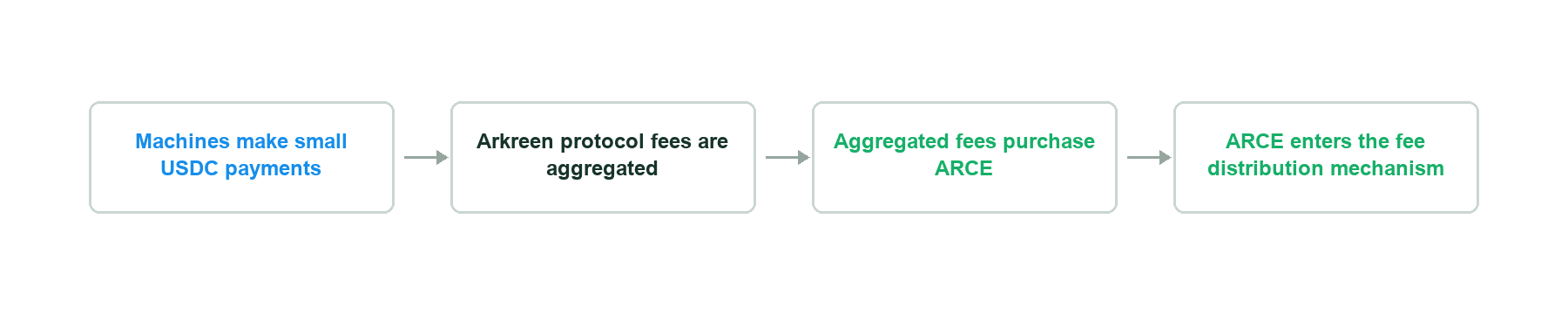
Circle’s programmable USDC infrastructure and agent payment tools can support this type of automated transaction flow. Circle Agent Wallets can apply spending policies, while Nanopayments are designed for high-frequency, sub-cent USDC payments.
These capabilities give Arkreen applications a path to automate energy transactions without requiring every physical device to manage protocol fee conversions individually.
Protocol value capture
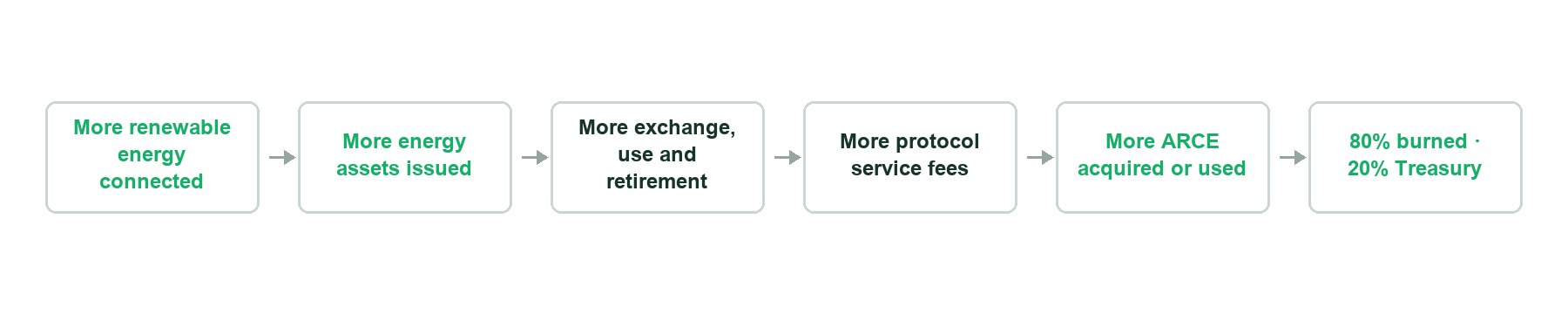
ARCE is designed to inherit AKRE’s existing service-fee distribution mechanism:
- 80% of protocol service fee revenue is burned.
- 20% is transferred to the Arkreen Treasury.
Arkreen has already implemented and published this mechanism for AKRE. The existing structure and burn history are available in the Arkreen Token Burn documentation.
As Arkreen protocol services become active on Arc, the same model will apply to ARCE.
For every ARCE permanently burned, the corresponding AKRE assigned to it in the Polygon reserve will also be burned or permanently retired. Burned ARCE will not create additional issuance capacity.
This keeps ARCE value capture connected to measurable protocol usage and maintains the relationship between the Polygon reserve and Arc supply.
Why ARCE/USDC liquidity is required
The ARCE/USDC pool provides the conversion path between Arc’s settlement currency and the utility token required by the AREC Protocol.
It allows:
- users to acquire ARCE for protocol fees;
- applications to convert aggregated USDC fees into ARCE;
- machines to settle in USDC while Arkreen fees accrue in ARCE;
- ARCE fee revenue to enter the burn and Treasury mechanism.
The initial Arc expansion includes 50 million ARCE deployed into ARCE/USDC liquidity positions using Uniswap.
A core position supports exchange and price discovery. Additional positions allow liquidity to expand as protocol activity and market demand grow.
ARCE/USDC is therefore part of the protocol’s operating infrastructure.
The initial expansion structure
ARCE uses a different ticker because there is no automated bridge between Polygon AKRE and Arc at launch.
The initial supply follows a transparent reserve model:
- Arkreen places 100 million AKRE in a publicly verifiable Polygon reserve;
- the reserve represents 1% of the total AKRE supply;
- the first 50 million ARCE are issued on Arc;
- every issued ARCE is matched by at least one AKRE removed from active circulation on Polygon;
- the remaining 50 million ARCE can be issued only under published expansion rules;
- first-phase ARCE issuance is capped at 100 million.
ARCE does not represent an undisclosed additional allocation.
At launch, there is no automated bridge or immediate public redemption mechanism. The reserve, ARCE supply and liquidity positions will all be publicly verifiable.
Energy machines as protocol participants
The AREC Protocol expansion also creates new possibilities for physical machines.
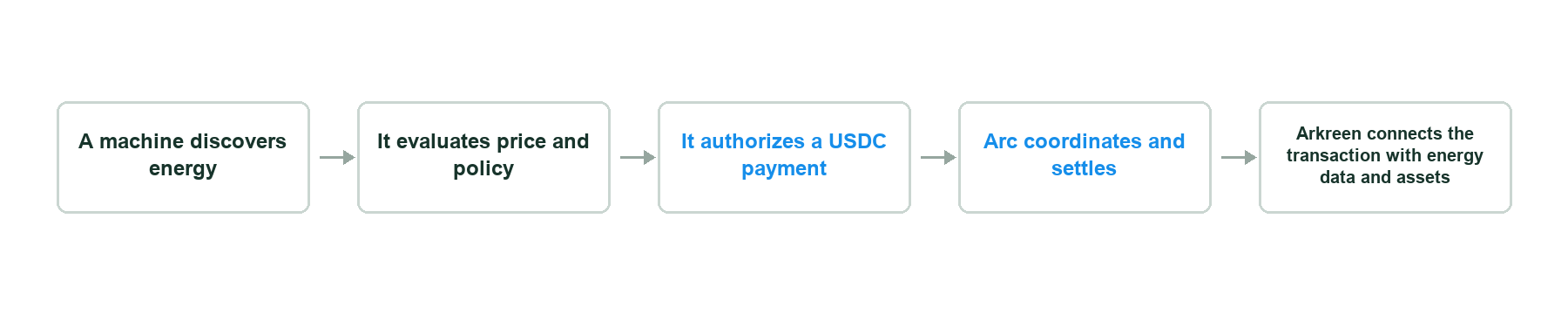
In an earlier Arc demonstration, TLAY used Arkreen’s eCandle and a Bitaxe miner to demonstrate an autonomous USDC energy payment every ten seconds.
TLAY brings wallet and transaction capabilities into physical devices, allowing a machine to evaluate an energy offer and authorize payment according to defined rules.
The demonstration provides an example of how machines can participate in the Arkreen energy economy:
The Arc Partner Spotlight on TLAY provides more detail on the demonstration.
As the AREC Protocol expands, similar interactions can extend from eCandle and bitcoin miners to robots, drones, charging equipment and other energy-dependent machines.
A path from AKRE to ARCE
The first phase establishes the AREC Protocol, ARCE utility and ARCE/USDC liquidity on Arc.
The longer-term direction is a phased migration from AKRE to ARCE at a fixed ratio:
1 AKRE = 1 ARCE
Under that framework, AKRE would be locked or burned on Polygon before corresponding ARCE is issued on Arc.
The migration mechanism will require development, security review and the applicable governance process before activation. Its ratio will remain independent of temporary price differences between AKRE and ARCE.
Making renewable energy native to Arc
The Arkreen Arc Protocol Expansion Plan begins with a clear objective:
Expand the AREC Protocol to Arc and make renewable energy an onchain native asset.
ARCE follows because the protocol requires a utility token.
ARCE/USDC liquidity follows because users, applications and machines need access to that utility.
The burn mechanism follows because Arkreen protocol activity is designed to flow back into the token economy.
Together, these components create a complete cycle:
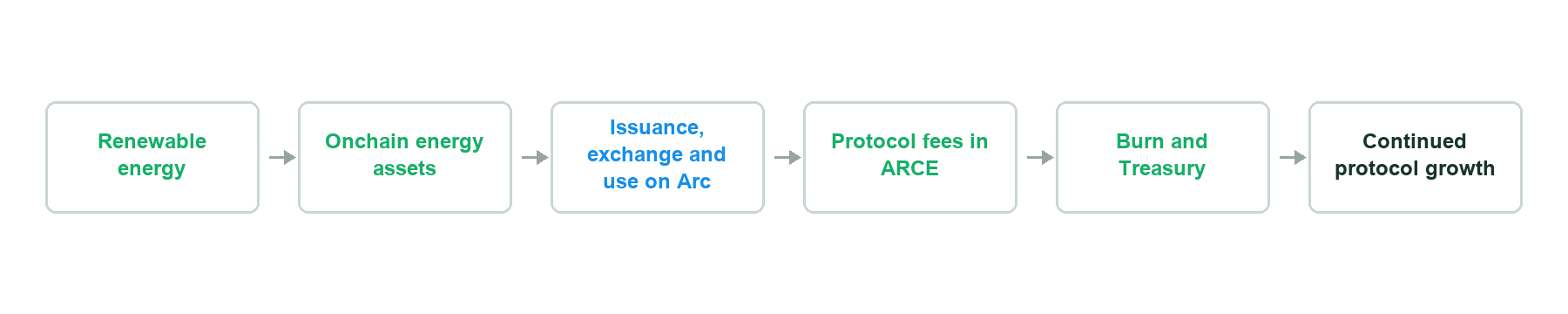
This is how Arkreen moves from connecting renewable energy resources to building an open, programmable energy economy on Arc.
Renewable energy, issued and settled as an onchain native asset.